Coherent, intense beams of ultrasound produce a sonic laser
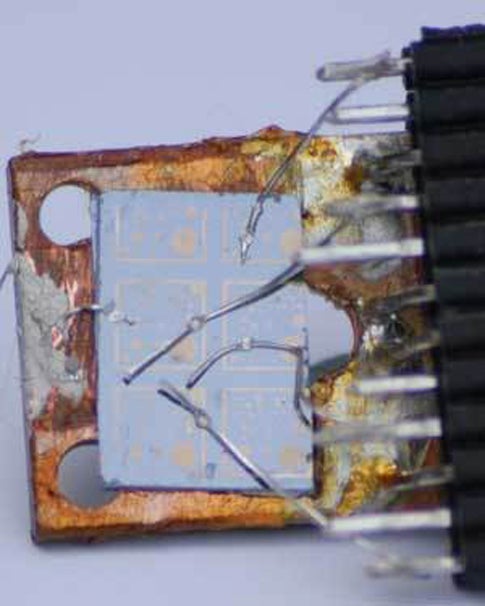
A Semiconductor Quantum-Well Saser The University of Nottingham's earliest nano-saser device via Laser Focus World

This has been a good week for sonic physics. First came reports that scientists used sound waves to create a sonic black hole. Now, it seems that a different group of scientists have used specially calibrated sound waves to create something almost as cool: a sonic laser.

The lasers most people are familiar with are formed from beams of light with identical wave structures, added together to form one giant, coherent wave. The saser, created by scientists from the University of Nottingham, England, works the same way, but with correlated sound waves instead of light waves.

The researchers started working on the idea in 2006, but it wasn't until recently that they finally got the saser to work. So far, they have only been able to generate sasers on the nanoscale, but even those small-scale sasers could have applications in computing, medical technology, and the development of super-fine sonogram sensors.

What happens when you fire a sonic laser into a sonic black hole? We hope to find out soon.`

[via Research and Development]

Want to learn more about breakthroughs in electronics, medicine, nanotech, and more?
Subscribe to Popular Science and enter to win $5,000!

6 Comments

bdhoro87

from coral gables, fl

Wasn't there a story not too long ago about a similar type of technology to be implemented for deterring pirates? The headline was something about mp3's, they created a sound that was nauseating and had the ability to rupture organs, and the ship would play it through directionalized speakers so only the target would hear it.

I believe you are refeering to the sonic cannon or LRAD. The LRAD is very loud and produces noises that can damage hearing.... imagine being surrounded by concert size speakers.

The saser is different in that it works by utilizing additive/interference properties of sound. It also differs in that it operates in ultrasound. Humans cannot hear ultrasound.

LRAD was low frequency sound if I'm not mistaken, this is high frequency.. yes?

The systems you are referring to do not create a unified beam of single wavelength focused sound.

They are applying dissonant frequencies to cause nerve and organ damage and discomfort.

They are more akin to strobing flashing disorienting wavelengths of sound. This is a single wavelength of sound wave focused into a unified beam like a laser.

There should be some quite interesting applications of this tech. they could use this easily in medicine as a directed sonic attack against specific medical issues like Gall and Bladder stones. and maybe even as treatment for certain types of tumors.

ok... laser=a very strait beam of light
saser= a very strait beam of sound.

i wonder what that could be used for.

perhaps better radio communications technology.


Download Our iPhone App

Stay up to date on the latest news of the future of science and technology from your iPhone with full articles, images and offline viewing


Follow Us On Twitter

Featuring every article from the magazine and website, plus links from around the Web. Also see our PopSci DIY feed


Become a Fan On Facebook

Share links with friends, comment on stories and more


December 2009: Best of What's New

In our December issue, Popular Science names the 100 best innovations of the year: bombproof wallpaper, self-parking cars, the fastest helicopter, and 97 more. Plus inventor profiles and videos.

Check out the best of what's new here.

Popular Science Photo Pool


Share your photos in the Pop Sci pool at www.flickr.com!
tags_sprite.png
POP_embeddedForm_cover_May09.jpg