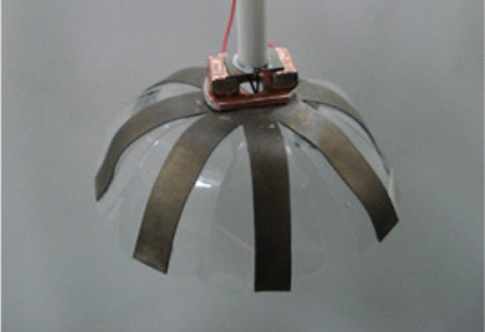
Jellybot Sung-Weon Yeom and Il-Kwon Oh

Even though a jellyfish is 90 percent water, it moves at about 40 mph. Jellyfish use their bell -- the top portion, above the tentacles -- to create a jet that propels them through water. Now, scientists at the Chonnam National University in the Republic of Korea have built a robot that mimics the movement. The robot, using an electro-active polymer artificial muscle, retracts and expands its skirt, exerting a minimal voltage and propelling the jellybot faster than you can swim.

The concept -- which could have practical implications for rescues in open water -- relies on resonant frequency to keep the energy requirement very low (think of the minimal force required to push someone on a swing) and the operation efficient and near-silent.

Sung-Weon Yeom, an engineer working on the project, says the robot jellyfish is guided, as is a real jellyfish, by water currents, but he's planning to experiment with a guidance system for better steering.

The robot jellyfish measures just a few feet long, but the researchers say the robot could be made much smaller -- just a few inches -- or much larger, matching the seven-foot behemoths that exist in the natural world.
Jellybot: How it Works:  Sung-Weon Yeom and Il-Kwon Oh

[via PhysOrg]

Want to learn more about breakthroughs in electronics, medicine, nanotech, and more?
Subscribe to Popular Science and enter to win $5,000!

12 Comments

sellassie

from Ft. Wayne, IN

Slow news day?...

First of all, some pretty interesting aquajellies as it is, though they may function differently (and much more complexly)
plus...no video? way to fail at promoting your work Dr. Sung-Weon.

Sorry so cynical, but WOW
this article looks like it would be denied by a highschool editir, not published on PopSci...shotty article and horrible supporting media....

once again sorry so cynical, but....WOW (all i can say)

Sorry you did not like it -- I don't think there are any videos of this, though.

40 mph huh... that's as fast as a shark, pretty good considering the lack of a nervous system, not to mention all those dragging tentacles in the water...

I'm thinking 40 mph must be a typo, and if it isn't, it should be related in knots...unless of course jellys can move over land...

Podboq, all of my research said 40 MPH and -- correct me if I am wrong, but I believe in instances like this the MPH is used (same for humans) because it is easiest to understand. We say a human swims/runs in MPH as well.

As a surfing enthusiast for over fourty years, I have seen more than my share of jellys, none faster than 4 MPH. If this mechanical jelly can move that fast it would be quite impressive. Why a jelly? I can imagine more of a fish shape with a vertical row of robo muscle with dual alternating frequency resinence to mimic the real 40 MPH creation.

Do you have references for your research?

Bull. That has got to be a typo. When's the last time you saw a gripping wildlife documentary where the jellyfish dramatically escapes its predator in a burst of 40mph jelly induced jet power? You didn't, and neither has anyone else. Heck, the leatherback sea turtle only goes about 21 mph, but it eats jellyfish. How is it catching them if it is only half as fast? Open sea ambush predation? Not likely. That strategy went out with the plesiosaurs.

i'm imagining rooster tails being thrown up by the cheetah of the seas....

I posted earlier with a link to my own research, and it was deleted, why is that? Because it contradicted the writer of the article??

Luckily my browser's history kept the remark I posted earlier... popsci needs to revisit it's posting rules and rethink the automatic disallowing of urls...

"w w w .reefed.edu.au/home/explorer/animals/marine_invertebrates/corals_and_jellyfish/jellyfish "

This page makes the claim that even one of the strongest swimming jellyfish, the box jellyfish, only swims at about 2 knots, or roughly equal to the speed an able-bodied person walks. They can move relatively faster depending on the current they're in...

According to the Book "Jellyfish" by David C. King:

"The Australian sea wasp, also called the box jellyfish, is thought to be the fastest-swimming jellyfish. By rapidly expanding then contracting its bell-shaped body, it thrusts itself forward. But, at top speed, the sea wasp is lucky to reach 5 Miles (8 kilometers) per hour. At that rate, it would not escape most predators, such as a large fish or an osprey."

I could not find anything credible online showing anything close to 40mph. I found this by doing a Google books search term, "jellyfish top speed"

i found 40mph from wiki.answers.... lol


Download Our iPhone App

Stay up to date on the latest news of the future of science and technology from your iPhone with full articles, images and offline viewing


Grab the Tech Buyer's Guide iPhone App

Carry everything you need to make a smart buy on HDTVs, cameras and 14 other product categories right in your pocket


Follow Us On Twitter

Featuring every article from the magazine and website, plus links from around the Web. Also see our PopSci DIY feed


Become a Fan On Facebook

Share links with friends, comment on stories and more


February 2010: Renovating America

Innovative fixes for five of the country's biggest infrastructure messes, plus a look the quest to read the human mind, the LCD screen that might finally kill paper dead, and the world's scariest science.

Read the issue here.

Popular Science Photo Pool


Share your photos in the Pop Sci pool at www.flickr.com!