CAVEman 3-D Virtual Patient Is a Holodeck For the Human Body
A 3-D virtual patient that allows doctors to visualize and diagnose ailments in high-definition
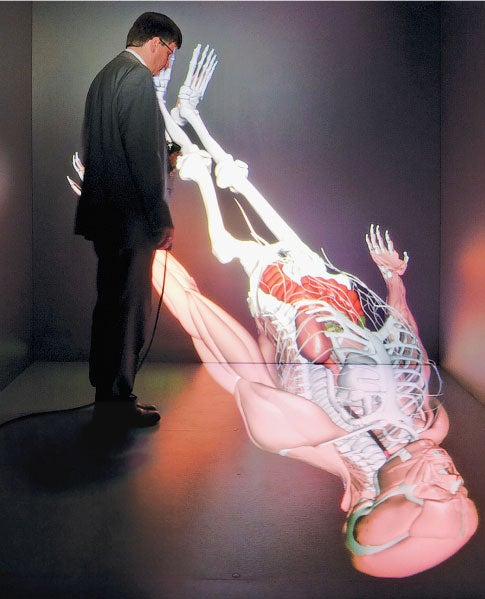
What happens when you pop a pill? Inside the University of Calgary’s $1.5-million virtual-reality room, scientists can don a pair of 3-D goggles and find out in high-definition detail. Biochemist Christoph Sensen and his colleagues have created a virtual human dubbed the CAVEman (for Automated Virtual Environment) that lets them monitor how a virtual body metabolizes medicine.
What: Caveman, a virtual-reality rig that simulates the anatomy and physiology of the human body
Where: Alberta, Canada
Why: Because the world needs a more affordable, less invasive alternative to body scans
Wow: Hit zoom to see a blood cell eight feet wide.
![The virtual-reality rig at the University of Calgary visualizes aspirin's journey through the body in 3-D. First stop: the stomach and intestines [red], where the drug is absorbed. Next up is the bloodstream [light green] and finally the kidneys [dark green], which flush by-products into the urine](https://www.popsci.com/uploads/2019/03/18/L6WS3BBRGYAOOOAJV5PJ4H74WM.jpg?auto=webp&optimize=high&width=100)
Aspirin in Action
In this image, three stereoscopic projectors mounted on the floor and one on the ceiling display a computer-animated body. Looking through the goggles, researchers can watch its bloodstream turn from white to red as aspirin travels through it. Sensen hopes to develop computer simulations that will model the progression of diseases like Alzheimer’s and diabetes and help scientists quite literally look for cures. Updated to reflect what’s happening inside a real patient, the technology could also help doctors diagnose and treat cancer. “You could stand inside your patient,” Sensen says, “and see how big the tumor is, how to treat it, and what the outcome will be.”