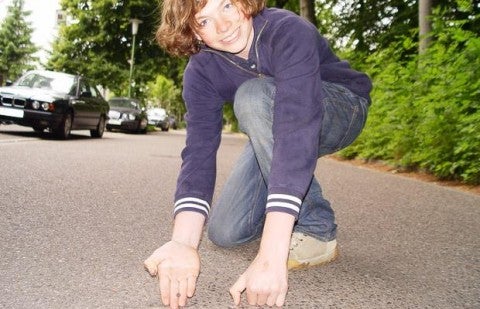
Last week we were treated to the unusual story of a human-versus-meteorite collision.
According to the Daily Telegraph, the youth whose hand was in the path of the pea-sized meteor saw a "ball of light." The article also made the claim that the impact with the ground left a "foot-wide crater." Both of these assertions are highly unlikely, as we shall see by simply applying some basic physics to the situation.
We know that meteors approach Earth with speeds of up to several tens of thousands of meters per second. Without an atmosphere, and therefore any friction to slow them down, these grains of cosmic flotsam would impact the surface without any significant change in speed. Even a pea-sized fragment moving at 10 kilometers per second would have a significant amount of kinetic energy -- about the same as a 100-pound boulder moving at 100 miles per hour. Now that might really hurt your hand, and put some cracks in the sidewalk.
In fact, though, we do have an atmosphere. Acknowledging this, what effect will this have on incoming space debris? Using some Newtonian mechanics, we can show that large enough rocks (on the order of 10 meters in diameter or more) will experience very little change in velocity due to air friction, and will impact Earth at velocities close to their original 11,000 m/s, with huge kinetic energies and the ability to form large impact craters. But, by the same mechanics, a pea-sized object will be slowed dramatically to a speed approaching its terminal velocity -- maybe to a final speed of a couple of hundred meters per second at best.
How do we deduce this? The amount of atmospheric fluid drag acting on an object moving through the fluid at a given velocity is given by the following equation:
Fd = 1/2Dv2ACd
where Fd is the drag force, D is the density of the fluid, v is the velocity of the object, A is the cross sectional area of the object (A = π r2 if the object is circular in shape) and Cd is the coefficient of drag. Assuming that the force of gravity acting on the meteor is small compared to the fluid drag we can apply Newton's second Law approximately as
Fd = 1/2Dv2ACd = ma
where m is the mass of the meteor, and a is its acceleration. Now let's compare fluid drag forces and the resulting accelerations for the respective space balls (or decelerations, if you prefer -- after all, the forces are acting opposite to the direction of motion, causing the objects to slow down.) We'll compare a meteor the size of a pea (1 centimeter in diameter or so) to one with a diameter a thousand times larger (10 meters).
Now because A depends on the square of the radius, our large rock has an area one million times that of the little rock, and assuming that the initial v, D, and C are the same for both meteors, we get that the "big 'un" experiences one million times as much drag force as the little guy, for the same initial velocity!So does this mean that the big 'un accelerates (slows down) at a rate a million times greater than the little fella!!? No, it does not. Remember: the acceleration depends not just on the force acting on the object, but also the mass of that object. The mass of the big guy is 1000 x 1000 x 1000 = one billion times the mass of the little one. (The mass of an object is equal to its density times its volume, and volume increases as the cube of the diameter. For example the volume of a spherical object = 4/3π r3)
The result? The acceleration of the pea will initially be around a thousand times greater than that of the large rock. The big 'un won't slow down significantly in the several seconds it takes to reach Earth's surface, but the little guy will get down below the speed of a bullet in that same period of time.
Could a pebble-sized meteor moving at that speed be dangerous? It could. Will it have a velocity sufficient to induce enough compressional heating to produce a "flash of light"? Not likely. Could it create an impact crater a foot in diameter? No, it couldn't. Busted!
Finally, for fun and comparison purposes, the video above shows a famous recorded meteorite flight culminating in an impact with the trunk of a parked car.
This space rock had a cannon-ball-sized mass of 12 kilograms when it hit the car, and while this would be approximately 1000 times the mass of our tiny pebble, it would still have been slowed to near terminal velocity before impact -- just like the pebble.
Stay up to date on the latest news of the future of science and technology from your iPhone with full articles, images and offline viewing
Featuring every article from the magazine and website, plus links from around the Web. Also see our PopSci DIY feed
Share links with friends, comment on stories and more
In our December issue, Popular Science names the 100 best innovations of the year: bombproof wallpaper, self-parking cars, the fastest helicopter, and 97 more. Plus inventor profiles and videos.
Check out the best of what's new here.
Yours is the first serious criticism I've seen published. Thank you so much!
Some additional notes....
REPORTS OF 14-YEAR OLD GERMAN BOY'S EXTRATERRESTRIAL ENCOUNTER DON'T ADD UP
The Story is All Meteorwrong
Of the following 2009 storylines, which is false: (a) in Monsters vs. Aliens, Susan (voiced by Reese Witherspoon) is struck by a meteorite and turns into a giant; or (b) on his way to school, 14-year old Gerrit Blank is struck by a red-hot, pea-sized meteorite which was traveling at a speed of 30,00MPH, which left a three inch scar after having caromed off his hand, and still traveled fast enough to leave a smoldering crater in the street?
Answer: Hollywood screenwriters have nothing on The Gerrit Blank Story. However, this story was framed as news.
The headline screamed "Schoolboy Survives Direct Hit By Meteorite Traveling at 30,000 MPH." Gerrit was widely quoted: "At first I just saw a large ball of light, and then I suddenly felt a pain in my hand. Then a split second after that there was an enormous bang like a crash of thunder. When it hit me it knocked me flying and was still going fast enough to bury itself into the road."
Apart from the velocity issue which was superbly addressed in this article...
A smoldering crater? As a result of cooling during an extended free fall to Earth, tiny meteorites are not even warm to the touch.
Sonic booms? Such sonic phenomena occur before impact.
The bright light? Sorry, Gerrit, but at approximately 10 miles in altitude, meteorites decelerate to a point where they are no longer luminous. The last several minutes of a meteorite's journey to Earth is an invisible, dark flight--and typically a meteorite will land a hundred miles or more from where it was last seen in the sky.
Did I mention that the object itself is not characteristic of a typical freshly fallen meteorite?
What's unclear is whether a vivid imagination or reckless reporting (or both) are responsible for the planetary-sized inconsistencies.
[The author is the Curator of the Macovich Collection of Meteorites in New York City] www.macovich.com
from coral gables, fl
Idk but if something is the size of a pea and then enters earth's atmosphere would it even reach the earth? I figured if a rock were to reach the ground from out in space it would have to start pretty big as it would lose mass on the way down.
I agree with dbhoro87, You need to calculate the initial size of burn off from the pebble. How much mass was lost on it's way though the atmosphere. It obviously couldn't have started out the size of a pea or we wouldn't be talking about this right now. Please redo you calculations with at least the size/mass of an orange to represent a more accurate determination of contact speed. Didn't anyone question this article before it was released? It doesn't make sense.
The calculation above is a reasoned approximation. It is thought that meteorites that survive a fall to the Earth's surface lose about 80 to 90 percent of their original mass. This means that a pea sized meteorite might have been about the size of a grape when it entered the atmosphere.
This difference in mass won't alter the general conclusion: If it was in fact a meteorite and it was the size of a pea when it got to the surface of the Earth, it would be moving near its terminal velocity and it would not be fast enough to create a flash of light. In contrast a large meteorite that is 10 m in diameter when it hits the ground will have slowed very little during its descent.
It's also worth noting that the calculated accelerations are only for a specific moment (at the initial velocity upon encountering the atmosphere)since the acceleration depends on velocity which is in itself constantly changing once the meteorite experiences air drag. To make a more precise calculation would get mathematically complicated, yet it will ultimately yield the same reasoned conclusion!
from puyallup, wa
This is what happened when a meteorite hit my backyard: http://www.vimeo.com/2149233
Burgerga123 nice video but i think its a fake
Busted! I always thought this story was not believable when I first read it. Now I know the science behind it. My thought was that if he was that close to the impact and it made a foot wide crater, that is some serious power coming from a small pea sized rock. He would be blown away I would think.
http://www.dandyid.org/id/suzy
yeah. how big would it have to be before it becomes a pebble on the ground. do a graph: if it were this big before it lands, then it would be this smaller when it lands. then we can see the relationship of original size to the final size when it lands. comparing your two specimens with such difference in size doesn't help your case one bit. only goes to show you're covering your own inadequacy.