Berkeley Lab Builds a Desktop Particle Accelerator
Multi-terawatt lasers make acceleration possible on a scale of inches instead of miles
Giant particle accelerators like the Large Hadron Collider (LHC) have become the poster children for big science. Immense in size, cost, and ambition, these gargantuan structures hurl particles at velocities close to the speed of light, in the hopes of uncovering the most basic constituents of matter and energy.
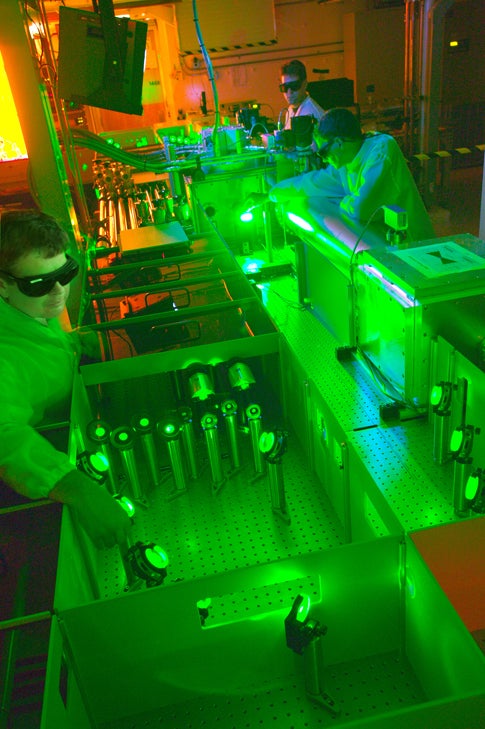
But when Wim Leemans gets his way, particle accelerators will be just another piece of lab equipment, no more obtrusive than a gene sequencer or a desktop printer.
Leemans heads up the BELLA program at Lawrence Berkeley National Laboratory, where researchers have figured out how to accelerate particles over inches, not miles. Now, armed with new funding, the BELLA team looks to pack even more punch into a small space.
The BELLA accelerator uses synchronized lasers to speed up electrons over very short distances. But whereas the Stanford Linear Accelerator (SLA) is 2 miles long, BELLA fits in a single room.
Of course, large accelerators like the SLA or CERN’s famous LHC are far more powerful than BELLA, and thus able to investigate much smaller particles. However, BELLA scientists believe that they can daisy-chain together a number of lasers to create an accelerator as powerful as the big boys, in a fraction of the space.
Boosted by $20 million from the American Recovery and Reinvestment Act, the BELLA project now aims to build on its 2006 success of accelerating a particle to a speed measured at billion electron volts (1 GeV) over a distance of only 1.3 inches.
That means the electron they accelerated reached almost half the speed of light. At those high velocities, scientists use measures of energy to denote the speed of an object (because
E
equals
mc2
, the speed and are related anyway).
Currently, the BELLA team is on track to create a 10 GeV accelerator by the end of 2013. In doing so, they are racing against European and Chinese teams also eyeing the prize of desktop accelerators.
To give you an idea of the difference in scale, and just because they’re awesome, we’ve pulled together a look at some of our favorite accelerators.
[via Next Big Future]

Intersecting Storage Rings

ISABELLE

Koffler Particle Accelerator

Stanford Linear Accelerator Center

Relativistic Heavy Ion Collider

Tevatron Collider
Large Hadron Collider