The Rescue Reel lets upper-floor workers descend in safety in case of disaster

It's a bird Kevin Stone's Rescue Reel allows for a smooth descent from tall office buildings John B. Carnett

Trapped on a high floor? Reach for today's featured Invention Award winner.

As the 9/11 inferno unfolded on television, one question kept dogging Kevin Stone: Why weren't the people trapped in the World Trade Center able to make their way to safety? "I said to myself, This is crazy," recalls Stone, an orthopedic surgeon and seasoned inventor in San Francisco. "There should be a better way to exit a skyscraper when something like this happens."

Invention: Rescue Reel
Inventor: Kevin Stone
Cost: $335,000
Time: 6 years
Is It Ready Yet? 1 2 3 4 5

Stone found all the existing systems for rescuing people from high places to be flawed or impractical, so he designed a device based on a fishing reel, a simple harness that would lower people steadily from skyscraper heights on a secure length of cord. The Rescue Reel affords people an easy way to engineer their own escape: All users have to do is open a file-drawer-size container and hook a Kevlar cord to a secure object or connection point (such as between a door and its frame). Then they step directly into the one-size-fits-all harness and rappel through an open window up to 100 stories from the ground. No special training is needed, and the entire sequence could take less than a minute.

Stone's major innovation is a centrifugal braking system that automatically controls the rate of descent. The Rescue Reel's cord unwinds from a spool and wraps around a shaft connected to a brake. As the shaft spins, a set of brake pads exerts force on the inner edge of the brake housing, smoothly slowing the user down. Should the automatic brake fail, the device is also equipped with a manual backup brake lever. Descending from 100 stories up takes less than four minutes—about two seconds per story.
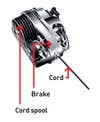
Rescue Reel: How It Works: As the cord unwinds, a self-adjusting braking system ensures that the wearer descends at a constant rate  Bland Designs

Stone tested a prototype in 2007, and Skala, a company specializing in rope-access systems, has since conducted extensive tests of the device at California's Vallejo Fire Department. It's a significant upgrade from the slow, cumbersome rope systems firefighters usually use for high-floor rescues, says fire-safety consultant Scott Douglass. "It's a lot more automated, and it's easier and more intuitive for the trapped person to use." He thinks it could be used for cliff rescues as well.

Now that testing is complete, Stone is preparing to market the Rescue Reel. A commercial-ready version should be available next year for about $1,500. He foresees lowering the price considerably once he starts mass production, making it practical for building owners who want to give their tenants an escape clause.

Check out the rest of PopSci's 2009 Invention Award winners!

Want to learn more about breakthroughs in electronics, medicine, nanotech, and more?
Subscribe to Popular Science and enter to win $5,000!

10 Comments

tech geek 0_0 what a great idea

That's an excellent solution! My only question is: What happens when everyone from the 20th - 100th storries are using these things to rappel down the side of a building on top of eachother?

And that's assuming that people up to the 20th can escape without the rappel AND that the people above 100 stories aren't smashing into the rappelers after jumping out a window.

Not to sound pessimistic but, what happens when the building is on fire, and hot flames are shooting out the side of the building?

Can you imagine hundreds of panicked people climbing over each other, TRYING to climb down the outside of a skyscraper, it would be a disaster!

I think the best option is to prevent planes from flying into our buildings. This is a good second best. I'm sure if the people who had free falled had this option it would have been a welcome improvement. Might be worthwhile having these devices for smaller buildings too.

So we are only going to rescue the un-injured people and everyone who is hurt or unconscious, how are they suppose to physically use this device ?

I think it's a decent idea even if it doesn't save everyone. Not everyone can be saved, and not everyone is going to try to save everyone. This is a simpler and compact solution that can get some people to safety. I don't think you can make anything that will save someone who is unconscious... because they're... you know, unconscious and can't do anything. The situations that this would be used in obviously wouldn't turn out perfectly, but you can make it less of a tragedy.

The system has been under development for 6 years. Is there a patent or pending patent application for it? I could not find any at USPTO. Is this a hoax?

TH
A Bit on the slow side. High Rise Escape Systems have already developed a system that can continuously evacuate people with the same system (not only each for himself) in a fire proof bag that can accomodate the injured, the aged and even pets. This System has already been patented and CE and ASTM certified. Check out www.HRES.com

This looks very good device. This will surely help a lot of people.

http://kidney-stones-symptoms.com

thanks for a wonderful share. Your article has proved your hard work and experience you have got in this field. Brilliant .i love it reading.

www.AdvanceLoan.net


Download Our iPhone App

Stay up to date on the latest news of the future of science and technology from your iPhone with full articles, images and offline viewing


Follow Us On Twitter

Featuring every article from the magazine and website, plus links from around the Web. Also see our PopSci DIY feed


Become a Fan On Facebook

Share links with friends, comment on stories and more


December 2009: Best of What's New

In our December issue, Popular Science names the 100 best innovations of the year: bombproof wallpaper, self-parking cars, the fastest helicopter, and 97 more. Plus inventor profiles and videos.

Check out the best of what's new here.

Popular Science Photo Pool


Share your photos in the Pop Sci pool at www.flickr.com!
tags_sprite.png
POP_embeddedForm_cover_May09.jpg