Making babies requires a male and a female, a sperm and an egg, right? Well, the wild world of animals is often more creative than the lot of us humans when it comes to making whoopee. In fact, some animals don't have sex at all, thank you very much.
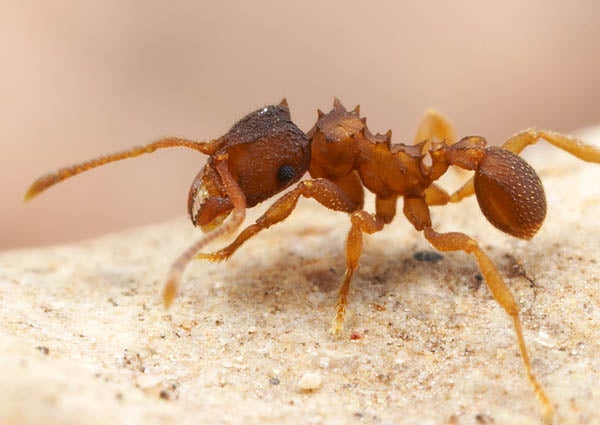
Just this month, bug biologists found the first all-female ant species, Mycocepurus smithii. The queen ant clones herself by making eggs that develop into adult females without fertilization. Some of those females will then become queens themselves. Apparently the species has been sexless for enough generations that the ants might not be able to mate even if they wanted to. Dissections showed that a key female sex part that normally interlocks with a male organ during mating had shrunken to a ghost of its former self.
Bugs aren't the only ones that can do without sex. Some lizards and fish reproduce purely asexually, and a few aquarium sharks have been observed popping out little clones of themselves with nary a male around.
Doing away with males can make a species efficient at making more offspring: 100 percent of kids will be egg-laying (or child-bearing) females instead of 50 percent. Also, why expend all that energy on mating rituals and copulation? For some species, males just seem to be dead weight.
Although a sexless existence can have these advantages, it's generally a dangerous lifestyle, which carries a greater risk of extinction.Environmental changes are less hazardous to species that have sex. By mixing some momma chromosomes with some poppa chromosomes, sexual reproduction shuffles genes around, making individuals of a species more varied. A sexual species will be more resilient in a changing environment, because a few of their members might randomly have the right traits to survive. If each ant is exactly the same, adverse conditions, such as a new bacterial infection, could easily wipe them all out.
So, in general, it's good to keep a few lads around for some down and dirty gene swapping.
Five amazing, clean technologies that will set us free, in this month's energy-focused issue. Also: how to build a better bomb detector, the robotic toys that are raising your children, a human catapult, the world's smallest arcade, and much more.


Online Content Director: Suzanne LaBarre | Email
Senior Editor: Paul Adams | Email
Associate Editor: Dan Nosowitz | Email
Assistant Editor: Colin Lecher | Email
Assistant Editor: Rose Pastore | Email
Contributing Writers:
Kelsey D. Atherton | Email
Francie Diep | Email
Shaunacy Ferro | Email
Have they sequenced the genomes of these asexual animals and their offspring to compare them? It would be interesting if these animals were able to produce a modified genome without sexual reproduction, and didn't produce perfect clones.
I would imagine they had done genetic testing. Then again, this IS PopSci's writing we're talking about, and that's not exactly reliable.
Alice Reilly
Department of Biology
Mercer University
are you two following me around?
We stalk you; your comments are sexy, lol.
Alice Reilly
Department of Biology
Mercer University
aw i was just kidding, i was following you two, er, sorta
you read my comments? think i'm a whackjob?
lol!
They probably looked at microsatellite DNA. And hopefully there is some mutation.
"Between the conception
And the creation
Between the emotion
And the response
Falls the Shadow"
- T.S. Elliot
A species of life without males, bah. Who's gonna move the furniture?
Quote from the article "Dissections showed that a key female sex part that normally interlocks with a male organ during mating had shrunken to a ghost of its former self. " end quote.
This assumes they had a normal sized organ at some time in the past. I assume they were created this way.
They don't like male species very strange insects. I never understand some the way of behaviour of some spices.
sex toys
Fungi are eukaryotic members. Can be found anywhere and everywhere. In a recent study, fungi were reported to be closely related to animals rather than plants and for this reason that I put in a separate group, ie the different plants, animals and microbes. Mycology is the branch of biology that deals with the study of fungi.
Quote from the article "Dissections showed that a key female sex part that normally interlocks with a male organ during mating had shrunken to a ghost of its former self. " end quote.
www.promdresspicture.com