Planes, Trains and Supersonic Spaceships
PopSci's vision for making travel faster, greener, and more fun

More Shoulder Room
Commercial Flight: 2020
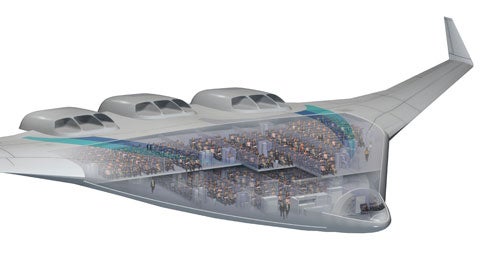
The long, skinny tube has to go. Tasked with improving the nation’s air transportation, NASA wants airplanes to burn 40 percent less fuel than a 777 by 2020 and 70 percent less by 2030. Not only that, it wants those same planes to be whisper-quiet. The best — and perhaps the only — way to reach these ambitious benchmarks is to design commercial planes more like stealth bombers and less like pencils.
This past winter, the agency awarded $12.3 million to Boeing, Lockheed Martin and other companies to develop the so-called N+3-generation airplane — that is, a design three generations ahead of today’s. The leading contender is the fabled blended-wing body, which replaces the conventional tube with a triangular shape. “It’s the only design that we think can meet our fuel and noise goals,” says Tony Strazisar, a senior technologist with NASA’s Fundamental Aeronautics Program. With high-speed wind tests of scale models under way, the blended wing could take flight before 2020. Here’s how it would work.

Body Shape
Engines
Gains in fuel efficiency and noise reduction could also come from embedding the engines into the topside of the fuselage. This produces less drag, and the airplane itself shields ground noise. The big challenge is figuring out how to design the air intakes to maximize airflow over the fuselage.
Passenger cabin
The blended wing’s widened fuselage will make for amphitheater-like seating, with long, wide rows. Of course, there will be fewer window seats, but the interior design could compensate through spaciousness or swanky amenities such as in-flight lounges, viewing areas or seat-back virtual windows.
Controls
“Blended wings have been tried for years,” says NASA’s Tony Strazisar, “but they’ve always faltered because the lack of a tail creates instability.” Boeing’s solution: nearly 24 control flaps on the wing, with computerized control systems to coordinate them.
Other Ideas Taking Off: Three paths to greener skies
2010: Recycling
The airline industry expects to retire more than 4,000 planes by 2023. Rather than junk their airplanes in the desert, Boeing and Airbus are developing plans to reuse and recycle as much as 85 percent of the materials in aircraft that are flying now, from tires and batteries to carbon fiber and hydraulic fluids.
2012: Seed Fuel
Montana’s Sustainable Oils is breeding camelina seeds — a canola derivative — that can easily be refined into jet fuel. Camelina’s main draw is that it can be grown quickly on fallow wheat fields, so it can slot into the existing agricultural infrastructure.
2020: Algal Fuel
In January, Continental performed the first algae-fueled flight in the U.S., flying an unmodified 737 for 90 minutes on a blend of half algae-derived fuel, half jet fuel. The next major step is to reduce the cost of squeezing a gallon of oil from algae from $100 to $2.
Thinking about booking a ticket to space? Check out our guide to the leading carriers.

Beyond the Concorde
Hypersonic Commercial Flight: 2050
Don’t let today’s anemic airline industry fool you: Supersonic flight will rise again. By 2015, 12 years after the last Concorde flew, Lockheed Martin expects to complete the Quiet Supersonic Transport, a business jet that can zip a dozen hotshots from Chicago to Paris in as little as four hours. But far more fun will be the “Spaceliner” under development by the German space agency DLR. Funded by the European Commission, the plane will be capable of flying 14,000 mph and delivering 50 passengers from New York to Sydney in less than 90 minutes — through space.
Think of the ship as a modified version of the space shuttle: a two-stage vehicle that takes off from a launchpad. “We’re not talking about exotic technology,” says Martin Sippel, the Spaceliner’s chief investigator. “We’re taking existing ideas and applying them in a way that makes economic sense for commercial travel.” The idea is that by reducing the technical demands inherent in the space shuttle’s design — such as how high and how fast the rig would fly — the Spaceliner could be safer than the shuttle, for a ticket price somewhat higher than a first-class ticket today. Here’s how your hypersonic flight would work.
Rockets
The Spaceliner would lift off on the back of a rocket powered by liquid hydrogen/oxygen thrusters capable of 25 launches. After separation, the rocket engines would glide to a recovery site, making rapid reuse and refurbishment much less complicated. Spaceliner’s Martin Sippel thinks the turnaround for the entire rig will be one to three days.
Takeoff
Within seven minutes, the airplane would reach the lower boundary of space, 62 miles up. At maximum altitude, it would be traveling faster than 14,000 mph — nearly as fast as the space shuttle. Instead of continuing up, it would dip into the atmosphere to generate lift and travel farther on less fuel. The extreme altitude means the sonic boom won’t disturb people on the ground.
Engines
The space shuttle is a hodgepodge of engine technologies: three hydrogen/oxygen engines on the craft, plus the solid-fuel boosters. Solid fuel, though more energy-dense, is roughly 10 times the cost of liquid hydrogen and oxygen. The Spaceliner doesn’t need quite so much thrust, and it has to run cheaper, so it will have just two engines, compared with the shuttle’s three.
Cooling
Passing through the dense lower reaches of the atmosphere at many times the speed of sound can heat up the aircraft to 5,400°F. To keep it cool, DLR engineers have invented porous ceramic tiles that would “sweat” water. A major component of DLR’s upcoming research will be refining the ceramics and doing larger-scale tests at faster wind-tunnel speeds.
Thinking about booking a ticket to space? Check out our guide to the leading carriers.
Rail Reinvented
Super Trains: 2011
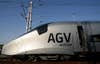
In a push to reduce carbon emissions and relieve crowded airports, trains are quickly replacing airplanes. Europe, with its long tradition of train travel, has been particularly aggressive. In 2007 the European Commission initiated a plan that will triple its high-speed-rail networks by 2020. The train-maker to watch? French firm Alstom, the name behind 70 percent of the trains that surpass 186 mph — nearly 650 of them. Its next-generation train, the AGV, just entered full-speed tests last December and in 2011 will be whizzing around Italy. If you’re disappointed at the prospect of having to fly to Europe to ride the AGV, don’t be. Alstom is in discussions to provide trains for the high-speed-rail system planned in California.
Here’s a look at some of the big innovations that will let the AGV hit a top speed of 224 mph while offering a roomy, comfortable ride.
Shape
The aerodynamics of the AGV not only increase speed but also cut noise. At its top speed, the train makes as much clatter as its predecessor, the TGV, does at 200 mph — no mean feat, since noise increases exponentially with speed. It required smoothing every surface on the train, from the hoses between cars to the farings on the front bogies (also known as wheels and axles), as well reshaping the nose cone.
Wheels
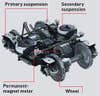
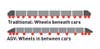
The AGV has “articulated” bogies. Usually every car in a train has two sets under it, just like your car does. But the AGV’s bogies are placed between cars. Thus, a 656-foot train carrying 500 passengers requires 13 bogies rather than 16, with a weight savings of one ton each. So the entire train would weigh 17 percent less than a similarly sized conventional rig, while creating 10 to 15 percent less drag.
A Better Bogie
Motors
Fewer Wheels, More Motion
The AGV will be the first train powered by motors that use permanent magnets, rather than electrified copper coils, to produce a magnetic field. The design radically cuts energy use, and the smaller motors can sit under each car, rather than in engines at the ends of the train. That means a 14-car AGV can carry 20 percent more people than the TGV, with 30 percent lower energy costs. The rotors also generate electricity during braking, so the train returns 8 to 12 percent of the power it uses back to the grid.
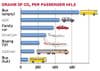
Check Your CO2 Quotient
How Green is Your Travel?**
Buses are more eco-friendly than planes, and both are more eco-friendly than cars. Right? Not necessarily. Fuel consumption and tailpipe emissions are only part of the picture. The correct answer factors in passenger occupancy, manufacturing processes and other indirect sources of carbon emissions. “Environmental thinking is getting away from just direct energy use and into the full repercussions,” says Mikhail Chester, a postdoctoral researcher at the University of California at Berkeley. He and civil-engineering professor Arpad Horvath have created the most comprehensive life-cycle analysis of the transportation industry to date — seriously, it’s thorough. For cars, it goes all the way down to the carbon required to build a road, emissions from gas tankers, and the computers that power the attendant insurance industry. Here are the results.
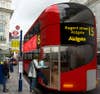
Double Deckers, Redesigned
Brits Get a Cleaner Commute:
Two new takes on greening the classic London ride
London is revamping itself for the 2012 Olympic Games, and part of that will entail bringing back its iconic double-decker buses. Last winter, two co-winners were announced in a competition to redesign the Routemaster: Foster and Partners, an architecture firm, collaborating with Aston Martin; and Capoco, a leading bus designer. Their entries mix old-time design elements and new technology.
Both propose aluminum, monocoque frames to cut weight and minimize bulk, and easy-to-repair hybrid engines, with flywheels that would regenerate battery power during braking. Inside, the Capoco design hews closer to the old layout. But the Foster version [below] is more of a departure. “It’s basically a mobile building,” says Alistair Lenczner, a partner at the company. “We wanted to create a living room.” The seats are recycled leather and the floor recycled wood. The layout riffs on the living-room feel: Downstairs are the typical forward-facing, flip-down seats, but upstairs the benches face each other.
Contractors are now bidding to build the buses, with production set to begin by 2011. They can use all or some of the elements in the winning designs, but looks will matter. “We have architecture competitions all the time,” says Alan Ponsford, Capoco’s design director. “But London’s 8,000 buses affect more people’s lives than any building would. The outcome should reflect that.”
Personal Planes: 2012
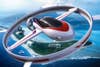
Wheel Fun
Cars and commercial jets aren’t the getaway craft they once were. Every year, Americans spend $78 billion dealing with traffic alone. Meanwhile, the “friendly skies” don’t seem so nice anymore. Commercial aviation is so crowded that NASA is already researching ways to restructure air traffic on a point-to-point model using small regional airports. Compare that with the current state of the private airplane. Gas efficiency is already on the order of cars — the new Icon A5, a light-sport aircraft on sale next year, will get 25 miles per gallon. And learning to fly has never been easier. A typical pilot’s license costs about $10,000 and requires 40 hours of training. But in 2004 the FAA created a new designation for light-sport planes: those with one engine, a flight ceiling below 10,000 feet and a top speed of less than 138 mph. Light-sport certification takes half as long as usual. In response, entrepreneurs are rushing forward with intriguing ideas and options.
Sarus
Few cities or suburbs can fit the long runways that even light aircraft require. So, the thinking goes, you need either a flying car or a hovercraft to make personal flight truly convenient. One of the most novel ideas out there is the Sarus [left]. Designed by Boston-based firm AeroCopter, the plane is ringed by a 21-foot rotor, which lifts it off the ground. In flight, the rotor tilts 87 degrees and then switches power to the rear rotors to propel it forward. Inventor Siamak Yassini has built a scale model and is now seeking funding for a full-scale prototype.
Hy-Bird Solar
LISA, a French manufacturer of sport planes, has paired with solar-cell maker Trina Solar to create an electric airplane, dubbed the Hy-Bird, whose 65-foot wings will be covered in flexible solar panels. Stocked with the sun’s energy, batteries will power the plane during takeoffs and charge all the instruments. Once aloft, the plane’s electric motor will run on a hydrogen fuel cell stored behind the pilot’s seat. The company has built a scale model of the plane and hopes to have a full-scale model ready for flight by the end of the year.
MS-1
If you can’t afford one of the fancier planes, you can always buy a kit and build a single-engine puddle jumper for about $60,000. But an extra $50,000 gets you a big upgrade: MySky’s new MS-1, a sleek two-seater with a single 120-horsepower motor set to debut in August. Like the light-sport Icon A5, it’s easy to fly, with two sticks for steering and throttle, and a top speed of 138 mph. It’s about $30,000 cheaper, though, and boasts better views — an enormous bubble canopy lets pilots see straight down and all around.
Thinking about booking a ticket to space? Check out our guide to the leading carriers.