A new take on pterosaurs could improve robot planes
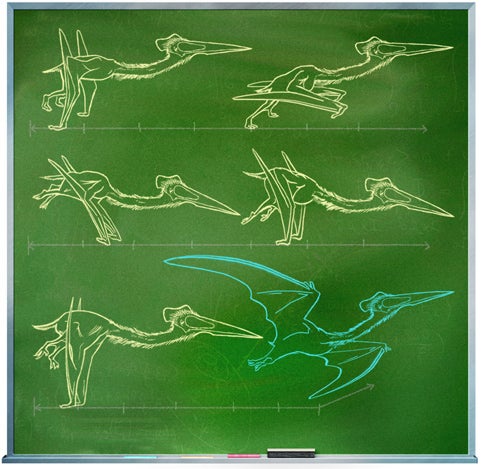
Hop, Skip, and Away Paleontologist Michael Habib theorizes that pterosaurs, which lived between 250 million and 65 million years ago, used their legs and wing “knuckles”—not just their hind legs, as previously believed—to leapfrog into flight. Kevin Hand

If it looks like a duck and flies like a duck, it must take off like a duck. Paleontologists long speculated that this was the case for pterosaurs, but new research shows that the prehistoric winged lizards employed a smarter launch strategy, using all four limbs to hop, skip, and jump their way into flight, instead of pushing off with two legs and flapping their wings as most birds do.

Because their hind quarters do most of the launch work, the bones in birds’ legs are stronger than those in their wings. Michael Habib, a researcher at the Center for Functional Anatomy and Evolution at the Johns Hopkins University School of Medicine, analyzed the bone structure and strength of 12 species of pterosaurs, from bat-size to one with a 34-foot wingspan. Habib found that they all had stronger arms than legs, ruling out a bird-style liftoff. “Instead,” he says, “this indicates that pterosaurs used all four legs in a one-two push to get up in the air.”

In less than a second, the pterosaur flicked its hind limbs, hopped onto its wing “knuckles,” and then gave a big push with its forearms to propel itself skyward. Habib thinks aeronautics engineers could learn from the technique. “A robotic vehicle capable of both walking and flying could launch rapidly, in limited space, using a system somewhat similar to the pterosaur’s.”

Want to learn more about breakthroughs in electronics, medicine, nanotech, and more?
Subscribe to Popular Science today, for less than $1 per issue!

1 Comment

Eggman002 (not verified)

I think I have seen one of these advanced flying vehicles before:

www.monstersinmotion.com/catalog/images/macross/YF-19_03.jpg


138 years of Popular Science at your fingertips.

Innovation Challenges


Popular Science+ For iPad

Each issue has been completely reimagined for your iPad. See our amazing new vision for magazines that goes far beyond the printed page


Download Our App

Stay up to date on the latest news of the future of science and technology from your iPhone or Android phone with full articles, images and offline viewing


Follow Us On Twitter

Featuring every article from the magazine and website, plus links from around the Web. Also see our PopSci DIY feed


February 2012: The Future of Fun

Science is reinventing play, from extreme sports to gamification to ridiculous roller coasters to the playgrounds of tomorrow, and this issue is chock full of fun. Also, on a less fun note: Did global warming destroy my hometown?


circ-top-header.gif
circ-cover.gif
bmxmag-ps