Holy reticulated snake spine! A fossil reveals a 2,500 pound prehistoric python (along with some surprising facts about global temperature)

Sliding Easy: An artists conception of the snake in its natural habitat, 60 million years ago.  Jason Bourque/University of Florida

Any character in a B-list film would yelp "Snake? Snaaaake!" upon spotting a specimen stretching longer than a school bus – and now scientists have uncovered the remains of such a beast.

A research team found the vertebrae of the 43-foot long snake down the Cerrejon Coal Mine in northern Colombia. Their report appears in Nature this week, and gives a conservative estimate that the snake weighed 2,500 pounds when it lived 60 million years ago.
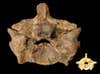
Big Changes: A comparison of the fossil vertebra (Titanoboa, left) and a similarly placed vertebra from the spine of a 10-foot-long boa constrictor (right).  Jason Head, Univ. of Toronto.
"At its greatest width, the snake would have come up to about your hips," said David Polly, a geologist at Indiana University-Bloomington. "The size is pretty amazing. But our team went a step further and asked, how warm would the Earth have to be to support a body of this size?"

"Titanoboa" would have needed an average annual temperature of 86 to 93 degrees F to survive, according to Jonathan Bloch, a paleontologist at the Florida Museum of natural History. The average annual temperature of the Colombian city Cartagena is just above 82 degrees F.

"Tropical ecosystems of South America were surprisingly different 60 million years ago," Bloch said. "It was a rainforest, like today, but it was even hotter and the cold-blooded reptiles were all substantially larger."

The new find represents an ancient relative of non-venomous constrictors, which wrap themselves around prey to suffocate them before swallowing whole. That contrasts with the approach taken by smaller, poisonous snakes.

Scientists also found skeletons of giant turtles and crocodilian relatives near the "Titanoboa" remains – possibly examples of the prehistoric monster's prey. That seems to fit with a general evolutionary drift toward "bigger is better," even if smaller has its advantages under other circumstances.

"Truly enormous snakes really spark people's imagination, but reality has exceeded the fantasies of Hollywood," Block noted. "The snake that tried to eat Jennifer Lopez in the movie Anaconda is not as big as the one we found."
Yep. That's one solid snake.

Want to learn more about breakthroughs in electronics, medicine, nanotech, and more?
Subscribe to Popular Science today, for less than $1 per issue!

4 Comments

Consider as well the snake's tendency to a poorly normalized size distribution. Most humans, for example, are similar in size (within the same population). Snakes, however, will often vary greatly. While this is uniform in dwarfing due to a lack of sustinance (smaller Eastern Diamond backs on coastal islands with limited prey-bases), it is not in the abundance of food (two corn snakes raised in captivity on the same diet can vary from three to six feet in maxium length).

Since they only found a very limited sample, we cannot know if that 43' monster was (a) an abberation of size (like a 6' corn snake) of a normally smaller species OR (b) a normal member of a species capable of signifigantly exceeding the size of the fossils found.

Science may have found a monster here, or it is possible that the real monsters were even greater in size.

J-lo is still safe, however, as any snake that big is going to be a slow ambush predetor (like big snakes today), not a clever hunter.

Also, on the temperatures needed, I wonder if he took into account gigantothermy as a reducer of heat requirements in larger cold-blooded animals. Also, species specific tollerances can exceed the general bulk to temperature ratios of cold blooded animals (the Canadian Garter Snake, for example).

This is really awesome that the remains have been discovered. I can only imagine what lies deep beneath the ocean floor, which only technology could see.
Such large snakes would not have need to be so quick, considering the competition size at the time. There energy would be better used elsewhere, like constricting dinosaurs.
King Cobra is still the most unique snakes ever.

~ You fall somewhere in the Balanced Frequency of Nature. Someone Along the Infinite Spectrum of Life ~

FaceBook: www.darkfx.cjb.net
DeviantArt: www.exodusprime.cjb.net
www.youtube.com/d4rkfx

Aw, that snake ain't so special.

Holy Sh*t! That is HUMONGOUS


June 2013: American Energy Independence

Five amazing, clean technologies that will set us free, in this month's energy-focused issue. Also: how to build a better bomb detector, the robotic toys that are raising your children, a human catapult, the world's smallest arcade, and much more.


Online Content Director: Suzanne LaBarre | Email
Senior Editor: Paul Adams | Email
Associate Editor: Dan Nosowitz | Email
Assistant Editor: Colin Lecher | Email
Assistant Editor: Rose Pastore | Email

Contributing Writers:
Rebecca Boyle | Email
Kelsey D. Atherton | Email
Francie Diep | Email
Shaunacy Ferro | Email

circ-top-header.gif
circ-cover.gif
bmxmag-ps