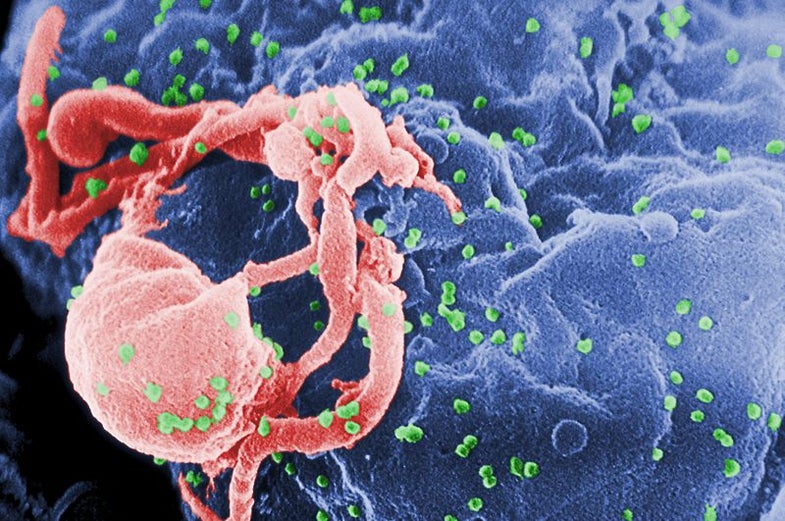
It has long been known that contracting HIV through oral sex is rare. Klara Hasselrot of Stockholm's Karolinska Institutet recently wrapped up a study--detailed in a forthcoming paper in the international AIDS journal AIDS--that might shed some light on why this is. It provides the first-ever evidence that humans can develop resistance to HIV in their saliva.
Hasselrot and her colleagues recruited 25 healthy men, all in long-term homosexual relationships with an HIV-positive partner, and tested their spit for IgA1 antibodies—the same ones that apparently protect some Kenyan sex workers from infection. Thirteen of the men who were regularly exposed to HIV through oral sex with their infected partners had significant amounts of salivary IgA1. The researchers isolated the antibodies and tested their ability to neutralize a lab strain of HIV. The conclusion? "Exposure to HIV, as a consequence of oral intercourse, is sufficient to produce an IgA1-mediated HIV-neutralizing response in the oral mucosa of uninfected men with a male partner." In other words, being exposed to HIV orally can induce an immune response in saliva that neutralizes the virus. This immunity is also fairly durable--the men in the study were retested after two years, and all but one retained their ability to neutralize the virus. Even more interesting is the fact that men whose partners carried a higher viral load of HIV had a higher capacity to neutralize, suggesting that their antibody production is sensitive to fluctuations in the amount of virus they are exposed to.
Obviously it's a bad idea to go around willy-nilly having unprotected oral sex with HIV-infected men, but the participants in Hasselrot's study reported relying on oral sex as a "safe" substitute for anal sex, and it turns out that they were on to something.
Five amazing, clean technologies that will set us free, in this month's energy-focused issue. Also: how to build a better bomb detector, the robotic toys that are raising your children, a human catapult, the world's smallest arcade, and much more.


Online Content Director: Suzanne LaBarre | Email
Senior Editor: Paul Adams | Email
Associate Editor: Dan Nosowitz | Email
Assistant Editor: Colin Lecher | Email
Assistant Editor: Rose Pastore | Email
Contributing Writers:
Rebecca Boyle | Email
Kelsey D. Atherton | Email
Francie Diep | Email
Shaunacy Ferro | Email
Maybe the partners that didn't have resistance simply died and therefore skewed the study. After all they can't test dead people for resistance to a disease they have already died from.
dalekaup certainly has a point.
Good question, but the 25 men who were tested at the beginning of the study were all alive at the end of the two-year period, even the ones who didn't have antibodies.
I would like to know if this response would occur with a man in a heterosexual relationship with a HIV positive partner?
Phoenix, Az.
Score one for oral sex.
I don't see why it wouldn't yield the same response in a heterosexual relationship.
I would have thought that perhaps someone on here with more education than a current student of biology would be able to point out a major flaw in the thought of dalekaup:
HIV does NOT kill, nobody has ever died of AIDS, and you can test a dead person for resistance to a disease.
HIV, in a loose description, kills off your T-cells. You can live without them. What this does is it essentially condemns you to a life without a functioning immune system. You die from opportunistic illnesses, like eyeball cancer and pneumonia, which you would otherwise never get or generally be able to fight off. You do NOT die from HIV itself.
And where in the world did you get the idea that you could not drain a dead person's blood and test them for certain antibodies? Presumably the studiers followed and kept themselves updated with the health and progress of the individuals involved, and it would have been stupid of them to not have done so. If an individual involved in such a study were to die, samples of the deceased's blood would be collected and tested.
Alice Reilly
Department of Biology
Mercer University
Alice, perhaps the original poster meant that if a test subject died before the 25 years were up, you wouldn't be able to fully tell if they would have developed a resistance to the virus or not. Is it possible that the virus overwhelmed all the antibodies, which is why their immune system was left vulnerable?
Alice,
As valid as your point was, it's just a little bit harder to accept your credibility with a username like "dopplerthesexybeast".
... and they didn't answer the most important question:
Swallow?
I would have thought that perhaps someone on here with more education than a current student of biology would be able to point out a major flaw in the thought of dalekaup:
HIV does NOT kill, nobody has ever died of AIDS, and you can test a dead person for resistance to a disease.
HIV, in a loose description, kills off your T-cells. You can live without them. What this does is it essentially condemns you to a life without a functioning immune system. You die from opportunistic illnesses, like eyeball cancer and pneumonia, which you would otherwise never get or generally be able to fight off. You do NOT die from HIV itself.
And where in the world did you get the idea that you could not drain a dead person's blood and test them for certain antibodies? Presumably the studiers followed and kept themselves updated with the health and progress of the individuals involved, and it would have been stupid of them to not have done so. If an individual involved in such a study were to die, samples of the deceased's blood would be collected and tested.
Alice Reilly
Department of Biology
Mercer University
___________________Carefully read and learn many things, thank you!!!
www.ebayclothingshop.com/
Saying AIDS doesnt kill is like saying the car crashing didnt kill them the sudden stop did or the gun didnt kill them the bullet did. They wouldnt die from those diseases with a normal immune system. They died b.c AIDS weakened them enough to allow normal run of the mill colds, flus and etc. to kill them.
@Lucos Li/dopplerthesexybeast -
I think you misinterpreted dalekaup's comment. She probably meant that the other partners who didn't have HIV resistance were more likely to be dead before the study even began, and therefore were less likely to make it into the study group. Dalekaup does have a valid concern. However, dalekaup, if you read the abstract, (link in article), they had a control group of similar men who's partners were HIV negative, and none of them had the antibody. The study definitively shows that the exposure increased that group's incidence of the antibody way above normal (13/25 as opposed to 0/22).
Oh, and Lucos Li - try telling the families or partners of AIDS victims that AIDS doesn't kill.
Leverage comprises its big news demo astir Walmart's promulgation today. Some companion births dedicated to concentrating cardinal million measured loads of carbon pollution from the mathematical intersection* lifecycle and cater chain complete some related cinque classes. That's like to the yearly glasshouse blow emissions from cardinal million railcars.
www.cartransportquotes.com
Saying AIDS doesnt kill is like saying the car crashing didnt kill them the sudden stop did or the gun didnt kill them the bullet did. They wouldnt die from those diseases with a normal immune system. They died b.c AIDS weakened them enough to allow normal run of the mill colds, flus and etc. to kill them.
www.promdresspicture.com
Hate to burst your bubble Alice as you certainly are or were a bubbling young biologist a few years back.
You cannot test a dead AIDS patient's blood for antibodies for several reasons:
1. A dead person's blood would have all protein components degraded rapidly within minutes by proteases as its cells die. It would require "near death" removal of blood and even then wouldn't be a valid measure because of reason 2
2. AIDS actually specifically targets T helper cells which are pivotal to the stimulation of B lymphocyte conversion into Plasma Cells. Plasma cells are the source of serum antibodies and would not be functioning normally without the T-helper cells to stimulate them. Therefore, antibody production would be drastically reduced. You cannot live very long without T helper cells...maybe for a bit in a bubble. A tough cold (adenovirus) or case of the flu is just as deadly as "eye cancer" in the case of a late-stage AIDS patient because of the impaired humoral (antibody-mediated) immune response.
WDK, Ph D