The smallest of 3,100 known species, this snake is as thin as a spaghetti noodle
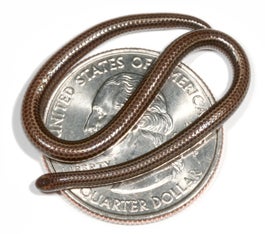
Leptotyphlops carlae Blair Hedges, Penn State

An evolutionary biologist at Penn State University has discovered a species of snake so small that it can fit comfortably on a quarter. The average adult of the species, a type of threadsnake named Leptotyphlops carlae, is less than four inches long. The discovery will be published in the August 4 issue of the journal Zootaxa.

Found in a remnant patch of forest on the Caribbean island of Barbados, Leptotyphlops is probably a rare species because most of its habitat has been cut down to make way for buildings and farms. Blair Hedges, who identified the tiny snake by its genetic signature and unique color pattern and scales, says that some older specimens of the species exist in museums but were misidentified by other scientists.

While larger snakes can lay as many as 100 eggs at a time, Leptotyphlops usually lays just a single, relatively huge egg. The snake that hatches from that egg is about half the size of an adult, while hatchlings of the largest snakes are only one-tenth the size of their parents. The reason for this disparity, Hedges says, is that tiny snakes must concentrate their efforts on producing offspring large enough to hunt and consume prey—in this case, the larvae of ants and termites. A snake much smaller than Leptotyphlops might not be able to produce viable offspring.
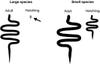
Size matters: Tiny snakes produce larger but fewer young. Hatchlings of the largest snakes are only one-tenth the length of an adult (left), while hatchlings of the smallest snakes are proportionately huge—half the length of an adult (right).  Blair Hedges lab, Penn State

Want to learn more about breakthroughs in electronics, medicine, nanotech, and more?
Subscribe to Popular Science and enter to win $5,000!

7 Comments

I am in Florida. I was cleaning out the car and I thought it was a worm. I picked it up and it was a tiny snake.

Found one on my floor about 2 weeks ago, wasnt sure what it was untill I saw a news report on them. I also live in Florida...near Tampa.

Few days ago I red this article about the "discovery" of this smallest snake in the Caribbean islands of Barbados named "Leptotyphlops carlae". I recognised the little snake since I have seen it in my own hands years ago while gardening around my home in North Palm Beach, Florida.
I love most of the creatures and I couln' t help noticing that the little black worm in my hand WASN'T a worm at all. He had scales and a little rould adorable non venomous snake head...and it was moving like a snake not like a worm. After enjoing my little encounter I released the little creature to go without knowing that it belong to a species never found before and that evening I told my family all about it.
Please inform the biologist at Penn State University...I know he gave his wife name Carla to the snake but I would love to think that I "Giugi" can be the unknown original founder. If he wants to cantact me he know how to do it.

I live in Tampa, FL--and in the past year, have found two of these snakes in my garden. They are so small, that a magnifying glass was needed for closer inspection, and to locate the eyes. They are VERY shiny, and paler in color on the ventral side.

I came to the US from South Vietnam after the VietCong's took over Saigon in 1975. I remembered seeing this tiny snake so many times in my country when I was a small kid. At first, I thought they were some earthworms because I found them under the trees in my grandpa's garden. But then my Mom told me they were snakes because, as she pointed out to me, their forked tongues had momentarily come in and out of their mouths looking for bad kids :) .

-----------------------
The Barbados Threadsnake only occurs on Barbados. What people in Florida and other places (Hawaii, other islands in the Pacific, California, Texas, South
America, Africa, etc.) are seeing is a common introduced species, the
FlowerPot Blindsnake, Ramphotyphlops braminus, that belongs to a different
family (there are other species as well, but this one is common around
houses). It was introduced probably from Indonesia. It is BLACK and very
thin. The hatchlings and young can fit on a coin, but the adults are larger
than the adults of the Barbados Threadsnake (the Flowerpot Blindsnake also
occurs on Barbados). The two are not the same species for the same reason
that not all small birds or small mammals are the same species (There are
3,100 species of snakes). Different species often have characters that must
be seen under a microscope. Often, their sex and adult status can only be
determined by an expert. Use internet searches to determine what you have,
and to learn more about the species that occur in your area.

Poisonous? I think that's an obvious question...


Download Our iPhone App

Stay up to date on the latest news of the future of science and technology from your iPhone with full articles, images and offline viewing


Follow Us On Twitter

Featuring every article from the magazine and website, plus links from around the Web. Also see our PopSci DIY feed


Become a Fan On Facebook

Share links with friends, comment on stories and more


December 2009: Best of What's New

In our December issue, Popular Science names the 100 best innovations of the year: bombproof wallpaper, self-parking cars, the fastest helicopter, and 97 more. Plus inventor profiles and videos.

Check out the best of what's new here.

Popular Science Photo Pool


Share your photos in the Pop Sci pool at www.flickr.com!
tags_sprite.png
POP_embeddedForm_cover_May09.jpg