The Space Archaeologists
What does the past look like from 200 miles up? A new generation of archaeologists has found that the history of civilization may look far clearer from the top of the atmosphere than it does from the bottom of a dig
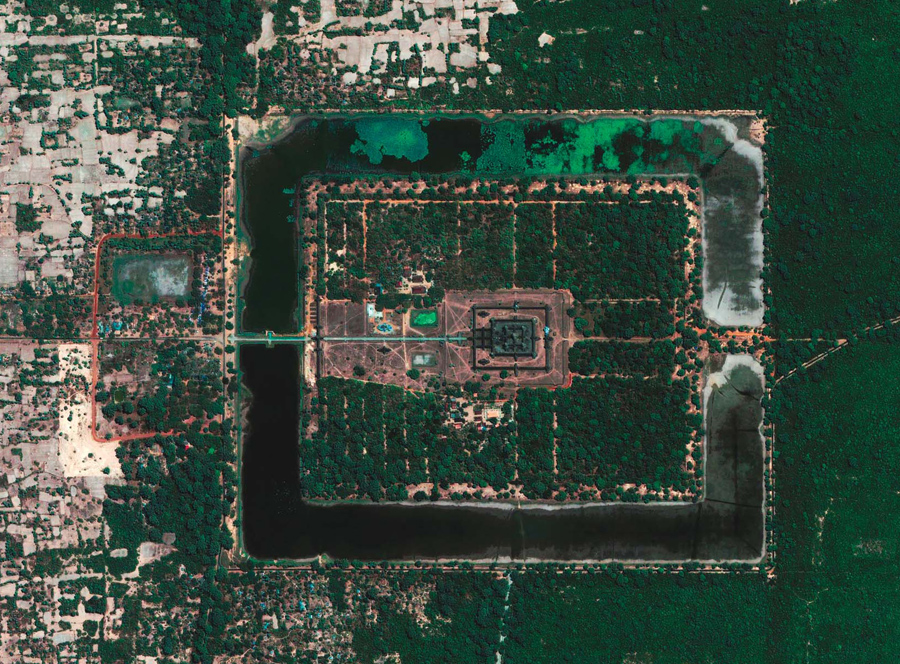
If it weren’t for the landmines, Lingapura would be a great place to dig. For part of the 10th century, this pocket of northwestern Cambodia was the capital of the famed Angkorian empire, a sprawling city studded with homes, irrigation channels, and more than 1,000 temples crowned with stone lingam, or phalluses. But ever since Pol Pot and the Khmer Rouge dotted Cambodia with millions of landmines in the 1970s, Lingapura’s ruins have sat mostly untouched.
For Damian Evans and Bill Saturno, now surveying Lingapura from atop a crumbling 1,000-year-old tower, the mines don’t really matter. Evans and Saturno are among a growing group of archaeologists who use radar, satellite imagery and other advanced technologies to uncover the mysteries surrounding ancient civilizations. This young vanguard of scholars explores not only regions where violence rules out groundwork, but also sites previously invisible from the ground: the ocean floor, dense jungle, even buried cities. They are transforming archaeology from a gritty, hands-on profession into an office job—what NASA terms, in program-funding documents, “space archaeology.” In doing so, they’re unearthing whole civilizations and rewriting history books: reshaping, in a few short years, the study of our preindustrial past.
Here in Cambodia, the new archaeology has changed the history of a civilization. The low-key Evans, a director of the University of Sydney’s Greater Angkor Project at just 32 years old, has already mapped northern Angkor, another heavily landmined area, from a computer screen in Australia. He has used radar and satellite images to chart its vast network of canals and reservoirs, proving that Angkor was once the largest city in the world, a metropolis consuming an area about the size of present-day Los Angeles. His work also underpins a radical new explanation of why, in the 15th century, the Angkor civilization died out, a finding that holds grave undertones for the megacities of the 21st century.
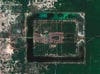
Now Evans has set out to map nearby Lingapura. The first stop in his mission is this tower, the closest approximation he can get to the vantage point of a satellite. When humans construct a house, field or temple, they alter the surrounding plants and trees—either deliberately, through farming or grooming the forest, or unintentionally, by enriching the soil with meal scraps and organic waste. This process creates vegetative trails that can linger for centuries. The team’s goal today is to discover what kinds of vegetation grow at Lingapura’s settlements and nowhere else—the space archaeologist’s equivalent of the X that marks the spot.
In the scattering of broccoli tops below us, Saturno, an expert in satellite imaging who typically splits his time between Boston University, the Guatemalan jungle and NASA’s Marshall Space Flight Center in Huntsville, Alabama, searches for clusters of unusually tall trees or circles of isolated species. If he can figure out what features correspond to human occupation at Lingapura, he can process satellite images so that the city’s trails pop out, allowing Evans to later identify hidden sites from his computer screen.
Hidden Gods
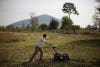
Saturno notices that the foliage surrounding the handful of temples not covered by trees is thriving, a promising sign. Returning to the ground, they tread a careful path to the temples; only a 30-foot-wide area around each building has been de-mined. Their first stop is a temple holding a one-ton, seven-foot-tall linga—”proof that size matters,” Evans cracks. But Saturno doesn’t respond. He’s busy examining the vegetation from a new angle. He gets excited when he spots a tall, bright-white tree growing near several temples. Sovann, their guide, tells him it’s a sralao tree. It’s almost too good to be true: a tree so distinctive that it will be easy to pick out in satellite photos. “There it is again,” Saturno says at a later temple, grinning.
Returning to the tower, where they’ve set up camp near a ramshackle concession stand, he couldn’t be more pleased. At around 11 the next morning, an Ikonos imaging satellite will pass over Lingapura, snapping images of the forest—including the sralao trees—below. Soon, Saturno and Evans will be back in their labs. And then the real archaeology will begin.
Satellite Power
Every few months, it seems, a discovery from the skies shakes up the world of archaeology. In Iraq, Harvard University archaeologist Jason Ur has revealed ancient irrigation canals that suggest that the 3,000-year-old Assyrian kingdom contained a network of previously undiscovered suburbs. At Easter Island, University of Hawaii and California State University scholars have exposed the paths—long a mystery—along which early Polynesians dragged statues. And in Guatemala, Saturno has uncovered sprawling Mayan sites dotted with hundreds of buildings.
This impulse skyward is not altogether new. Flying over Europe in World War I, conscripted archaeologists noticed enormous patterns in the crops below. Later excavations would show that these were remnants of buried settlements. Archaeology was transformed by the work of people like British Lieutenant-Colonel G.A. Beazeley, who once dryly noted that he was shot down before he could survey an irrigation system in Mesopotamia. Charles Lindbergh, an amateur enthusiast, discovered Pueblo cliff houses in the American Southwest and Mayan ruins in Central America. But only in the past few decades, with the introduction of remote sensing—digital sensors that illuminate the Earth’s surface from air or space—have archaeologists been able to expose sites invisible to the naked eye.
As the new methods spur increasingly spectacular discoveries, they are changing historians’ understanding of the ancient world. “People are looking at this data,” says Sarah Parcak, an archaeologist at the University of Alabama at Birmingham, “and going, ‘Oh my goodness, we’re going to have to reconceptualize our vision of ancient landscapes.’ “
For archaeologists, the rise of remote sensing places a sudden premium on technical knowledge. In doing so, it rewards a certain comfort with computing not typically found among the old guard. Parcak was 23 when she started her dissertation on satellite imaging at the University of Cambridge. She searched papers in geology and other fields for information on how to analyze satellite images; there was no textbook for remote archaeology. (Now an old hand six years later, she’s writing it.) But the utility of her approach soon became clear.
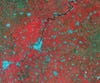
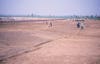
While still in graduate school, Parcak loaded an image of the Egyptian Nile River Delta taken by NASA’s Landsat Earth-observing satellite into a program called Erdas Imagine, a cross between Google Earth and Photoshop that geologists and climate scientists use to analyze satellite images. All natural features—trees, water, sand—reflect and absorb light differently, and the program can tease out any unique signature the researcher is looking for. Using data from known archaeological sites, Parcak had already figured out how to sort for the high organic matter and phosphorus content that marked Egyptian “tells,” or ancient house mounds. She processed the new images so that any tells would show up pink.
When she analyzed the images, her computer screen filled with pink splotches. “I thought, ‘Wait a minute, those can’t all be archaeological sites,’ ” Parcak recalls. But then she went into the field with a GPS receiver. At the pink points on the Landsat image, the delta’s flat green fields gave way to silty brown mounds: remnants of tells. Parcak has since used satellite data to uncover hundreds of sites in Egypt, none of them exposed to the naked eye.
NASA’s Archaeologists
Yet Parcak’s technique is not universally applicable; what works in the Egyptian delta won’t necessarily work in the Brazilian rainforest. Archaeologists have to tailor remote sensing to their sites. Satellite imagery is valuable for wet agricultural regions like the delta or heavily forested areas, while treeless plains or deserts call for radar.

Local CHarm
In northern Angkor, which isn’t as heavily forested as Lingapura, Damian Evans uses synthetic aperture radar (SAR), a type of all-weather radar beamed from the belly of an aircraft that can gather far more information than ordinary radar alone. The time it takes for the radar waves to reach the ground and bounce back up to the aircraft records changes in elevation, and variations in soil humidity and other factors produce signals of differing “brightness,” thus allowing archaeologists to pick out ancient canals and man-made mounds.
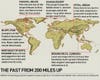
The excitement around remote sensing means that archaeologists now work closely with NASA. Saturno and his partner at Marshall Space Flight Center, archaeologist Tom Sever, fly around the world to examine projects that might benefit from the space agency’s technology. In Pasadena, California, radar scientists at the Jet Propulsion Laboratory (JPL) are turning out increasingly sophisticated versions of SAR and working with archaeologists to apply them to their sites. And last year, NASA went official, creating a space-archaeology division under its Research Opportunities in Space and Earth Science program [see “The Past from 200 Miles Up,”]. The initial batch of grants allots $2 million to seven projects around the globe. Although that’s not a lot for the space agency, archaeologists, who are used to working with low budgets, consider it a vital infusion of resources and expertise. “This is just the beginning,” Sever says.
The Ground War
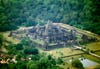
Archaeologists, like skilled workers in other professions, have not uniformly embraced the introduction of new technologies. The dynamic is in many ways embodied at Angkor. Once home to an illustrious civilization spanning 600 years and now containing the world’s largest temple, Angkor Wat (wat is the word for temple in Khmer), along with hundreds of subsidiary temples, the ancient city has long attracted aspiring Indiana Joneses. But in the past decade, those adventurers have had to bunk with unlikely company: indoor archaeologists more at home in a computer lab than a field camp.
Angkor’s early archaeologists were foot soldiers in a European battle to showcase colonial finds. At the turn of the 20th century, the British had fixed up India’s Taj Mahal, and the French, who controlled much of Southeast Asia, hurried to show off Angkor Wat. In 1907, the École Française d’Extrême-Orient (EFEO), a French research organization with 17 centers throughout Asia, opened an outpost in Siem Reap, near the temple, on the banks of an Angkorian canal.
In their focus on temples, however, the French archaeologists overlooked the surrounding land—and the people who had lived on that land. Historians have long puzzled over why Angkor, after flourishing for centuries, fell apart. Some EFEO scholars surmised that Angkor died out because its rulers ordered progressively more complicated temples, ultimately sapping the empire of resources.
In 1992, when United Nations peacekeepers arrived in Cambodia to oversee elections after decades of war, the EFEO transferred Christophe Pottier from Thailand to the old complex in Siem Reap. A roguish Frenchman, Pottier typified the classical colonial adventurer: a khaki-clad daredevil with an eternal five o’clock shadow and the tan born of decades spent in the tropics. The EFEO was still preoccupied with spectacular remodeling jobs, and Pottier, trained as an architect, was put to work restoring temples.
Ground Truth
Later that year, the United Nations Educational, Scientific and Cultural Organization (UNESCO) named Angkor a World Heritage Site and soon after hired Pottier to map it. Flying over Cambodia in a helicopter, he quickly noticed traces of rice paddies, roads and canals—hundreds of unrecorded sites in all. Angkor, he realized, wasn’t a cluster of temples but a full-fledged city.
In his spare time, Pottier set out on motorcycle to record the sites he’d seen from the air. Equipped with an early GPS receiver, a camera, a notebook and an antique stereoscope—a viewfinder that functions like 3-D glasses, adding depth to a composite of bird’s-eye images—he searched for evidence of occupation. When he found decaying laterite or brick walls, slight hills suggesting the mounds houses were built on, or pot fragments, he marked off sites on stereoscopic photos. Returning to his office, he laid tracing paper over the photos and meticulously copied out the points, later transferring them to a map.
At the time, the Khmer Rouge still hadn’t fully relinquished power. During Pottier’s first year in the field, the guerrillas kidnapped and murdered a British mine remover a few miles from his site. But Pottier canvassed Angkor with a stubborn fearlessness, surviving on a mixture of luck and armed escorts. In the end, he mapped 232 square miles of southern and central Angkor—the density of landmines in the north defied even his valor—and rounded out his architecture degree with an archaeology dissertation. The project took him six years.
Culture Clash
In 1996, as Pottier was riding through the Cambodian hinterland, Roland Fletcher was spending his days in the libraries of the Smithsonian Institution in Washington, D.C. A Cambridge-trained archaeologist, Fletcher was on leave from the University of Sydney to research a book on preindustrial cities. Looking at rough maps of Angkor one day, he noted a lopsided settlement plan that barely extended outside the city’s collection of temples, leaving little room for fields and house mounds. “It was obvious that there was something wrong with the plan,” he says.
A bookish theoretician, Fletcher has a penchant for crisp polo shirts and loafers and speaks in dense, looping sentences. A colleague jokes that his landmark work on urbanism, The Limits of Settlement Growth, should be titled The Limits of Reader Tolerance. But he has a big-picture perspective rare in archaeology. The existing portrait of Angkor didn’t fit with what he knew of other early low-density cities, and he pledged to solve the puzzle. Following a talk he gave at the National Air and Space Museum, an audience member asked if he had seen the radar images of Angkor captured by the space shuttle Endeavour in 1994. He had not, and so he picked up the phone and called NASA.
The images revealed objects 100 feet across or more, crude by today’s standards. But one image, which took up the length of Fletcher’s office, offered a view of much of Angkor. He had no experience with satellite images. “It looked like crazy art,” he recalls. “Amazingly beautiful, with these incredible colors.” But he made out a long vertical groove stretching north-south—a canal—crisscrossed by a series of east-west lines that he guessed were channels. The lines extended far beyond central Angkor, suggesting that the temples were at the center of something much larger than historians had assumed. He rushed to Cambodia, where Pottier showed him the map of southern Angkor he’d traced by hand. It was exactly as Fletcher had imagined it.
The next year, Fletcher and Pottier founded the Greater Angkor Project. They made an unlikely partnership—a grizzled French expat and a highbrow British professor—but they shared each other’s determination to uncover the mysteries of the Angkorian landscape. They just didn’t agree on how.
Space Travel
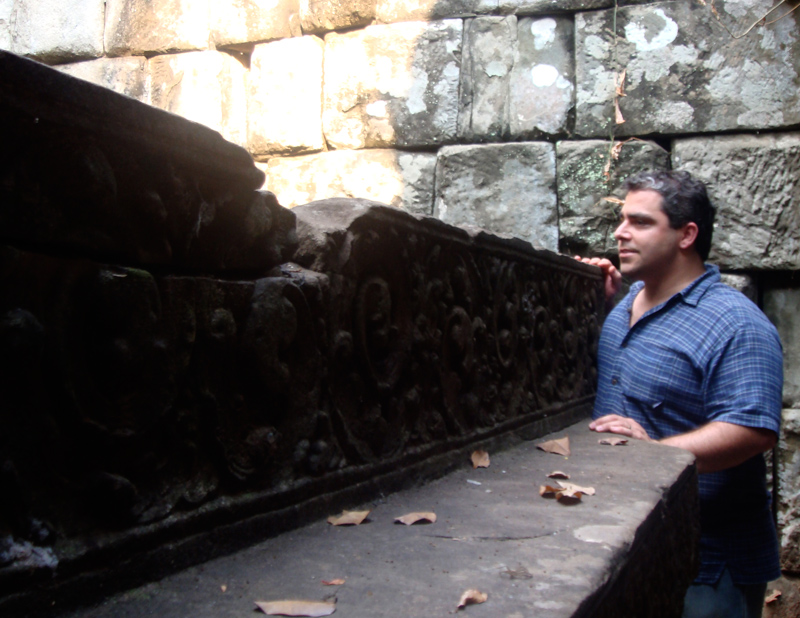
Fletcher believed that satellite imagery and radar could help them illuminate the inaccessible north. But Pottier felt that any continuation of his work had to be done using the same painstaking (not to mention dangerous) methods he had used in the south. Although radar and satellites could detect variations in moisture and vegetation not visible to the naked eye, their resolution was inadequate, he thought, next to simple aerial photographs. “Radar—I would not say it’s worthless,” he tells me, “but it has a very limited interest.” The Endeavour image Fletcher had seen “had very, very poor resolution, so it didn’t show anything.” NASA was hyping its technology, he adds, claiming credit for discoveries that actually preceded the shuttle flight. But proof of the technology’s power was hard to deny: Using the Endeavour image, Fletcher had intuited in a few minutes what Pottier had spent half a decade uncovering.
Cracking the Data
NASA has used synthetic aperture radar to peer through the clouds of Venus and to study the folds of Saturn’s largest moon, Titan. It has also mounted a unit onto a DC-8 jet and used it to map the world closer to home. Yet an Airsar run, as it’s called, requires staffing the airplane with up to 10 people, and thus was outside an archaeological budget. Then, in 2000, NASA collaborated with the Australian government to map parts of Southeast Asia. Fletcher saw his chance. He called NASA and eventually convinced the University of Sydney and the Mekong River Commission, a water-management organization, to bankroll a detour over Angkor. Taking off from Bangkok that September, the jet veered south at the Thai-Cambodian border and traced a cross over Angkor. Fletcher received data spanning more than 10,000 square miles.
There was only one problem: No one in the University of Sydney archaeology department knew how to use it. The department was one of a handful in the world with an archaeological computing lab, but its researchers were primarily concerned with developing mapping software.
Then Damian Evans, at the time a college sophomore searching for career direction, stepped forward. On Fletcher’s second trip to Siem Reap, he had taken Evans along because the student had been there as a backpacker. With Fletcher’s encouragement, Evans decided to use the Airsar data to expand Pottier’s map to northern Angkor. He hung around the archaeological computing lab in his spare time, fiddling with software. Through an e-mail correspondence with JPL radar scientist Scott Hensley, he learned how to turn the data from television-screen fuzz into the grainy black-and-white pictures that suggested a landscape. In just a year, Evans had mapped out a rough sketch of the canals and roads of inaccessible northern Angkor.
Kettle Detector
He enrolled in the University of Sydney’s doctoral program with the goal of producing a more detailed map. He collated the Airsar data with aerial and satellite photographs into a geographic information system and pored over it, devoting about an hour to each of 1,500 square kilometers. This time, he could pick out traces of mounds and moats left by small neighborhood temples.
Evans restricted his analysis to only those formations that appeared in two separate data sets. Even so, he pinpointed thousands of new sites, including 94 temples and several dozen roads and canals. Ultimately, the student mapped 580 square miles of northern Angkor. He more than doubled Pottier’s map in a fraction of the time—and he’d done it sitting at his desk.
The Australian described his findings in a dissertation, submitting it to Pottier for review. Even now, the paper seems to be a source of tension. Evans says Pottier scribbled furiously in the margins, at one point mocking his analysis with a cartoon figure of an Angkorian man shooting himself in the head. “I had never seen so much red ink,” he says. When asked his opinion about the work, Pottier simply says the map is “wide enough now to do more analysis of what was going on in the north”—implying that groundwork is still the project’s primary goal. But his tan deepens into a dark crimson.
Elsewhere in the world, the new map of Angkor was widely praised. Evans became the principal author on a paper published last fall in the journal Proceedings of the National Academy of Sciences describing the document (Greater Angkor Project researchers won’t publish the full-resolution map for fear that looters will beat them to new sites). The paper also offered the first evidence supporting a provocative theory of Angkor’s demise.
Breaking with temple-centric theories of the civilization’s decline, Evans suggests that the true answer lies in the landscape. In this analysis, Angkor’s people exploited the land, cutting it with canals and a complex irrigation system, until it became unsustainable. When Pottier, a co-author on last fall’s paper, sat down with Fletcher in 1999 and agreed to explore Angkor’s demise, he already suspected as much. But it was only with the radar and satellite findings that the Greater Angkor Project could offer the world definitive proof, upsetting a century of Angkorian archaeology.
The Launch Forward
Every January, during Cambodia’s dry season, Australian archaeologists fly in to excavate sites identified on Evans and Pottier’s map or verify their own remote-sensing findings. The Greater Angkor Project now includes a paleobotanist, a radiocarbon-dating specialist and an American Vietnam-vet pilot, who flies the archaeologists over their sites in an ultralight plane for quick aerial views. These days, the scientists are also trailed by documentary crews filming segments on the discovery of Angkor’s canal-based culture.
With Fletcher jetting around the world, Pottier has become the weary supervisor of a dozen young Anglo-Saxon scholars. At drinks after days spent in the field, the running joke is a well-delivered “Eet eez obviez!” Down the road from the EFEO, the Australians are renovating a house that will serve as the project’s headquarters. They say they’ll decorate it with animal skins and tacky paintings—a direct affront to refined French taste.
Bill Saturno returned to Marshall Space Flight Center a few weeks after our visit to Lingapura. Now equipped with firsthand knowledge of what to search for, he and Tom Sever decided to order Ikonos images of Angkor. They will process them this summer and then travel next winter to Angkor to verify their findings with Evans.
Meanwhile, JPL researchers are busy refining synthetic aperture radar. The latest operational version, Geosar, is the most elegant yet. Whereas eight to 10 people are needed to operate an Airsar flight, Geosar fits into the hull of a small Gulfstream jet. Most important, it has four times the resolution of Airsar, along with a longer band of radar that can penetrate through the forest canopy, allowing archaeologists to see beneath the trees rather than just read the tops of them. Evans is hopeful. “If it lives up to its promise,” he says, “Geosar may revolutionize the way our work is done here.”
Fletcher envisions a Geosar run over much of northern Angkor. As with Airsar, he’s waiting for a government agency or private company to pay for a flight. After that, he would like to try out the technology over early settlements in Myanmar, Sri Lanka and Vietnam, comparing the results against Angkor. Evidence is building, he says, to suggest that Angkor is not an isolated case—that there were other sprawling, low-density cities in southeast Asia. The question is whether they, too, ensured their downfall by overengineering their landscape.
That next phase of work could have far-reaching implications. As urbanization spurs an explosion of slums in Asia, Africa and Latin America, development experts are debating how to accommodate megacities. Fletcher simply sees a resurgence of Angkorian-style settlements. He thinks remote-sensing work on the sprawl of the past could illuminate strategies for sustainability, or at least show what doesn’t work. The demise of cities like Angkor won’t necessarily mean that today’s megacities “will fail catastrophically,” he says. “But we had sure better find out.”
** For a look at the archaeology in action, launch the gallery here.**
Mara Hvistendahl has written about science and the environment for Harper’s, the Financial Times and Archaeology.
Future of Archaeology
Step One

Step Two
![Using a visible-light image from the Quickbird satellite, Parcak spots a buried wall [stretching from the center of the brown field toward the upper left].](https://www.popsci.com/uploads/2019/03/18/XUCHUNG75G5BNCCGEELSIDCMRY.jpg?auto=webp&optimize=high&width=100)
Step Three
Step Four
From the Beginning

Step One
Step Two
Step Three