Powdered pig bladder made Lee Spievak's sawed-off finger grow back. Is this the future of medicine?
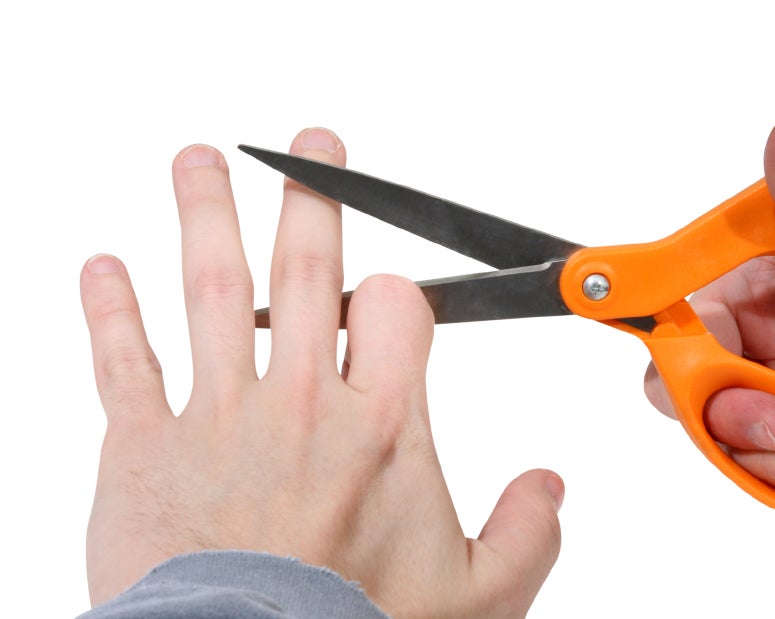
Missing Fingers Hold off. The medicine's far from perfected. iStockphoto

What do starfish, salamanders, and the Hulk have in common? They all have the power of regeneration. Starfish can regenerate their legs; salamanders can do that and a few better by regrowing their tail, and parts of their heart and eyes. The Hulk, well, the Hulk can regenerate it all. We ordinary humans are not so lucky. If we lose something, it's gone for good, unless, that is, we happen to have a brother working in the field of regenerative medicine.

Last year, a man named Lee Spievak was working in a hobby shop when he accidentally put his finger into the blades of a spinning propeller on a model airplane. He lost half an inch of flesh, down to the bone. His doctors told him the severed portion would be lost for good. Fortunately for Spievak, his brother had access to a powered compound made from the cells lining the interior walls of a pig's bladder.

Developed by a lab at the University of Pittsburgh, the powder—known as extra cellular matrix—tells tissue cells to grow rather than to scar. After about a month of daily application, Spievak's entire finger had regrown and sealed up. The nail returned a short while later. Although his case is not part of any clinical trial, he is the first documented person to have experienced successful regeneration.

The researchers on the project emphasize that the technology still harbors many unknowns, not the least of which is the accidental encouragement of cancerous growth. But if Spievak's results are any indication, the powder could prove to be a medical breakthrough on a grand scale.

Via BBC

Want to learn more about breakthroughs in electronics, medicine, nanotech, and more?
Subscribe to Popular Science and enter to win $5,000!

9 Comments

The human body will regenerate it's liver if no more than about 70% has been severed. As far as I know this is the only organ we are capable of doing this.

russell1

from manson, wa

that is so cool

I would like to see a time lapse video of the regrowing process. it could be quite interesting.

justcuzz

from Forest Hills, NY

Pigs and humans are a close match,biologically speaking. Do we have 'extra-cellular matrix" in our bladder lining?

Why doesnt our body do this already? It doesnt benifit the body not to be hole, i just cant believe that throughout evolution, something as useful as a regenative body didnt come in. Or are there some sort of side-effects associated with it or dangers to the body?

It is already (not well) known that a finger will regrow naturally if the 2 following conditions are present:
1: There is no stitches
2: The cut goes no farther than the 1st articulation

(Read in Scientific American, march 17th, 2008)

"Why doesnt our body do this already?" Because after ore ancestor had his arm bitten off by that T-rex it clotted up scabbed over and scared up and we got over it. But the lizard people spent so much time growing back new limbs that they forgot to have children. Its a good thing too, because lizard people could lay 10,000 eggs a year; we'd really be having a food shortage if they were still around.

that is very cool.

It sounds as if a lot of you are interested in limb regenertion, so let me get into the details.

We have learned from salamanders a lot about limb regeneration. If we applied what they do, then we would have to first have our fibroblasts go to the wound, then have nerves give signals for cell differentiation and proliferation in the first week after the amputation, maybe more or less because we are not salamanders.
Normally we would then just have epidermal cells covering the wound and eventually a scar would form. Instead, we would need to make a blastema, and make our fibroblast cells give more signals. This would eventually form a limb pattern and the new limb would begin growing.
In a salamander, this whole process takes around 55 days, though I would'nt be surprised if it took longer for a human.

The protein powder used by this man probably helped because the protein might have acted as a scaffold for regrowing tissues. It would also be important to learn how to block fibrosis. This could be applied to helping to regow limbs as well.


Download Our iPhone App

Stay up to date on the latest news of the future of science and technology from your iPhone with full articles, images and offline viewing


Follow Us On Twitter

Featuring every article from the magazine and website, plus links from around the Web. Also see our PopSci DIY feed


Become a Fan On Facebook

Share links with friends, comment on stories and more


December 2009: Best of What's New

In our December issue, Popular Science names the 100 best innovations of the year: bombproof wallpaper, self-parking cars, the fastest helicopter, and 97 more. Plus inventor profiles and videos.

Check out the best of what's new here.

Popular Science Photo Pool


Share your photos in the Pop Sci pool at www.flickr.com!
tags_sprite.png
POP_embeddedForm_cover_May09.jpg