The Littlest Big Bang
Scientists are building ultra-cold systems that mimic the most extreme edges of the universe. Can these analogues help solve the big bang’s mysteries?
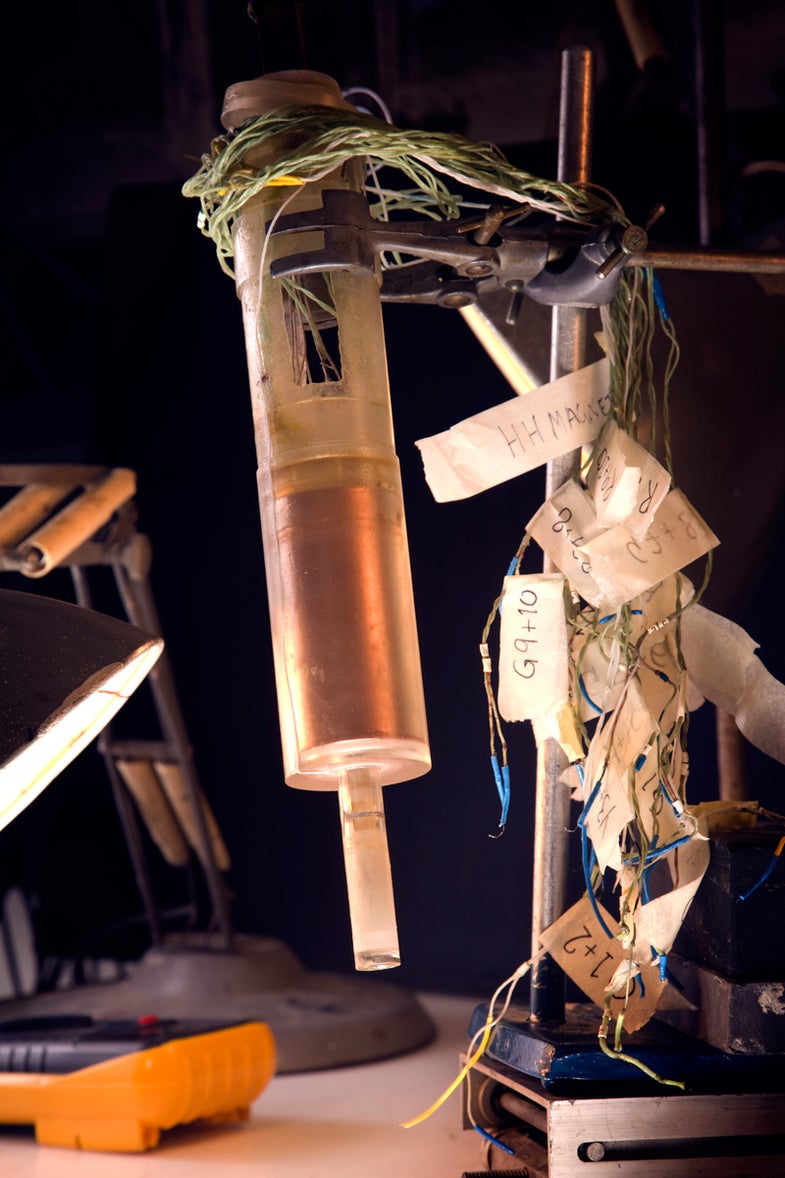
The device is a cylinder a bit smaller than a pinky finger, filled with helium and cooled to just above absolute zero. Inside, a young universe—or something very much like one—evolves. As the helium sloshes about, it mimics a process that may have powered our own universe a few moments after the big bang. And once the fluid settles down, the little whirlpools that remain may be akin to the defects in early spacetime that ultimately gave rise to galaxies, stars and planets.
This universe in a teacup was built by a team at Lancaster University in England. Their study, reported in the January issue of the journal Nature Physics, probed the theory of cosmological inflation. This theory posits that just after the big bang, the universe suddenly grew very rapidly for a split second and then, just as suddenly, slowed down. This faster-than-light expansion is supposed to explain all sorts of things about the universe today, such as why it seems to be more or less the same in every direction, and how large objects, such as clusters of galaxies, coalesced out of the cosmos.
Most physicists believe that inflation occurred. The trouble is in the details—no one knows why it happened, nor quite how. It takes an awful lot of energy to make a universe accelerate, and pretty powerful brakes to get it to slow down again. Plenty of physicists have hazarded guesses at where all that energy came from, but with only one universe around to look at, and with the period of inflation 13 billion years or so in the past, it’s tough to say which of the proposals are right.
This is not an isolated problem. Cosmological phenomena—black holes, for instance, or the big bang—do not lend themselves to experimentation. Cost aside, you don’t want a supernova going off in your laboratory. So how are scientists to test large-scale theories of the universe? Physicists working in the growing field of “quantum analogues” have an answer that may seem strange: Look at the very small.
The Business End
Two Branes in the Night
The particular type of inflation that the Lancaster group reproduced is called brane inflation, and it is most often associated with string theory, which posits that everything is made of infinitesimal strings. A brane—short for membrane—is an object embedded in some higher-dimensional space, called the bulk. Many things can count as a brane. An infinitely thin string is a 1-brane, because it has only one dimension (its length); a flat sheet is a 2-brane. According to some cosmologists, the universe may be a 3-brane, living in a four-dimensional bulk.
If so, then our universe may not be the only one. There could be many 3-branes, some like the one we live on, floating around in the bulk. According to the theory, two approaching branes would build up just enough energy to trigger inflation—that sudden, rapid expansion of space. Then, once the branes collide, that energy suddenly vanishes, ending the inflation just as quickly as it started.
To test this version of inflation, the Lancaster group watched two pools of ultra-cold liquid helium collide. Helium serves as a good substitute for the early universe because of its symmetry—essentially, the regular patterns underlying its structure. Scientists believe that the hot, young universe was homogeneous and symmetric. As it cooled, some of those symmetries disappeared. The same thing happens with cold helium.
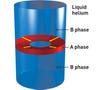
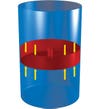
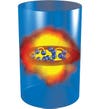
At just 0.0003°F above absolute zero, the superfluid helium in this experiment lines up in one of two orientations, the “A phase” and “B phase.” The group set up the system so that an A-phase part separated two B-phase parts, and the two A-B interfaces represented two branes [see the explanatory gallery]. The team then smashed the two B phases together in the same way that the universe could have smashed into another brane. In both cases, the way the symmetries disappear are identical.
What did they find? One of the characteristic features of brane inflation involves its answer to another cosmological problem: How did clumps of matter, in the form of galaxies, grow out of what was a smooth universe? Brane inflation predicts that, after the branes collide, small defects ripple through the universe. These defects, sometimes called cosmic strings, were points around which matter coalesced; as the universe expanded, these little mass centers grew too, ultimately becoming clusters of galaxies.
In the aftermath of the Lancaster group’s experiment, little vortices lingered in the helium, much like the defects in spacetime predicted by brane inflation. And though they don’t quite prove that brane inflation occurred, they offer tantalizing insight into what might have occurred 13 billion years ago. “What we have done is to show that an analogue system with a similar underlying mathematical language behaves in a certain way,” says Richard Haley, a member of the group. But if branes are real, and two of them collided shortly after the big bang, then this experiment is a new reason to believe that branes created cosmic strings, and thus help explain how the universe came to be the way it is.
![Inflation imprinted minuscule defects onto the smooth universe. These defects grew over time, eventually forming the large-scale structure of the universe we observe today. Information from galaxies in a 2-D image [right] can be converted into a 3-D map [left] that shows how galaxies clump together into clusters.](https://www.popsci.com/uploads/2019/03/18/QFLBVYPW7DPNELEEWPSE6WYOJQ.jpg?auto=webp&optimize=high&width=100)
Chunky Universe
Down the Dumb Hole
In 1972, William Unruh, a professor of theoretical physics at the University of British Columbia, gave a presentation on black holes to an audience of non-specialists at the University of Oxford. He told a story about a community of fish living near the top of a waterfall. As far as the fish were concerned, the waterfall was a boundary—if you ventured too close to the lip, you would pass a point of no return and never be heard from again. Moreover, since this boundary marked the point where the speed of the rushing water grew faster than the speed of sound, any pleas for help by the doomed fish would fail to get out. Unruh called this silent abyss a “dumb hole.”
For eight years, this story remained a quirky explanatory device, an analogy he used with undergrads to introduce how light behaves near a black hole. Then, in 1980, Unruh was assigned to teach a fluid-mechanics course. “While preparing my lecture notes one evening, my mind made the connection,” he recalls. It turned out the analogy wasn’t just qualitative, an approximation. “I realized that the equations were identical,” Unruh says—the analogy was exact. Substitute sound for light, rushing fluid for the curvature of spacetime, and an ill-fated screaming fish for an equally unlucky astronaut with a radio, and the two situations are indistinguishable. Mathematically speaking, your shower drain is a black hole.
But there’s more to the story. One of the biggest mysteries about black holes is whether they’re really, truly black. In 1974, theoretical physicist Stephen Hawking predicted that black holes have a finite, though very small, temperature, which means they radiate. “Hawking radiation,” if it exists, means that black holes are more of a charcoal-gray.

King of Cold
Hawking’s calculation was a breakthrough. Ever since the laws of quantum mechanics were unraveled in the 1920s, physicists had been trying to combine these laws of the very small with Einstein’s theory of gravity. (Nearly a century on, they still are—that quest, among others, is what drives string theorists.) Hawking didn’t create a quantum theory of gravitation, but his calculation was one of the first that applied quantum mechanics to a gravitational system, and it remains the most famous.
Yet for now, Hawking radiation is just a theoretical supposition, an educated guess at what happens near the horizon of a black hole. The difficulty is that the signal from Hawking radiation is extremely weak. No one has been able to see Hawking radiation coming out of a black hole, although some hope that a gamma-ray satellite to be launched this month will detect it.
But there may be another way. When Unruh noticed that the equations for sound near a waterfall were the same as for light near a black hole, he checked whether Hawking’s calculation also applied to the waterfall. And sure enough, dumb holes, too, should emit particles by a process akin to Hawking’s.
Unfortunately, it’s almost as hard to observe Hawking radiation from a dumb hole as from a black hole. A waterfall’s edge is a warm, busy place, and the tiny temperature bump that would come from Hawking radiation would be overwhelmed by all the activity. According to Unruh, managing to pick out the Hawking radiation in a dumb hole is possible, “but doing it would require such an effort, I doubt it will be done for a while.”
Yet dumb holes aren’t the only black hole stand-ins around. Once Unruh pointed out the mathematical analogy between fluid dynamics and black holes, other theorists began to notice connections as well. In 2000, Ulf Leonhardt, a professor at the University of St. Andrews in Scotland, published a paper in the journal Physical Review Letters describing a system in which light, rather than sound waves, would be sucked into an artificial black hole. Two years later, he showed how it could be tested in the laboratory. Once more, the world of quantum analogues would dip into the ultra-cold.
Stop Light, Then Spin
Black-hole equivalents happen when you satisfy one simple condition: Your fluid must flow faster than the waves that travel through it. Light would seem to be a bad choice of wave, because it is very fast and fluids are comparatively slow. But that’s not always the case in an exotic form of matter called a Bose-Einstein condensate.
A Bose-Einstein condensate forms when all the atoms in a gas cool down to their lowest possible energy state. These atoms then “condense” into a single mega-atom that behaves as an enormous quantum particle. Bose-Einstein condensation occurs only at a fraction of a degree above absolute zero, a temperature so cold that nearly everything comes to a stop.
Under the right conditions, that includes light. In 1999, physicist Lene Hau of Harvard University slowed light down to a moderate walking pace as it passed through a Bose-Einstein condensate. Two years later, she slowed it to a stop.
What’s more, rotating a Bose-Einstein condensate creates a regular pattern of vortices—localized quantum-mechanical waterfalls. According to Leonhardt, these quantum waterfalls should act like black holes for slow light, just like Unruh’s dumb holes would for sound. Hawking’s telltale temperature increase should be easy to catch when you’re perched just above absolute zero.
So far, no one has successfully performed Leonhardt’s proposed light experiment. But he has since shown how to create other black-hole analogues using easier experimental setups. As this magazine went to press, results from the first of these experiments were set to be announced.
Ultimately, though, what’s the point? Hawking’s calculation is about real black holes warping the fabric of spacetime. He never said anything about slow light or waterfalls. According to Unruh, observing analogue Hawking radiation would “strengthen one’s faith in the validity of his prediction.” On the other hand, if we didn’t see Hawking radiation, “it would mean that we seriously misunderstood something in the fluid situation,” he says, “and would lead to the strong worry that we had misunderstood something analogous in the black-hole case.”
Either way, quantum analogues can’t provide final proof that this or that theory of the universe is correct. But until scientists figure out how to see a black hole up close, or how to turn back the clock and study inflation, analogues offer a terrestrial way for experimenters to study them. As physicists push the boundaries of their understanding further and further away from everyday experience, the importance of experimental evidence becomes ever more acute—just as the necessary experiments become more difficult, or even impossible. Analogue systems are one way to fill in the gap, to check that physicists’ theories indeed make sense.
Deciphering the systems that we can see, prod, and fiddle with will always be easier than understanding the ones we can’t. Luckily, it sometimes happens that we can use relatively familiar cases as models for the more exotic. As Unruh puts it, “Analogy is not identity. But analogy can sometimes be a very good guide.”
James Owen Weatherall is a Ph.D. student at the Stevens Institute of Technology and at the University of California at Irvine.
Little Big Bang
Step One
Step Two
Step Three

Step Four