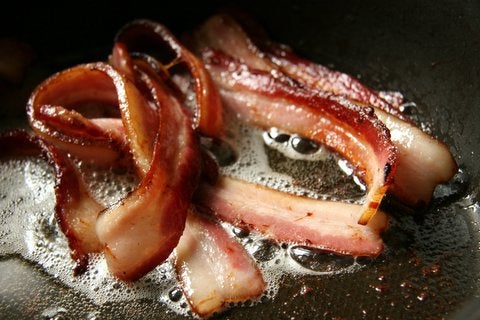
As if fast food and TV weren’t enough to make and keep us fat, a new study from the University of Western Ontario has found that our fat may also be making us fat. Neuropeptide Y (NPY) is an appetite-stimulating hormone produced by our brains, which is responsible for a lot of our drive to eat. Scientists had previously thought that overweight people simply had more NPY flowing from their heads than they needed. As it turns out, the UWO study found that not only do our brains produce NPY, but our abdominal fat makes it as well.
That, of course, could lead to a vicious cycle of obesity—as soon as someone accumulates enough abdominal fat, the fat cells produce NPY, which tells that person to eat, which produces more fat, and on and on. Additionally, they found that NPY also stimulates the production of what are called fat cell precursor cells, which eventually turn into proper fat cells themselves.
The hope for now is to develop a blood test for NPY to detect whether it is coming out of abdominal fat cells and traveling up to the brain so that it could in the future be blocked. In the meantime, our best bet is probably still willpower.
Five amazing, clean technologies that will set us free, in this month's energy-focused issue. Also: how to build a better bomb detector, the robotic toys that are raising your children, a human catapult, the world's smallest arcade, and much more.


Online Content Director: Suzanne LaBarre | Email
Senior Editor: Paul Adams | Email
Associate Editor: Dan Nosowitz | Email
Assistant Editor: Colin Lecher | Email
Assistant Editor: Rose Pastore | Email
Contributing Writers:
Rebecca Boyle | Email
Kelsey D. Atherton | Email
Francie Diep | Email
Shaunacy Ferro | Email
Yeah, can I get two eggs with that?
Troll
---------------------------------------------------------------------------------------------
To pursue a great idea, a man need not have a Ph.d or a million dollar university budget, he must only convince his wife that it is in the best interest of humanity to let him have the garage.
This makes sense from an evolutionary perspective. In nature, fat is a good thing. When food is abundant, the body would need a mechanism to drive the individual to eat beyond the point of immediate satiation. Otherwise, it couldn't take advantage of a temporary plethora of food to pack on a surplus for lean times. The body would need some kind of sensor for food abundance and fat would serve this purpose by serving as an automatic measure of calorie input and output. When input exceeds output, more fat gets created. The fat then secretes the neuropeptide Y signaling the behavioral centers that excess food is available.
The mechanism fails to be adaptive only in our profoundly unnatural state of overwhelming food abundance.
According to "Good Calories, Bad Calories", by Gary Taubes, the hormonal chain that produces hunger has been worked out for quite a while.
The chain basically involves insulin reacting with fat cells, which triggers hormones in the fat which are then sent to the brain, which turns on hunger effects.
Hunger affects include decreasing energy consumption by inducing lethargy, the desire for food, and a decrease in metabolism which brings on feeling of cold.
Its interesting that this discovery explains that the chemical is produced by fat, but fails to mention that insulin drives the process. Do they not know that? Or do they leave it out on purpose? The fact that they left it out, is probably the reason why you have bacon in your photo rather than a piece of cake.
Jim