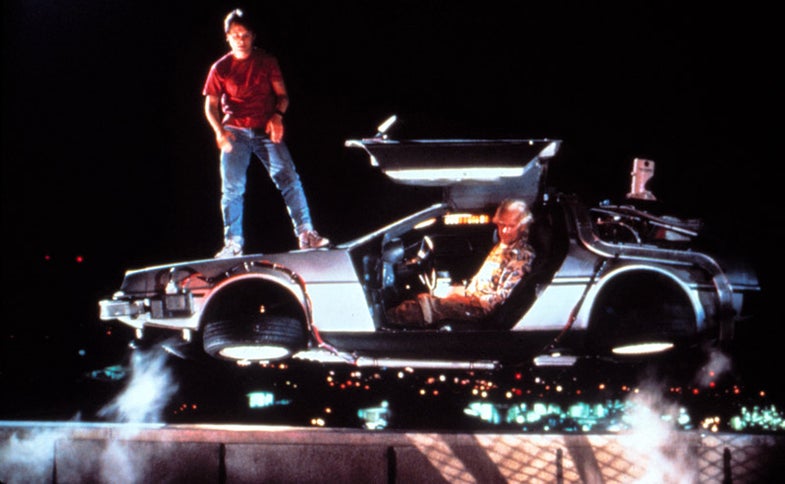
For any vehicle—airplane or car—to fly, there needs to be some force pushing it up so that it can overcome gravity. Airplane wings are specifically designed to create just such a force. As a plane moves forward, the wings push air down, and because for every action there's an equal and opposite reaction, this action creates an upward force on the wing, called lift.
Cars are designed to fight lift, and a DeLorean's "wings" won't make up the difference. The doors aren't shaped or angled to push enough air downward to create a significant upward force. They're relatively short, so there isn't much surface to push up on anyway, and they don't protrude straight out, which is ideal for flying. Worse still, the doors' bulky interior padding and the side-view mirror would create a good deal of drag. Not to mention that the doors would probably break off if forced to support the entire weight of the car.
Another strike against a flying DeLorean is that it's exceptionally boxy, so even with the doors shut, its 20 or so square feet of frontal area (the part of the car that hits the most air) is greater than on most cars its size. Pop the gull-wing doors open, and you're inviting air into the car, which makes for a huge amount of drag resistance. A DeLorean's top speed of 105 mph (with doors closed) isn't nearly enough to overcome this. Even if you installed a stock car's engine and could get the car going 200 mph, it still wouldn't take off.But that's probably a good thing. If you did somehow manage to get the car airborne, you'd have another problem: Once the tires left the road, there would be no force pushing the car forward. Drag—and gravity—would take over, you'd slow to the point where lift couldn't keep you aloft, and not even a Flux Capacitor could prevent you from crashing back to the ground.
Diandra Leslie-Pelecky dissects the science of driving fast in her book The Physics of NASCAR.
Stay up to date on the latest news of the future of science and technology from your iPhone with full articles, images and offline viewing
Featuring every article from the magazine and website, plus links from around the Web. Also see our PopSci DIY feed
Share links with friends, comment on stories and more
In our December issue, Popular Science names the 100 best innovations of the year: bombproof wallpaper, self-parking cars, the fastest helicopter, and 97 more. Plus inventor profiles and videos.
Check out the best of what's new here.
from werwer, www
i was amazed to read this in the article. are you serious? running out of topics to cover? just needed to waste space? put another pheromone ad.
I can only agree that the doors would come off, but there is a very old saying in flying that with enough power you can make a barn door fly!
#1: What a silly question. Was there nothing better to print?
#2: Is the woman who wrote the answer really a physicist? If so why doesn't she know how an aircraft wing actually works? Most physicist's refer to it as Bernoulli's Principle.
#3: Why did it take so many words to answer this question? Was it because she was trying to sound smart?
Steve Warns
A sillee man hoo aint gots much skoolin but no's hees not smart enuf two rite in won of them glossy newz papers.
Diandra Leslie-Pelecky's explanation of how a wing works in 'Would my DeLorean fly if I popped its gull-wing doors and floored it?' (March 2008) is completely incorrect.
'Lift' is an upward SUCTION force on the top of a wing due to a decrease in pressure on top of the wing. 'Lift' is NOT due to a build up of force underneath the wing.
Some assume the pressure on the bottom of a wing builds up as the wing moves through the air. It does not. The bottom of a wing is NOT flat, just curved LESS than the top. Like on the top of the wing, the curved shape on the bottom of the wing also DECREASES the pressure below the static air pressure all around the plane.
Both the top and bottom of the wing have a DECREASE in pressure. It is simply that the curvature on TOP of the wing is MORE of a curve than on the bottom, therefore the wind has to pass over the top faster than it does over the bottom curvature to get to the trailing edge at the same time as the wind going over the bottom. As such, the pressure decrease on the top is greater than the pressure decrease on the bottom. This causes SUCTION on TOP of the wing, not a PUSH from the bottom. The SUCTION is called 'lift'. It may be a paradigm shift in thinking but it is just the way it is: blow over the top of a piece of paper and experience the vacuum effect of 'lift'. The paper moves upward. Light items in the back of a pickup are vacuumed out of the moving truck due to 'lift' or suction pulling them out as air moves rapidly over the top.
Also, I think Leslie-Pelecky's claim that automobiles are designed to fight 'lift' is generally incorrect. Due to the curvature on the top of the automobile, the reality is that 'lift' is responsible for reducing traction to the rear wheels as the air over the top of the vehicle suctions the lighter rear of the average automobile upward. That is the reason 'spoilers', tiny upside down wings, are often applied to increase performance, i.e. traction, to the rear wheels. The 'spoiler' wing, being upside down, creates 'lift' on the bottom/or longer edge, suctioning the vehicle downward with increasing force as the wind speed over the long curvature of the upside down wing increases. In other words, the 'lift' on top of the vehicle is off set or 'spoiled' by the 'lift' on the upside down wing, thereby helping the vehicle to maintain traction.
Sincerely,
Rev. Dr. Donald Doherty
former member of the Canadian Air Force
Prince Albert, SK
Canada