Cop Tech 2010
Stink bombs, pain beams, spy drones-this is the future of law enforcement, brought to you by the Los Angeles Sheriff's Department
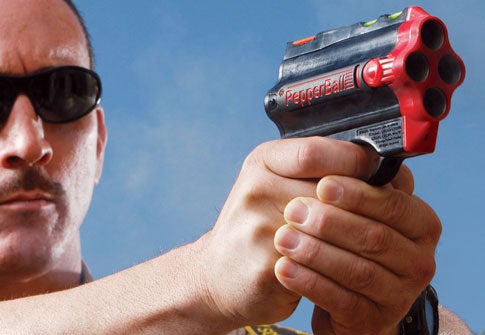
For a behind the scenes video of staff photographer John B. Carnett’s photo shoot with the LASD, check out the video at the bottom of this page. And for a gallery of the latest and greatest crime-fighting gadgets, click here to launch the gallery.
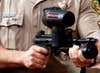
It´s a sweltering Saturday afternoon in late August, and I´m crouched beside a run-down house in East L.A. with Commander Sid Heal of the Los Angeles Sheriff´s Department. Rather than peek through the window and expose his head, Heal points a boxy-looking device at the side of the house and flips a switch. A grainy image of a man inside appears on the device´s screen. Heal and I watch him walk across the living room, enter a closet, and crouch down.
We´re not on a stakeout, exactly. More like a shopping expedition. As head of the LASD´s Technology Exploration Unit (TEU), Heal is hunting for a gadget that can see through walls. Standing behind us, Avrom Gilbert, a representative with Camero, the Virginia-based company that makes the radar system, explains how it works. It relies on ultra-wide-band radio waves to penetrate wood and concrete. Complex 3-D computer software processes the signals and generates an image.
The device seems miraculous to me, but Heal has the manner of someone sizing up a used car. He peppers Gilbert with questions: How long does the battery last? Can it be recharged from a vehicle? How much training is necessary? How many seconds does it take from unpacking to getting a useful image? Can the metal often found in California stucco cause distortions?
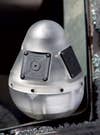
Heal, 56, is the LASD´s technology guru, charged with procuring futuristic crime-fighting equipment. In a post 9/11 world, police work is more complicated than it used to be, and the traditional handcuffs and pistol aren´t enough anymore. In his 10 years with the TEU, Heal has tested hundreds of gizmos, including stink bombs, pain beams, a bullhorn that can project sound up to two miles away, spy drones, a microwave emitter that can stall the engine of a fleeing car, and blinding LED strobe lights see the gadget gallery here.

Part of the need for new equipment stems from the changing role of law enforcement. “The line between war and crime has become blurred,” Heal says as we drive away from the house. “Police officers are now expected to prevent and respond to terrorism. Soldiers are asked to guard prisoners and investigate crimes. Street cops have sub-machine guns.”
Heal´s push for more-sophisticated weaponry has made the LASD a standout among the nation´s 17,800 police departments. “We routinely field questions from about five different law-enforcement agencies each week,” Heal says. And when the LASD finds a new technology, the repercussions are felt nationwide. In 2000 Heal introduced the Taser, making the LASD the first major law-enforcement agency in the U.S. to adopt the stun gun. More than 9,800 police agencies now use it.
John Gnagey, the executive director of the National Tactical Officers Association, calls Heal a pioneer. “He is bridging the gap between scientists, manufacturers and law enforcement.”
The Wild West
It was in South Central, at the hands of a PCP addict, that Heal first understood how underequipped the typical officer is. On a late summer night in 1982, Heal, then a 32-year-old deputy, was patrolling with his partner near Watts, a particularly dangerous neighborhood, when the radio squawked that a vehicle had smashed into a streetlight. Arriving at the scene, Heal saw a mangled car and, slumped beside it, a man with one eye dangling from a socket. Inside the car, broken bottles of liquid PCP leaked onto the floor. As Heal searched the car, the man leapt to his feet and attacked him.
Heal´s partner managed to wrestle the drug-addled man away, but even a team of six failed to strap him to a gurney. Ultimately, the ambulance drove off, leaving the officers to cart the assailant to the hospital themselves. The episode perfectly illustrated the outdated tools of modern police work. Heal and his partner had been far from help, responsible for patrolling a large area and in contact with backup only by radio. They had no way of surveying the scene except by leaving the safety of their car and approaching on foot. Had backup not been in range, nothing short of a bullet would have subdued the attacker. “Back then,” Heal says, “if Wyatt Earp had come to work for us, he wouldn´t have had any trouble adapting to the equipment.”
But it wasn´t until a tour of duty in Somalia in 1995 as a reservist with the U.S. Marine Corps that Heal acquired the experience he´d need to remedy the LASD´s shortcomings. Desperate for nonlethal weapons to disband rioters and keep gunmen from blocking the delivery of food and medicine into the country, the Corps tapped Heal´s 20 years of law-enforcement experience and put him in charge of gear procurement and peacekeeping training. “Money was not an issue,” he recalls. “I had a guy following me around with a blank checkbook. We got everything-lasers, sticky foam, sponge grenades, aqueous foam, stun guns. I just had to ask.”
After Somalia, Heal returned to the LASD, began lobbying hard for better crime-fighting tools and, in 1996, the LASD´s undersheriff authorized Heal to establish the TEU. The first and only unit of its kind in the country, the TEU´s mission is remarkably broad: to explore all technologies, no matter how far-fetched, that might at some point improve the three main areas of police work-effective detection, communication and, when necessary, martial action.
Being a cop is especially challenging against the backdrop of L.A. At 4,084 square miles, Los Angeles County is about 1,000 square miles larger than the combined area of Delaware and Rhode Island. Only five states surpass its population of 10.2 million. The county is home to sprawling suburbs, densely populated urban areas, deserts, mountains and several offshore islands. On average, it experiences one federally declared emergency a year, including fires, riots, and floods. Patrolling it all are just an estimated 19,000 police officers and deputies. By comparison, New York City employs 37,000 officers to patrol 322 square miles.
Heal´s meager budget (“exactly zero,” he says) adds another degree of difficulty. But because he is principally interested in designs for the future, rather than in purchasing what´s on the market now, he´s able to offer his contractors a non-monetary form of payment: expertise. Most law-enforcement agencies buy products only after they have been tested by larger agencies. Heal represents the tempting possibility of a long-term partnership with not just the LASD but other agencies around the country. “We help developers by serving as their consultant,” Heal explains. “Getting us involved at the early stages of development, they can avoid costly mistakes and define what they really need.”
Tough Customer
When I meet Heal at his office at the LASD´s Emergency Operations Center in East L.A. in September, I am struck by the simplicity of his setup. The LASD´s gadget HQ, it turns out, consists of a few desks, a couple computers, a stack of magazines. To see the technology in action, Heal says, he spends most of his time on the road, visiting some 200 companies, government officials and private inventors every year, some as far-flung as Brazil, in pursuit of new gear.
Today we stay close to home, traveling an hour away to La Verne, California, to visit Chang Industries, a defense contractor that has been developing and evaluating, on behalf of the LASD, the first unmanned aerial vehicle for local law enforcement.
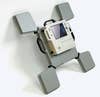
Heal wants a surveillance craft that gives on-the-ground officers portable airborne awareness of their environment. His primary request: Make it small. “First I measured the trunk of a patrol car,” says Sam de la Torre, the drone´s designer and a former prop developer for motion pictures. “It also needs to be light, so it won´t kill someone if it crashes over a populated area.” The SkySeer, as the drone is called, weighs just four pounds (in the event of an engine failure, it glides to earth) and stows away in a four-foot-long carrying case. A single officer can unpack and deploy it within minutes.

It´s also incredibly easy to fly, another of Heal´s requests. Using a “ground station” the size of a briefcase, the operator selects a destination on a digital map and throws the drone into the air like a paper airplane. Guided
by GPS, the drone circles quietly above its target, relaying digital video footage to the ground station in real time. When the batteries fade after about
an hour, the drone automatically glides back to the operator. Heal anticipates that the SkySeer will become a routine part of the LASD´s work as soon as this year, pending approval by the Federal Aviation Administration.
Also close to deployment is a next-generation bullhorn called the Magnetic Audio Device, or MAD. It can project undiluted sound over a distance of up to two miles by emitting planar sound waves in a very narrow path, similar to a laser. “You won’t believe it until you hear it with your own ears,” Heal says, leading me into the parking lot of the manufacturer, HPV Technologies, in Costa Mesa, California. To test it out, I stand in front of a black speaker box, and Heal plays a recording of a standard Navy command: “Heave to the right! This is a restricted area.” As I walk away across the blacktop, the recording defies the widening distance between us, remaining as clear as it would from a man speaking over my shoulder. When I step outside the sound beam, there is instant silence. One step back, and the sound returns with full force.
The LASD began testing MAD last year with special-operations commandos, who used it during training sessions to speak with hostage-takers. Heal won´t say when the LASD might permanently adopt the device, but he looks forward to using it for crowd control. “I can´t wait for a way to talk to someone out of thin air,” he says.
Yet for every gadget that pans out, dozens never reach the supply room. Most of them prove to be prohibitively expensive, impractical or unreliable; the LASD has adopted just 35 of the hundreds of technologies that Heal has investigated. Take James Tatoian´s microwave emitter, for instance. A mathematician and the CEO of Eureka Aerospace in Pasadena, California, Tatoian has developed a powerful 250-megahertz microwave beam that can stall the engine of a car from a distance of 35 feet, a device that would no doubt come in handy in L.A., the car-chase capital of the world. Heal recognizes the system´s value but points out the inadvertent threat it could pose to such equipment as traffic signals, cellphones and pacemakers. (Tatoian has already fried his garage-door opener and often crashes the computers in his workshop.) It will take Tatoian at least another year to whip his prototype into LASD shape. Heal must then sell the Los Angeles County Board of Supervisors, a bureaucratic gauntlet that can take as long as a year, depending on the cost and complexity of the device.
Better Than Bullets
Magnetic bullhorns and spy drones may make police work easier, but nonlethal weaponry offers the most dramatic promise. Over the years, Heal has lost count of his personal injuries but recalls one year in which he was admitted to the hospital on eight occasions. In his career with the LASD, 42 deputies have been killed in the line of duty and he´s personally witnessed the shootings of several assailants at the hands of deputies.
Heal believes that to avoid shootings, law-enforcement agencies must broaden what they call the “use-of-force continuum,” which begins with verbal warnings and ends with a pull of the trigger. Nonlethal weapons such as foul-smelling chemicals and temporary pain rays offer other options.
But is that enough? Merrick Bobb, founder of the Police Assessment Resource Center, an organization that documents police abuses, agrees that there needs to be more-humane options but doesn´t imagine that an improved utility belt will fundamentally alter the equation. “I don´t use the term “nonlethal,’ ” he says. “Less than lethal´ is more apt. These new instruments can still cause serious damage.” In 2004, Boston police fired pepper pellets at a rowdy crowd following a Red Sox victory and killed one woman when a pellet struck her in the eye. And last November, a UCLA officer used a Taser to repeatedly stun an unarmed student for refusing to vacate the school library. “Any tool is vulnerable to abuse,” Bobb says. “The key is adequate training.”
Yet the recent shootings of unarmed suspects-perhaps most notably the death of Sean Bell, shot outside his bachelor party in New York City last November-point to the need for an alternative to live ammunition. And sometimes the right gear really does make the difference.
In 2002 Heal handed LASD sergeant Scott Walker his first Taser. A few days later, Walker was deployed to arrest a mentally unstable man who had led deputies on a wild car chase and then barricaded himself inside his vehicle. “We spent two hours trying to talk him out,” Walker says. When the man finally exited his car, he ignored commands to drop his knife, seemingly intent on provoking the deputies into killing him. Deputies first tried to stop him with rubber bullets, but he kept on, and even fought off a police dog. As deputies prepared to shoot, Walker fired the Taser at him. The man collapsed, helpless but alive. “The Taser was the tie-breaker that saved his life,” says Walker. “His brother actually thanked us, which is something we don´t normally hear.”
Reinhard Kargl is a freelance writer in Los Angeles.