The Fifth Annual Brilliant 10
Worms, planets, extra dimensions: just a few of the things that inspire the most creative young scientists of the year
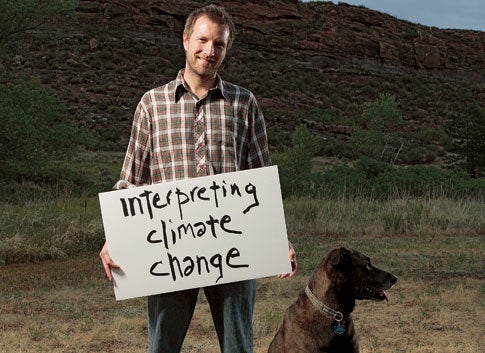
By “brilliant,” we don´t mean smart. Or at least not just smart. Brilliance is marked by insight, creativity and tenacity. It´s the confidence to eschew established wisdom in order to develop your own. It´s the foolishness needed to set out for the edge of understanding and sail right past it, ignoring the signs reading “Thar be monsters” (not to mention “Turn back lest ye never be awarded a decent research grant again”).
That´s why, when we started the six-month-long process of selecting our Brilliant 10 awardees, we asked hundreds of respected scientists, university department heads and journal editors to name not the most established or well-known scientists in their fields. We asked for the mavericks. The young guns. The individuals who are changing not just what we know but the limits of what we think it´s possible to know. The eventual winners are young (average age: 34), and each is just beginning to be noticed in the world outside their respective fields. But among their peers, our winners´ oft-radical ideas are generating a rare degree of respect and admiration. Among us, as well. And for that, they deserve to be part of our Brilliant 10.
Nima Arkani-Hamed, 34
_**Inventor, Fifth Dimension
**_
Explaining gravity was just the start-now he thinks our universe might be one in a near-infinite sea
How can gravity be so strong that it can move planets yet so weak that a simple refrigerator magnet can resist its pull? The question eats at the core of physics; our best theories don´t come close to explaining why gravity is so much weaker than the other fundamental forces (electro-magnetism, for example). Hard problems, though, often demand unorthodox solutions, and the one Nima Arkani-Hamed and his collaborators came up with is a doozy. Gravity, they hypothesized, is seeping out of our three-dimensional universe and into two exceedingly large extra dimensions that are diluting its force. In other words, our universe has a leak.
One year and three papers later, brand-new fields of research had sprouted up around the idea. Just a
year after he got his Ph.D. from the
University of California at Berkeley, Arkani-Hamed had become a household name (well, in the households of theoretical and particle physicists). “It was obvious to me that Nima was going to be a star, even as an undergrad,” says Harvard University theoretical physicist Howard Georgi, who tried unsuccessfully to woo Arkani-Hamed to New England for grad school. “Now he is so far ahead of everyone else in his generation that it´s a little embarrassing.”
Arkani-Hamed did eventually end up at Harvard-at 30, he was made a full professor of physics-and it´s there that he´s following his latest hunch. But this time, it´s not extra dimensions he´s betting on. It´s extra universes-some 10500 of them. He and a growing minority of maverick scientists suspect that our universe is just one of untold billions of universes that exist side by side in a cosmic landscape, each with its own laws of physics and its own constants of nature.
His first piece of evidence, albeit indirect, for this multiverse could be collected as soon as next year, when physicists in Geneva turn on the Large Hadron Collider (LHC), the most powerful particle accelerator in the world. If Arkani-Hamed´s calculations are correct, the LHC will reveal a hidden feature of the universe called split supersymmetry, or split susy (pronounced “SOO-see”), a theory that half of all particles in the universe have partner particles that the LHC will be able to see. (Not incidentally, the LHC may instead turn up Arkani-Hamed´s extra dimensions.) If it works, and the LHC finds these partner particles, “it will be a mammoth hint that the multiverse is real,” Arkani-Hamed says.
So what does this mean? Remember 500-odd years ago when a heretic named Copernicus broke the news that our little planet Earth was not, in fact, the center of the universe? Well, brace yourself. If Arkani-Hamed and his cohorts are correct, our existence is about to be denigrated again. As he explains, “The significance of our world within the multiverse will be no greater than one atom relative to all the matter in our universe.”-rena Marie Pacella
Jerry Goldstein, 35
_**Space Weatherman
**_ He showed why Earth´s natural plasma shield isn´t as stable as we hoped
As a student at Brooklyn College, the only “B” Jerry Goldstein received was in a physics class, so he did what no other right-thinking college student would: He decided to go into physics precisely because, in his words, “it´s the only thing that keeps me on my toes.”
Today he studies the magnetosphere, an invisible magnetic shield that wraps around the Earth. Although scientists knew that the outer layer
of this shield is buffeted by solar winds that come tearing off the sun
at a million miles an hour, most of them thought that the inner layer,
the plasmasphere, was a relatively placid blanket of electrified gas.
Goldstein changed all that. Using readings from NASA´s IMAGE satellite, he demonstrated that during the most severe solar storms, that supposedly calm blanket of plasma almost completely erodes into outer space. This exposes astronauts to intense electromagnetic radiation, fries circuit boards on defense and communications satellites, and creates 250-foot errors in GPS readings. Goldstein went on to rebuild the models of how the Earth interacts with the sun so that they matched the new data. In the process, he showed the plasmasphere to be a more volatile environment than anyone had predicted. Jim Burch, a colleague of Goldstein´s at the Southwest Research Institute, notes that if it weren´t for Goldstein, “we´d still be trying to figure it all out 10
years from now.”-Adam M. Bright
**Melody Swartz, 37
**
_**Body Part Builder
**_ She´s showing how a mysterious current inside the body could help us grow organs
Every paper cut is a reminder of the blood pulsing through our arteries, but Melody Swartz is about to demonstrate the importance of a lesser-known kind of flow, the slow currents of intercellular fluid pulsing through our tissues. With any luck, that flow will prove to be the long-sought-after key to growing organs in the lab.
At the Swiss Federal Institute of Technology of Lausanne, she points to the web of tubes on her monitor. “See those thin, spindly things?” asks Swartz, who is also a bioengineer at Northwestern University. “Those are the begin-
nings of a functional network”-the first biological system that she´s grown by exploiting the intercellular currents.
Previously, the processes driving organ growth were so poorly understood that bioengineers were able to create only a few simple tissue types, such as skin and heart muscle. Last year, however, Swartz´s experiments with human cells showed that during development, these currents redistribute proteins called morphogens, which then signal cells to create networks of capillaries that support growing tissue. She was the first to show that these slow streams are so crucial to development that when they are absent, specialized tissues degenerate into something of a biological casserole gone wrong.
Swartz´s driving force has always been her mechanical mind. As an undergraduate, she majored in engineering, not biology, and even today, she likens her discoveries to “taking apart a car and seeing how it works.”
Her research is so novel that she sometimes has had trouble nailing down grants; her studies tend to defy predesignated award categories. According to her colleagues, this difficulty shows how revolutionary her approach is. Her work suggests, for instance, that creating transplantable organs in the lab will require reproducing the currents of intercellular flow. Understanding these currents could also help researchers invent new cancer-fighting drugs, since tumor cells use them to spread to the rest of the body. “She´s showing how sensitive cells are to small changes in flow,” says Linda Griffith, a bioengineer at the Massachusetts Institute of Technology. “These are phenomena that will endure as foundational ideas.”-Elizabeth Svoboda
**David Thompson, 36
**
_**Arctic El Nino Discoverer
**_ His identification of a key northern weather pattern pulled climate science into the stratosphere
David Thompson was still in his 20s, a graduate student at the University of Washington, when he helped discover a phenomenon that would radically alter the way climatologists understand northern weather patterns. Thompson and his adviser, atmospheric scientist John M. Wallace, were the first to identify the extent of a climate system that engulfs the top third of the planet. This Arctic Oscillation (AO), as they called it, changes weather patterns all over the hemisphere, from blizzards in Cleveland, to rainfall in Spain, to the frequency of the Eastern seaboard´s dreaded Nor´easters. Call it El Nio of the North.
Swirling counterclockwise from a latitude of 55 degrees north-about parallel with Moscow and Ketchikan, Alaska-the AO can shift from its negative phase (when its ring of wind blows more slowly and is easily thrown off course, causing cold Arctic air to spill out into the midlatitudes) to its positive phase (when winds are strong, holding in the cold air) as frequently as every few days. But over time, trends emerge. The positive cycles associated with warmer winters, for instance, dominated much of the 1980s and 1990s
The discovery of the AO had a near-immediate influence on many fields of climate study, notably among climate-change experts who suspect that emissions may be responsible for pushing the AO to remain in the positive phase for longer periods of time. Meanwhile Thompson, now a professor at Colorado State University, turned his focus south, where cooling over parts of Antarctica has been held up by global-warming skeptics as evidence that the world is not, in fact, heating up. In 2001 Thompson and Susan Solomon of the National Oceanic and Atmospheric Administration offered a more likely explanation for the temperature aberration: the ozone hole. That huge void in the atmosphere, they found, shifted wind patterns over Antarctic in a way that cooled its surface-except, tellingly, over the Antarctic peninsula, the glaciers of which have been calving into the Southern Ocean at alarming rates.
What ties Thompson´s global
work together is an obsession with
the importance of the upper atmo-sphere. “What happens down here comes back down,” he says. “The tail does wag the dog.”-Kalee Thompson
Kelly Dorgan, 26
_**Worm Whisperer
**_ Her engineering tricks turned the underground world inside out
“I´ve always kind of liked worms,” says Kelly Dorgan as she tries to coax one to begin burrowing through a tank of gelatin. This particular specimen, a six-inch-long sandworm provided by a local bait shop, isn´t cooperating, and Dorgan, a Ph.D. candidate at the University of Maine, gently prods it while she readies her video equipment. She needs good footage for an upcoming paper. Dorgan turns on a backlight. The worm writhes on the surface of the gelatin. Dorgan adjusts her monitor. The worm noses around. Dorgan nudges. The worm wriggles. Nothing happens. Fi-nally, our little star acquiesces, and with a sudden display of resolve one doesn´t expect from an invertebrate, plunges its head into the gelatin and executes a swift, surprisingly elegant descent.
Working mostly in this chilly lab, Dorgan has challenged a century-old theory, endorsed by none other than Charles Darwin, about how worms move. The work has quickly established her as an authority on the world underground. Steven Vogel, a professor of biomechanics at Duke University, says “Anyone who´s working in her area is going to start by checking her papers or writing her an e-mail.”
Worms are notoriously difficult to observe, and biologists have never been able to say definitively how they move. Darwin, who always liked worms himself, was one of the first scientists to seriously investigate the question. He didn´t believe “that the ground could yield on all sides” to a worm nosing through soil. When push came to shove, he thought, worms swallowed a path through the earth. His theory held for more than 120 years but led later scientists to wonder why burrowing should be so popular. Compared with other ways of getting around (walking, swimming, flying), eating through mud seems extraordinarily inefficient.
Dorgan thought worms must use some kind of trick to help them through the mud, but to investigate the forces involved would require the equivalent of a degree in engineering. “My background was pretty much straight biology,” she says. “I didn´t know any of the physics I needed.” To remedy that, she took engineering
classes by day and Googled shop tricks by night. She eventually came across a method known as photoelastic stress analysis, which employs an elaborate setup of polarized light and camera filters to measure the stress placed on an object. She found a seawater-gelatin mixture that had the physical properties of marine sediment and let it set in a tank. Then she added a worm and filmed it burrowing.
By studying the stress fields around the worms, Dorgan discovered that they actually launch their mouths inside out like a wedge to pry open the mud. Then they ease into the space opened by the crack. To keep moving, they just keep leveraging the crack. In engineering terms, this is known as crack propagation, and Dorgan´s studies suggest that it costs the worms much less energy than having to ingest every inch of mud in their path.
Her finding has changed scientists´ understanding of the entire underground ecosystem. Everywhere biologists look now, they´re realizing that burrowers such as clams, sea urchins and even growing root tips are really living levers. Next, Dorgan plans to study the large-scale effects of burrowing in coastal areas, where worms can mix up the top four inches of the mud, releasing buried nutrients and churning up pollutants like DDT. Scientists have studied the phenomenon, known as bioturbation, since at least 1881, when Charles Darwin made the first serious attempt to describe it.-Adam M. Bright
Omar Yaghi, 41
_**
Hydrogen Nano-Architect
**_ He’s building the minuscule scaffolds that could one day hold the hydrogen in your gas tank
Omar Yaghi walks out of his chemistry lab at the University of California at Los Angeles, closes the door, and looks over his shoulder. “I’ve had a terrible secret for most of my career,” he says with a sly grin. “I’m afraid of chemicals.”
It’s an unlikely phobia for a chemist whose research papers rank among the most influential in his field. But Yaghi chose his field for its intellectual puzzles, not its explosive ingredients. Fill a jug with one of the materials he’s invented (it looks like baby powder), and, as paradoxical as it seems, it will hold more natural gas than an empty room. Many chemists believe that Yaghi’s creations, if suitably tailored to store hydrogen, could lead to the first workable fuel tank for a hydrogen car.
If you zoomed in a billion times, his substances would look like enormous scaffolds. Materials scientists had seen similar frameworks before, but they couldn’t custom-build them for specific purposes. “It was a dream” to engineer these frameworks to chemists’ specs, says University of South Florida professor Mike Zaworotko. “Yaghi was the person who turned it into reality.”
To build the frameworks, Yaghi used tiny metal supports, which, because they form stable joints, allowed him to create nearly any pattern. His tight-knit honeycombs, for instance, are great at storing gases–as gas molecules stick to the crossbeams, they draw close to-gether, becoming compressed without high pressures or low temperatures.
“We [humans] like to control our surroundings,” Yaghi says. “I’m no exception.” Even as a child in Jordan, Yaghi wanted to manage his life on his own; he felt offended whenever his parents checked up on him by asking for his report card. He moved to the U.S. to start college at age 16 and has organized his days around science ever since. “I find that shaving in the morning, taking a shower, is an impediment to me getting to the lab,” he admits.
Within the next few years, Yaghi’s devotion could pay off in real-world applications such as filters that capture the carbon-dioxide emissions from smokestacks. But to Yaghi, such uses are a secondary concern. “I didn’t start out to solve some big societal problem,” he says. Rather, he’s always simply chased the unknown. “If you do that honestly, then usefulness to society will come.” –Lauren Aaronson
Terry Tao, 31
Math’s Great Uniter
He searches the mathematical universe for his next big trick
The code breakers who are about to employ a powerful new method to piece together broken messages have UCLA day care to thank. While waiting to pick up their kids, Terry Tao, a UCLA mathematician, and Emmanuel Candes, a mathematician from the nearby California Institute of Technology, wondered if it was possible to reconstruct
a garbled message even if you inter-
cepted only bits and pieces of it. Using ideas from fields as diverse as geometry, statistics and calculus, they not only proved it possible (in special cases), they showed how to do it. Their technique is being adopted by anyone trying to clean up a jumbled signal, be they CIA agents tapping phone lines or doctors restoring spotty brain scans.
The work is quintessential Tao: a breakthrough in a new field that requires a mastery of techniques from across the mathematical spectrum. It´s this kind of ingenuity that won Tao this year´s Fields Medal (announced as this issue went to press), the Nobel Prize equivalent in mathematics. He´s the youngest person to receive the Fields since 1986, which was two years before the then-13-year-old Tao became the youngest person ever to win the International Math Olympiad. In the decade since he earned his Ph.D. from Princeton University at age 21, “he´s really taken the math world by storm,” says Tony Chan, the dean of physical sciences at UCLA. Tao has made major discoveries in at least five branches of mathematics, and, Chan says, “the senior people in these fields are scratching their heads in awe.”
Tao´s most famous result brought an end to a mathematical search that had lasted for centuries [see box, left], in which he used techniques from several fields to uncover an astonishing pattern among primes. But to Tao, the tradi-tional boundaries between different mathematical fields don´t seem to exist. “They´re interconnected in some way,” agrees John Garnett, his colleague at UCLA. “You have to be Terry Tao to see all this, but they are.”-Lauren Aaronson
Tao´s Infinite Primes
Terry Tao and Ben Green at the University of Bristol in England found a surprising pattern among prime numbers. Here´s the condensed version of their 35-page proof.
First, Find a Prime
A prime is a number divisible only by 1 and itself, such as 3, 11 and 421.
Then, Create a Prime
Arithmetic Progression (PAP)
That´s a sequence of prime numbers in which each number is separated from the next by the same difference. The PAP “5,11, 17, 23” is four numbers long, and each number differs from the next by six.
What did Tao and Green prove?
There are infinitely many PAPs of every length. So “5, 11, 17, 23” is just one of an infinite number of PAPs with four numbers in it. There´s also an infinite number of progressions that are five, 10 or even 1,936,046 numbers long.
Sara Seager, 35
_**
Seeker, Distant Earths**_
Her simulations tell astronomers what fingerprints life may leave on other planets
In the past decade, astronomers have found 200 new planets orbiting distant stars, and not one of them looks like Earth. Sara Seager, an astronomer at the Carnegie Institution of Washington, thinks that´s set to change. Having devised a way to figure out what kind of atmosphere, if any, a far-off planet has, she´s trying to prove that planets like our own dot the Milky Way.

Since information about what distant planets are made of is scarce, Seager created her early models of extrasolar planets by considering what Earth must look like from thousands of light-years away. She then altered her “Earth” in a thousand different ways-doubling its size, or adding strange gases to the atmosphere-and recalculated its appearance each time. Her library of worlds not only reveals what newly
discovered planets might be made of, it also gives astronomers ideas for what to look for. “She is predicting things for which we have little or no experimental data,” says San Francisco State University astronomer Debra Fischer, a member of the renowned team credited with discovering most of the known planets outside our solar system. “And those predictions drive all our observations.”
In fact, Seager´s models helped in finding the first atmosphere around a distant planet. In 1999, just one month after Seager earned her Ph.D. from Harvard University, astronomers discovered a planet that passes in front of its parent star during every orbit as seen from Earth, blocking a small but detectable amount of starlight. Seager plugged what was known about the planet into her models and predicted that this Jupiter-like “gas giant” would have sodium and potassium in its atmosphere. Two years later, astronomers searched for and found these chemical “signatures.”
Seager has since used her technique to chart the atmospheres around 12 worlds, and now she´s looking for chemical signatures like ozone, which could indicate Earth-like conditions and maybe even extraterrestrial life. She´s cataloguing every potential chemical that might be released by alien life and modeling what biosignatures each compound might leave in a planet´s atmo-
sphere. That way, when a telescope brings back those first signs of a living world, we´ll recognize it for what it is: another Earth.-Rena Marie Pacella
Erich Jarvis, 41
Bird-Human Translator
His studies of songbirds are upending much of what we thought we knew about human language
If you think being surrounded by a chorus of songbirds would be a delightful experience, think again. Stepping into the middle of Erich Jarvis´s zebra finch breeding colony at Duke Univer-sity is like entering an auditorium filled with 200 tiny, screeching car alarms. The only pleasant sound in the room comes from Jarvis himself, as the star neurobiologist sings a surprisingly faithful version of a song made by the courting male zebra finch.
Jarvis learned the song the same way finches do: by listening to other finches and imitating the tune. This makes humans and finches both “vocal learners,” a rare trait in the animal kingdom (only humans, songbirds, hummingbirds, parrots, bats, dolphins, whales and elephants are known to do it). Jarvis´s groundbreaking work suggests that this shared ability is rooted in a fundamentally parallel brain structure. It also may provide proof that “language” is an innate ability encoded into all vertebrate brains.
Jarvis first investigated how songbirds learn new songs by freezing, slicing, and dyeing the birds´ brains immediately after their final serenade. That process confirmed that birds use two distinct neural pathways to learn a song, one in front of the brain and one in back. He then discovered that on the neurological level, humans (and parrots and hummingbirds)learn to speak (and sing) in the same way.
But if each group evolved the ability to “speak” independently, how could
our brains all employ the same neural arrangement? Jarvis believes the answer lies in evolution-when we shared a common ancestor 300 million years ago, brains were hardwired for language. If he´s correct, even sophisticated human language grew out of the brain´s ancient networks, the same networks out of which “language” arises in finches.
Once neuroscientists better understand this genetic blueprint, they can in theory alter it, perhaps to repair brain damage or simply to enhance our ability to learn new languages. Until then, Jarvis is expanding his studies. He´d like to do more work on mammals, especially humans (though he finds it difficult to find subjects). “I see myself working with humans, but not just with humans,” he says. After all, there´s so much to learn from the birds.-Adam M. Bright
Luis von Ahn, 27
_**The Matrix Builder
**_
If something´s too hard for computers, he tricks human processing units into solving the problem
Most artificial-intelligence researchers face the gargantuan task of making computers think like humans. Carnegie Mellon University professor Luis von Ahn works the other way around. He harnesses tens of thousands of people´s reasoning skills for those rare yet important jobs that are too hard for computers. His strategy is to make the work seem like a game. Von Ahn´s most popular application tackles one of the most difficult tasks in computer science: labeling every image on the Internet. Computers can´t make fine distinctions in visual information, so in the ESP Game (espgame.org), randomly paired online participants compete to label photos from the Web. If it´s successful, your next Google Images search might turn up exactly what you´re
looking for.-Elizabeth Svoboda