5 Bold Ideas For A Hurricane-Proof New Orleans
Why just rebuild the Crescent City when we can reinvent it? Here, the complete plan for riding out a category-5 storm
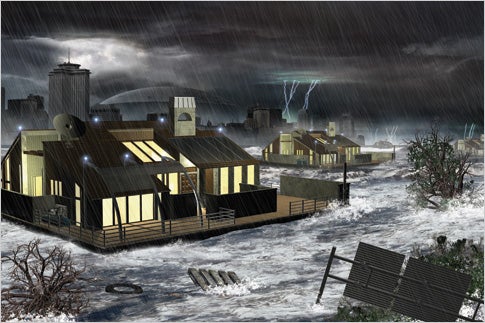
By now you know that engineers had long predicted the cataclysmic flooding that struck New Orleans. But what you might not realize is that Katrina-a category-4 cyclone when it made landfall in Louisiana on August 29-was not the worst-case scenario. That would be a direct hit from a category-5 hurricane, which would send a storm surge over the city’s levees and submerge New Orleans in minutes. Anyone who had ignored evacuation orders would drown.
New Orleans needs more protection than levees alone can offer. But in Louisiana, a comprehensive flood-control program had been repeatedly rebuffed-by environmentalists who fretted over the effects on ecosystems, by fishermen who feared for their livelihood, by engineers dead- locked over competing proposals, and by administra- tors who dismissed the plans as too expensive.
Katrina changed everything. All ideas-no matter how costly or far-fetched-are back on the table. In the end, officials might opt for a Band-Aid approach. They shouldn’t. Relying solely on patched-up old levees is like asking the U.S. Border Patrol to fend off a full-scale military invasion.
Shielding New Orleans will require an arsenal of technologies that work collectively. We consulted experts from around the world to identify five innovative solutions that together could provide a category-5-strength de- fense. Although such a system would entail a ground-up reengineering of New Orleans and much of its nearby coastline, the payoff is a city more defensible against nature’s wrath than any other. Here’s our vision for safeguarding the city.
Sea Gates
Hold back storm surges with giant air-filled walls
The History
Katrina’s wind-driven waves weakened the levees designed to keep Lake Pontchartrain from spilling into the city eight feet below it. Some 58 billion gallons of water-about 3 percent of the lake’s volume-flooded more than three quarters of the city.
Since the 1960s, engineers have considered installing floodgates that would close during hurricanes to prevent a storm surge from backing up into the lake. But the concept was scrapped in 1977 because of concerns that the gates would hinder marine life and nutrients from moving back and forth with the tides.
Similar gates already shield Holland and Britain from violent North Sea storms and tidal surges, and are under construction in Venice. Like New Orleans, Venice lies below sea level, inside a slowly sinking lagoon. By 2011, engineers in Venice will have installed an array of 78 steel-and-concrete barriers at three inlets that separate the lagoon from the Adriatic Sea. Together the string of barriers will span nearly a mile, a distance greater than what would be required to separate New Orleans from the Gulf of Mexico. “I think you could build a solution in New Orleans similar to what we are now building in Venice,” says Maria Teresa Brotto, the project’s managing engineer.
The Specs
A row of giant sea gates would stretch across each of the two narrow waterways that link Lake Pontchartrain to the Gulf, at Rigolets and Chef Menteur Pass. During fair weather, the hollow gates, which would together span about 3,000 feet, would be filled with water. They would rest flush against the seafloor, where they wouldn’t interfere with marine life or tides.
Should a storm approach, compressor pumps would force air into sealed chambers inside the gates, making them buoyant. One side of each hinged gate would be attached to a concrete foundation on the seafloor; the opposite side would rise out of the water.
Alberto Scotti, chief designer of the Venice project, says his sea gates can withstand waves cresting to 16 feet. To fend off a category-5 storm, Louisiana’s gates would need to be reinforced to handle winds upward of 160 mph. They would also have to be taller than those in Venice. “We know that Katrina had in some places a 27-foot storm surge,” says Susan Jackson, a public affairs officer for the U.S. Army Corps of Engineers New Orleans District.
The Challenge
The hurdle is cost, with estimates ranging from $500 million to more than a billion.
The Status
Army Corps engineers are evaluating several concepts. Preliminary hurricane-protection recommendations
are due by early summer.
Engineered Wetlands
Restore nature’s barriers against storms-quickly!
The History
Vast swamps protect New Orleans from the open ocean, but they are shrinking at the rate of an acre every 30 minutes. Since 1930, more than 1,500 square miles have vanished. By 2050, a third of the inland shorelines currently sheltered by wetlands will be exposed to open ocean.
Much of the blame lies with the oil and gas industry. Developers have dredged at least 9,000 miles of canals through fragile wetlands to access oil and gas reserves and to create navigable waterways. The canals channel saltwater inland with the tides, drowning wetland plants accustomed to shallow freshwater.
The Louisiana Department of Natural Resources, the U.S. Army Corps of Engineers, the U.S. Environmental Protection Agency, and state and federal agencies aim to reverse the destruction with a $14-billion, 30-year wetland restoration plan called Coast 2050. A key to its success will be pumping sediment from the Mississippi River through huge pipelines into surrounding marshes and swamps. Over decades, this will fill in open areas and stimulate the spread of native vegetation. In the short term, however, biologists are identifying wetland flora that can adapt to saltier, deeper water. So far, efforts to rejuvenate damaged areas with these plants have been slow going. That’s because the typical method for wetland restoration is to plant grasses and trees by hand-a process that is both tedious and expensive.
Herry Utomo, a geneticist at Louisiana State University’s AgCenter, has a better idea: Genetically enhance wetland grasses to grow in almost any environment, deep or shallow, salt or fresh. The experimental grasses will produce hearty seeds that sprout readily after being airdropped by crop dusters-no more hand planting.
The Specs
For the past six years, Utomo and his research team have been selectively breeding 13 varieties of cordgrass and California bluegrass in a three-quarter-acre testbed. They’re also working in the lab to identify salt-tolerant genes that can be integrated into the DNA of the evolving grass crop.
In February, Utomo will conduct his first major field trial, dropping 100 pounds of the enhanced seed onto Louisiana marshland. Done on a much larger scale, this type of restoration could cost as little as $10 per acre. Hand planting typically costs $3,500 or more per acre.
The Challenge
If the tests go well, it will still take decades to rebuild all that has been destroyed. “But at least we will be able to restore some areas very fast,” Utomo says. “At the current rate of loss, we have to do something to speed up recovery.”
The Status
Utomo says it will take a further two to three years to develop a full-scale production crop of seeds and begin wetland restoration in earnest.
Mega Plumbing
Build a subterranean system to keep the city dry
The History
Shortly after Katrina barreled ashore, Robert Bea assembled an ad hoc team of engineers and headed to New Orleans. Bea, a professor of civil and environmental engineering at the University of California at Berkeley, had been invited to Louisiana by the U.S. Army Corps of Engineers to survey Katrina’s aftermath. One problem that immediately struck him was The Challenge of getting water out of the low-lying city once it flooded. He blames that, in part, on the open canals that crisscross New Orleans. During a storm, the canals can overflow or crumble entirely, spilling millions of gallons of water into surrounding neighborhoods. From there, the water has nowhere to go.
The Specs
Bea recommends doing away with the canals and replacing them with underground concrete sluiceways, called boxed culverts, to form a giant plumbing system that would carry floodwaters out of the city. Buried under a few feet of ground cover, the culverts would be at least 10 feet tall and 20 feet wide.
“The current canals are arteries for water to flood the neighborhoods,” Bea says. “We should fill them in, put nice parklands above them, and build a drainage system underneath. It would be like the plumbing in your shower.”
Because New Orleans is below sea level, however, the system can’t depend on gravity to move water uphill and back into Lake Pontchartrain. For that, Bea suggests a set of heavy-duty, storm-proof pumps-ones that are armored, diesel-powered and positioned on high ground so that they would keep running no matter what Mother Nature throws at them.
The Challenge
The technology is simple, but turning canals into culverts would require a
massive engineering effort, at a cost of about $1 million per mile of canal, Bea estimates. (The city’s three primary canals-the 17th Street, London and Orleans-and their tributaries extend for about 50 miles, and industrial waterways add another 50 miles.)
The Status
After his tour of New Orleans, Bea drafted a white paper entitled “What Do We Do Now?” that outlines his culvert plan. At the very least, he argued, the city’s three primary canals should be enclosed. But officials aren’t making any promises.
Community Havens
Divide the city into sections so that flooding is limited to smaller areas
The History
Submarines and aircraft carriers are divided into many compartments. Should one begin to leak, crew members can seal hatches and isolate the flooded compartment before the entire vessel sinks. It’s a strategy that Joseph Suhayda, former director of the Louisiana Water Resources Research Institute and a retired civil engineering professor, says could be easily incorporated into a new levee system for New Orleans. Under the current system, he says, “there is no internal management of water if the levees fail.”
The Specs
Suhayda’s solution is to create an interlocking network of reinforced floodwalls that would divide New Orleans into what he dubs “community havens.” “There are natural topographic ridges in the city that could be linked together and subdivided to compartmentalize the city,” he explains. “Then if there were a leak or a breach in one place, the water could be confined.”
Community haven floodwalls would be less obtrusive than existing earthen levees, which require about three feet of width to support every foot of height. Floodwalls used to partition the city would resemble the narrow concrete sound barriers used to flank freeways. Surface streets would pass through steel floodgates.
Should a storm surge penetrate earthen levees along Lake Pontchartrain, floodgates would be automatically sealed to stop water from spreading south over the city. Suhayda proposes ringing hospitals, power stations, evacuation shelters, police and fire stations, and other essential buildings with a second tier of floodwalls. “You want to make sure that even if the city floods, you’re not going to lose the critical sites,” he says.
Suhayda estimates the cost to erect a floodwall network at less than $1 billion and says it could be completed in two to three years. “We could join together some of the internal topography in New Orleans,” he says, “and immediately provide flood protection.”
The Challenge
Even the most attractive floodwalls would change the character of New Orleans-blocking light and views and creating isolated neighborhoods.
The Status
The Louisiana-based company Hesco
Bastion has designed a product called the Concertainer that looks like a 15-foot-long ice tray and can be filled with earth or sand and stacked Lego-style. A wall made from Concertainers and positioned along Lake Pontchartrain survived Hurricane Katrina unscathed. But so far, there are no official plans to build similar walls to enclose and protect neighborhoods.
Amphibious Houses
Create foundations that double as life rafts and lift homes to safety if other flood-control mechanisms fail
The History
Dutch taxpayers have spent more than $8 billion to hold back the sea, but their defenses are not foolproof. As a backup, engineers are experimenting with homes and businesses designed to survive floods by rising above them. In the town of Maasbommel, the construction firm Dura Vermeer is now completing a prototype neighborhood of 34 “amphibious
houses” designed to float atop floodwaters. “The Dutch have been fighting water for ages,” says company spokesman Dick van Gooswilligen.”So rather than seeing it as a threat, we decided to try to create an infrastructure and environment around water.” The concept could work in New Orleans to protect the most vulnerable neighborhoods-those closest to levees or farthest below sea level-if other mechanisms
fail to keep the city dry.
The Specs
In Maasbommel, each $350,000 home is bolted to a concrete foundation that functions both as basement and life raft. On dry land, the watertight foundation rests on a set of steel pillars. As floodwaters reach the base of the house, it begins to rise off the pillars-up to 18 feet if needed. To prevent it from floating away, two taller mooring posts thread through sleeves attached to the house. This allows for the buoyant structure to gently rise and fall with floodwaters the way a floating dock at a marina seesaws up and down through high and low tides. Flexible utility conduits preserve gas and plumbing hookups and electricity during a storm. “The houses are not necessarily hurricane-proof,” van Goos-willigen says. Levees and sea gates [see page 58] would still have to absorb the brunt of the storm surge. “But [the homes] would have worked in New Orleans in the floods after Katrina.”
Eventually, whole city blocks could be built on massive barges. During fair weather, the barges would rest in recessed casings on dry land, more or less unnoticeable until floodwaters poured in and sections of the city began to float. Engineers might even eliminate levees in the most flood-prone parts of New Orleans. Inside this newly formed waterfront district would be entire neighborhoods on floating barges.
The Challenge
Converting the roughly 50,000 homes leveled by Katrina to floating structures would cost $18 billion, or nearly double the price of rebuilding traditional houses. But modeling even a small section of the city-perhaps a shopping district, park or waterfront attraction-after the Dutch system could rally public support for future amphibious neighborhoods.
The Status
At the moment, officials in New Orleans aren’t considering amphibious homes as part of the rebuilding effort. That might change if the Dutch experimental homes survive the next flood intact.