Car Crashes . . . Criminals . . . Cancer . . . Black Swans? AAAAAIIIEEEH!
Sometimes our biggest fear is not knowing what to fear most. Fortunately, the weird science of risk analysis can teach us to judge better and fear smarter
On December 27, 2004, while the world was focused on the Indian Ocean tsunami, a few astronomers were contemplating the possibility of an even deadlier disaster: that of a massive asteroid striking Earth. A fifth of a mile wide–heftier than the space rock that leveled a vast swath of Siberian forest in 1908–Near-Earth Asteroid 2004 MN4 had grabbed the attention of NASA scientists just before Christmas. They put the chance of an April 13, 2029, collision at 1 in 2,700 and two days later upped the odds to 1 in 165. On the morning of the 27th the astronomers elevated their assessment again, this time to an alarming 1 in 38. On the Torino scale, which measures the likelihood and potential severity1 of an asteroid impact, they gave the asteroid a 4, the highest alert ever issued. Like most people, I was oblivious to this maybe menace. These days, it can be hard to keep your hazards straight. There are the usual suspects–car crashes, crime, cancer–and a seemingly endless parade of new threats. Breakneck global warming, bioengineered smallpox, gray goo? Sometimes my worst fear is not knowing what I should fear most.
Assessing and avoiding risk is a Darwinian imperative; mitigating risks that can’t be dodged is ancient as well.2 With current science, medicine and technology, we know more and can do more about risk than ever before, and in the past century, American life expectancy has jumped from 47 to 77 years. Somehow, though, the good news hasn’t gotten out. A recent study showed that nearly 80 percent of us think the world is more dangerous than it used to be, not less. Earlier this year, I launched a risk-research study with a subject pool of one: me. First I kept a diary, recording and ranking every hazard I encountered for two weeks. Then I submerged myself in accident, mortality, epidemiological and toxicological data; purchased a small library of scholarly books; and interviewed the country’s foremost risk experts. I sent them a copy of my diary for review. The key questions: How accurate was I at rating risks, and how could I do better? Sure, I’ll never live risk-free, but maybe I could learn to live risk-smart. Did I? Let’s take a look.
**JANUARY 23, 2005
Biking the Urban Snowstorm**
Yesterday, New York was slammed by one of the worst January blizzards in a century, a frigid nor’easter that dumped a foot and a half of snow. After such an onslaught, there’s really only one sensible activity: sledding. Friends of mine are meeting in Brooklyn’s Prospect Park, and I’m running late. I decide to bike. “I’ll wear my helmet,” I promise my girlfriend, Anne, as I rush out the door.
In my diary, I record biking as being highly risky. But riding very carefully, I reason, offsets the danger. When the risk experts review my journal, however, they cry foul at this rationalization.3 “Sometimes we decide how we want to live our lives and then invent reasons why certain things do or don’t worry us,” says George Gray, executive director of the Harvard Center for Risk Analysis. It seems that I’ve fallen prey to a couple common perceptual traps. Canadian psychologist Gerald Wilde might see my actions as an example of the risk-balancing process he calls homeostasis–the helmet makes me feel safe, so I engage in a more dangerous behavior than I would have otherwise.4 Other researchers have demonstrated that feeling in control–as you do at the handlebars of a bike–provides a false sense of security. In a 1989 study, Hofstra University psychologist William Sanderson had panic-prone patients breathe air that was 5.5 percent carbon dioxide, which is known to provoke panic attacks. Half of them were informed that they could lower the carbon dioxide concentration by twisting a dial, and this group reported fewer and milder attacks–even though the dial was a dummy.
Flatbush Avenue, my primary route to the park, is only partially plowed. I ride over slush, a foot or two from buses and cars, with slipping tires. The good news: I’m not drunk. A recent Johns Hopkins University study found that one in three fatal bicycle accidents in Maryland was linked to alcohol; a blood-alcohol level of 0.08 or higher was found to increase the risk of serious or fatal injury by 2,000 percent. The bad news: I’m a man. Of the 800 bicyclists killed in accidents with cars each year, 90 percent are male; 80 percent of the 500,000 injured are men. Male cyclists do slightly outnumber female ones, and men tend to bike more often, but these factors alone don’t account for the elevated death and injury rates. Men, it seems, simply take more risks. For anyone, though, bikes can be dangerous: Traveling a mile by bike is almost 14 times as likely to be fatal as a mile by car.5
In the park, it’s a full Norman Rockwell scene, with kids in mittens and scarves towing sleds across sparkling snow. I meet my friends, and we head to a crowded bunny slope. Some 33,000 Americans a year are injured while sledding, but the sport registered little concern in my diary. This time, the facts are with me–after all, millions of people go sledding every winter and don’t get hurt.
Risk assessors rip their hair out at the general public’s innumeracy; many people jump to conclusions based only on absolute numbers and don’t consider ratios as well. For example, the average number of people killed each year in hot-air balloon accidents is 2.6, while the number killed in hunting accidents is 600. But there are two million hunters in the U.S. and just 3,000 hot-air balloonists, which makes ballooning’s death rate 30 times as high as that of hunting.
JANUARY 24, 2005
Home, Sweet Home?
Last year researchers at San Diego State University and the University of Colorado, targeting a forgotten front in homeland security, decided to study soap scum. “Over time, vinyl shower curtains accumulate . . . lush microbial biofilms,” they reported. The films contain Sphingomonas spp. and Methylobacterium spp., opportunistic pathogens that can lead to serious blood and urinary-tract infections. Although the scum is thought to threaten only people with weakened immune systems, biologist Scott Kelley nonetheless advises caution. “I clean my shower curtain more frequently now and change it much more regularly,” he told the San Diego Union-Tribune.
Finishing my shower, I step carefully around the dripping vinyl. In my journal, I ranked being at home as the safest part of my life, but David Ropeik, the director of risk communication at the Center for Risk Analysis, disagrees. “Home isn’t as sweet as we think,” he tells me.
Consider my morning routine by the numbers. An estimated 280,190 toilet, shower and bathtub accidents sent victims to the emergency room in 2002, according to Injury Facts, a gripping statistical compendium published annually by the National Safety Council. (This article cites the latest available U.S. data unless otherwise indicated.) I shave with a razor (an implement linked to 33,532 injuries) with hot water (involved in 42,077 injuries) at the sink (23,283 injuries). For breakfast, I slice a grapefruit with a knife (441,250 injuries) and pour juice into a glass (86,909 injuries). Before sitting down to eat, I jog down two flights of stairs to fetch the newspaper. Easy, champ. Falls are a significant danger, causing about 28 percent of the 30,000 accidental home deaths6 each year (poisoning and fires are the other top killers).
Depressing stuff. “If you were a fanatical risk analyst and started to work through all of the risks you’re facing, you’d be immobilized,” says Paul Slovic, a professor of psychology at the University of Oregon. “You’d probably end up staying in bed all day.” That, sadly, wouldn’t be a good idea either. Every year, around 400 people unintentionally suffocate or strangle themselves in bed.
As a risk-pro-in-training, though, I’m learning to pause for consideration before becoming alarmed about anything. The U.S. population numbers nearly 300 million, so the chance of any one of these accidents happening to me is remote. What’s more, home hazards aren’t equal-opportunity. Fatal falls, for instance, are 70 times as likely when you’re 75 or older as when you’re 44 or younger. Still, domestic risk isn’t insignificant. In 2003, one in 37 people was disabled for a day or more by an injury at home; according to Injury Facts, disabling injuries are more numerous in the home than in the workplace and in car crashes combined.
The headlines in the paper are grim, and I take a deep breath and sigh. Oops, bad idea. In later risk research, I learn that exposure to air pollution is estimated to be 10 to 50 times as high indoors as it is outdoors7; most of us spend the majority of our time inside, where poor ventilation allows pollutants to accumulate. A partial list of the toxins that might be in my lungs this morning: carbon monoxide, nitrogen dioxide and gases from household products; mold, mites, mildew and dander; traces of lead, asbestos, pesticides, arsenic, flame retardant and product packaging. Yuck.
The danger posed by some pollutants is well understood. For example, radon gas–invisible, odorless and radioactive, seeping up naturally from the ground into homes–has been identified as the number-two cause of lung cancer in the U.S.8 For many other pollutants, though, scientists simply aren’t sure of the health effects. More than 75,000 chemicals are employed in U.S. industry and agriculture. So far, the Centers for Disease Control and Prevention’s National Biomonitoring Program has tested peoples’ bodies for the presence of just 157 of them.
An emerging area of concern is synthetically produced nanoparticles, which some scientists theorize might be dangerous because of their ability to accumulate in the body and penetrate cell membranes. Last year, Eva Oberdrster, a researcher at Southern Methodist University, placed buckyballs–a type of carbon nanoparticle being studied for use in drugs, computers and fuel cells–in a fish tank at a concentration of 0.5 part per million. (One of the first consumer products to use buckyballs is, of all things, a crack- and chip-resistant bowling ball.) Though preliminary, Oberdâ€rster’s results were troubling: Within two days, the nine largemouth bass in the tank had all developed brain damage. It’s far too early to draw any conclusions about a human health hazard, however, so what to make of nanoparticles? My risk-educated attitude is to place uncertain dangers like this one on a mental watch list. I’m not going to lose any sleep over buckyballs–not yet–but I will stay alert for more hard science.
**JANUARY 25, 2005
Where the Streets Are Insane**
It’s midday, and, feeling sluggish in my home office, I step out to pick up a soda. The nearest deli is just down the street, across the X-shaped intersection of Lafayette and Fulton. This is a loathsome spot, crowded with some of the world’s worst drivers. Speeding minivans run red lights. Lincoln Town Cars make unsignaled rights, oblivious to pedestrians. Buses blaze past, inches from the curb. Ever since our first week in the neighborhood, Anne and I have called this the Intersection of Death.
In 2003, an estimated 80,000 pedestrians were injured and 5,600 were killed by cars. For men in my 25-to-34-year-old age bracket (I’m 34), the annual death rate is 5.5 per 100,000 people, which doesn’t seem too high. (By comparison, car accidents, the leading cause of death for men my age, kill at a rate of 26 per 100,000.) The risk experts later advise me, however, that statistical averages only hint at my personal danger level. Consider that New York streets are far busier than average and that New Yorkers spend more time walking than typical Americans do. Also, I’m an incorrigible jaywalker. You can get your soda faster if you beeline across the Intersection of Death.9
In the diary, I rate jaywalking as I did snow-biking–as a significant but manageable danger. Again I’m guilty of making a common perceptual error: Studies show that people significantly underrate everyday risks and overrate new ones. When the first cases of mad cow disease appeared in Germany, 85 percent of people polled thought the disease was a serious threat. Mad cow was a much bigger problem in the U.K., but it had been around awhile; in polls conducted there at the same time, only 40 percent of the public indicated serious concern.
Anne never jaywalks across the Intersection of Death.10 Studies have consistently concluded that women, on average, are considerably more apprehensive about risk than men are. The theories as to why this is so run along predictable sociobiological lines: Women bear and nurture children and are therefore instinctively protective of life, etc.
It turns out, though, that risk-assessment differences aren’t just a man-woman thing. In a 1994 study, James Flynn of Decision Research in Eugene, Oregon, found that the gender difference in risk ranking was attributable to roughly 30 percent of his subject pool’s white males, who ranked all risks as being very low. Members of this subgroup tended to be better-educated, wealthier and more politically conservative than the rest of the pool. Inoculated by success in life, they were less pervious to worry and expressed optimism about their own–and society’s–ability to deal with danger.
**JANUARY 26, 2005
Natural-Grown Killers**
I’m hungry. I’m in a hurry. I know that a high-fat diet can lead to heart disease, the number-one killer in America, and I don’t care. I’m going to eat a Quarter Pounder at McDonald’s, along with fries, a Coke and cookies. The meal is delicious. And in one sense at least, it’s healthier than a charbroiled burger I’d gobble at a backyard BBQ. This month, the U.S. Department of Health and Human Services added chemical compounds found in grilled meat–some of which are also found in cigarette smoke–to its official list of probable cancer-causing agents.11
I finish lunch feeling satisfied–and vaguely queasy. In any given year, one in four Americans suffers from food poi- soning. Although most cases are rela-tively mild, 325,000 result in hospitalization and 5,000 in death. I logged no food poisoning concern in my diary, and my unperturbed reaction is typical. “People are more concerned about risks that are catastrophic and rare than those which involve fewer fatalities but are more frequent,” write Richard Wilson and Edmund Crouch in Risk-Benefit Analysis.
Crossing the street from McDonald’s
I enter the Union Square farmers’ market. There are tables of apples–Empire, Gala, Winesap, Macoun–and vendors selling cider and whole-grain bread. I’m drawn to a booth with an intriguing sign: HAWTHORNE VALLEY FARM–DEMETER-CERTIFIED, BIODYNAMIC. Inside, a bearded man tells me that the farm’s crops are grown without the use of artificial fertilizers or pesticides; even the Hawthorne cows eat organic feed. This eases the impact on the environment, but does it make the food safer than the meal I just scarfed? “I’d say it’s at least 200 times safer,” he says. I plop down $20 for a skimpy T-bone steak.
Afterward, I wonder: Is an artificial-pesticide-free farmers’-market offering–an apple, for instance–significantly safer than a standard grocery-store one? Before my risk education I would have said “yes”; now I’m less certain. The Food and Drug Administration (in 1999) and the U.S. Department of Agriculture (in 2000) each tested close to 10,000 food samples from grocery stores around the country. They concluded that fewer than 2 percent of the samples had pesticide residues above allowable limits and that even then, most were well below the amount thought to be unhealthy.
Research in the 1990s by Bruce Ames, a molecular biologist at the University of California at Berkeley, indicated that 99.9 percent of the pesticides eaten by Americans are natural. You can give lab rats cancer with substances found in cabbage, cauliflower, broccoli and bananas. “I’m not saying that we should be avoiding broccoli,” Ames says. Consuming plenty of fruits and vegetables lowers your cancer risk. But his work illuminates two common risk-perception errors. First, artificial risks are automatically assumed to be worse than natural ones. People fret about the radiation from their cellphones giving them cancer, then go to the beach without sunscreen. Second, people’s judgments are inappropriately polarized; they fail to recognize that most things in the world present a mix of risks and benefits.
**JANUARY 27, 2005
Urban Myths and Menaces**
The off-off-Broadway show that I’m watching–The Top Ten People of the Millennium Sing Their Favorite Schubert Lieder–has its moments. In slower stretches, though, I find myself glancing around the cramped theater: at tangles of cable snaking between stage lights; at peeling black paint on the walls; at the nearest exit. Ever since that Rhode Island nightclub fire that killed 100 people two years ago, clubs and theaters have made me nervous. After the show, I walk carefully on the sidewalk. Last year, a woman in the East Village was killed after stepping on a metal plate that had become electrified with what the papers disturbingly referred to as “stray voltage.” Waiting for the subway home, I step behind a pillar when the train rushes into the station. Everyone knows how people get pushed onto the tracks by deranged criminals.
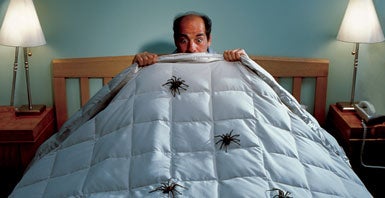
I will later place these urban fears midway up my risk list, but statistically speaking, even these rankings are unwarranted. The annual U.S. death rate from fires is a little higher than one person per 100,000. The rates for sidewalk zapping and platform pushing are far lower–in recent New York history, there have been one known electrocution and a handful of pushing incidents in a city of eight million people who walk and ride trains daily. It seems that I’m the victim of several closely related cognitive pranks: availability, which means that familiar, easily imagined risk scenarios are feared more than long-term, abstract threats; dread, the idea that rare but acutely horrible fates (deadly spider, snake and shark attacks) are dwelt upon more than humdrum ones (heart attacks); and disproportionate visibility, which causes people to believe that if something is highly publicized, it must also be highly probable.
Relaxing on the subway, I shift into iPod mode; I continue listening while walking a couple blocks to my apartment. It’s nearly midnight, and I keep an eye out for anyone suspicious. I’ll rank crime as only a moderate danger in my diary–the city is the safest it has been for decades, right? Right. The number of murders, for instance, which hit an all-time high of 2,245 in 1990, plunged 75 percent to 575 in 2004. New York is one of the safest large cities in the country. Plus, as a relatively young man, I must rank pretty low on the potential victim list, right? Wrong. Andrew Karmen, a professor at John Jay College who is one of the city’s most respected criminologists, corrects this faulty assumption. Many women, he tells me, take anti-crime precautions such as traveling in groups; older people generally aren’t out late; and married people usually travel together. Who is most likely to be out at night, alone and distracted, thus presenting himself as an easy target? An overconfident guy like me, strolling down the street at midnight, listening to his iPod.
**JANUARY 27, 2005
High Stakes**
Today I’m flying to Montana to begin a weeklong skiing and driving vacation in the Rockies. Because the atmosphere is thinner at 37,000 feet, my exposure to ionizing radiation is 100 to 300 times as great as it would be at sea level. A study in Great Britain found that flight-crew members are exposed to significantly more ionizing radiation per year than workers at nuclear power plants are. Other studies have noted slightly
elevated cancer rates among crew members, but the health danger is negligible for less-frequent fliers like me. Dear Diary: not worried. Suddenly, though, the plane jolts with turbulence, seeming to drop 150 feet before catching itself. Dear Diary: freaked out.
I know this is senseless, and subsequent research supports me. Flying is the safest form of transportation around, with an infinitesimal average annual fatality rate of 0.03 deaths per 100 million passenger-miles. The rate for driving is almost 30 times as high. Irrational fear isn’t my fault, though–I’m just wired that way. Joseph LeDoux, a neurobiologist at New York University, uses functional MRI and other brain-imaging studies to look at how the brain processes fear. One of his conclusions is that the thalamus usually dominates, reacting quickly and powerfully to potential threats by triggering behavioral, autonomic and endocrine responses. The cortex, responsible for the thoughtful consideration of danger, steps in later. We fear first and think second. This may help to explain why it is that if a risk evokes powerful emotions, your fear level will be mostly unaffected by the actual odds. This cognitive error, known as probability neglect, has been well documented. In one study, people indicated that they were willing to pay roughly the same insurance premiums whether a catastrophic risk’s odds were 1 in 100,000 or 1 in 10,000,000. In another, participants were asked to imagine that they might be given a “short, painful, but not dangerous electric shock” and asked how much they would fork over to avoid it. On average, people were willing to pay $10 to avoid a 99 percent chance of receiving a shock, and nearly as much–$7–to avoid a 1 percent chance. The outcome was sufficiently bad that the odds didn’t really matter.
**FEBRUARY 3, 2005
Driving to Distractions**
I’m headed north on Highway 191 toward the Tetons, with a view of the jagged range that gets more mesmerizing each minute. I crack the windows and crank the stereo but avoid the country stations–because I feel like listening to rock, not because of the alleged hazard to mental health. For “The Effect of Country Music on Suicide,” published in 1992 in the journal Social Forces, researchers Steven Stack and Jim Gundlach analyzed the music played in 49 metropolitan areas and found that the greater the airtime devoted to country music, the higher the suicide rate. “Country music is hypothesized to nurture a suicidal mood through its concerns with . . . marital discord, alcohol abuse and alienation from work,” the authors wrote. I’m learning to interpret research like this cautiously. The study established a statistical correlation, not definite causation, and noted that the effect, if real, would only be on people already at risk of committing suicide.
Cruising along at 65 mph, I pull out my digital camera and snap a few pictures through the windshield. The cellphone rings. It’s one of my editors, back in New York, and we talk for 10 minutes about an upcoming story.
In my journal, I correctly rank driving as the riskiest thing I do–car crashes are the leading cause of death for people between the ages of 4 and 34. I didn’t, however, appreciate how significantly distractions increase the danger. Talking12 while driving can cause inattentional blindness, a perceptual phenomenon vividly illustrated in a 1999 study by Harvard psychologists Daniel Simons and Christopher Chabris. Their experiment concluded that when you concentrate on one thing (the study’s subjects counted basketball passes), you can miss something completely obvious (many of them didn’t see a person walking by in a gorilla suit). In a study last year of inattentional blindness that employed a driving simulator, University of Utah psychologist David Strayer found that drivers took 18 percent longer to hit the brakes when they were talking on the phone. Previously, he’d shown that cellphone users drive worse than people who are legally drunk.
**FEBRUARY 4, 2005
Extreme Behavior**
I challenge myself while skiing; it’s the only sport that I’m even remotely good at. The runs at Grand Targhee in Wyoming are pretty easy, so I go beyond the resort’s boundaries to a bowl topped by a semicircle of low cliffs. I get ready to ski down.
I view resort skiing as pretty safe, and for the most part, I’m right. During the winter of 2003-2004, 41 people were killed and 37 seriously injured at U.S. ski resorts; overall, a person’s chance of dying on any given visit is less than one in a million. As a result of improved binding technology, the rate of broken legs has declined by 90 percent since the 1970s.
Exposure, however, determines risk. New Yorkers don’t fear getting smacked by falling coconuts, whereas if you live in Papua New Guinea, the problem is considerable.13 Similarly, avalanches are a non-issue for most Americans, but they’re a big deal for anyone who ventures outside the safety-regulated confines of a resort–as I’ve done today. In the past five years, an average of seven backcountry skiers a year have been killed in avalanches, making it a sizable risk considering that there are fewer than 300,000 enthusiasts in the U.S.
I know that backcountry skiing is among the most dangerous things I do, but today I feel pretty safe. Maybe I suffer from what’s known as optimistic bias. Most of us do. Surveys have revealed, for instance, that the majority of people think that they’re better than average at driving, a mathematical impossibility. For the sake of argument, though, let’s say that I am better than average at skiing. Does that make me safer?
The short answer is “no,” for the reason that experts at skiing and other risky endeavors take bigger chances.14
Researcher Ian McCammon analyzed information on 598 U.S. avalanches between 1972 and 2001 and found that people with avalanche-assessment abilities severely undercut their skills by taking risk-assessment shortcuts. The accident victims relied on social proof–they witnessed other people skiing where they were going to ski and assumed that meant the slope was safe. (Think: monkey see, monkey do.) They were trapped by commitment–the need to stick to a decision, even a bad one, in order to appear consistent and decisive to peers. And they fell prey to a form of familiarity–the belief that if you’ve done something in the past and gotten away with it, you can do it again with guaranteed safety.
Skiing down, I choose my line carefully.
**FEBRUARY 5, 2005
You Never Know What Could Hit You**
I’ve reached 10.8 mph on the treadmill, a new personal record for (stationary) land speed, and am experiencing runner’s high tinged with anxiety. Underfoot, the rubber belt is damp and slippery, and I don’t need to know the annual number of exercise equipment injuries (nearly 40,000, as it happens) to fear a nasty fall. Back in Brooklyn, I like to jog in the park, and things can be dicey there, too. On a run last fall, I suddenly heard a desperate “Watch out!” from behind me. Jumping aside, I narrowly missed being trampled by a galloping horse, the man atop it pulling helplessly at the reins. Horse trampling is so 1850. Who knew to worry about the danger in contemporary New York? Risk pros have a name for a hazard like this: “A black swan is an outlier, an event that lies beyond the realm of normal expectations,” wrote Nassim Nicholas Taleb, the author of Fooled by Randomness, in a 2004 op-ed piece for the New York Times. A black swan is particularly troubling, he argued, because “its very unexpectedness helps create the conditions for it to occur.”
Hoping to avoid nasty surprises, credible scientists speculate considerably about black swans. The most far-out of these risks are, as Wilson and Crouch put it, “predictable by very well verified physical theories but involve events which have never been observed and probably never will be observed.” For example, on Long Island, the Brookhaven National Laboratory operates a particle accelerator with the potential to seriously screw up my afternoon run. In theory, it could generate quarks that would reassemble themselves into a “strangelet,” which would in turn absorb matter until the entire planet was transformed into a hyperdense sphere 100 meters across. It sounds like sci-fi. Nevertheless, Brookhaven’s director took the threat seriously enough to have physicists study the scenario before allowing the accelerator to begin operating in 2000.
The strange-matter event and a host of other doomsday scenarios–greatly accelerated global warming; the engulfing of the world by self-replicating nanobots (the so-called gray-goo
problem); the engulfing of the world by self-replicating nano-organisms (green goo); severe bioterrorism–are detailed in Richard Posner’s Catastrophe: Risk and Response. Posner, a U.S. Court of Appeals judge and a lecturer at the University of Chicago Law School, argues that we should think more about these low-probability, high-consequence risks. “The probable costs of the catastrophic risks, when compared with the probable costs of efforts to minimize them, indicate that we are not doing enough,” he writes.
So what about 2004 MN4, that hunk of rock hell-bent for Earth? Don’t worry about it. After reviewing earlier observations, scientists determined that the asteroid will swing 22,000 miles wide of Earth. Which doesn’t mean that society is completely safe. There are an estimated 1,100 major near-Earth asteroids, 30 percent of which haven’t been identified yet; any one of them would impact with a force greater than all of the world’s nuclear arsenals detonated at the same time.15
There’s nothing I can personally do about the asteroid menace, so I’m glad NASA is on the case. But exposure to most other hazards is at least partially dictated by my lifestyle and decisions–and ability to assess danger. At the end of the diary project, I tallied the box score to compare my risk ratings to those of the experts and found–to my surprise–that I belong to a small subgroup of the population that chronically underestimates risks. I made cognitive blunders, and my logic was overpowered by emotion. But now I know enough to do better in the future. “Overall I´d give you a B-minus,” Ropeik says charitably.
I call Slovic for a wrap-up interview, and he attempts to cheer me up about the failures of my risk rankings.16 It´s easy to document faulty perception, he says, and the serious behavioral mistakes that result in injury and death. More difficult is demonstrating the positive side of our judgment–we make dozens, if not hundreds, of correct risk decisions daily. “You must have done something right in the two weeks,” he says. “After all, you survived.”