Is Science Fiction About to Go Blind?
Awed at the pace of technological advances, a faction of geeky writers believes our world is about to change so radically that envisioning what comes next is nearly impossible.
by Jonathan Worth
The starship Field Circus is racing through space on a seven-year journey to a brown dwarf three light-years from Earth and, if all goes well, a business meeting with an alien civilization from another universe. It’s around the year 2030, and there’s time to kill, so three crew members, Boris, Pierre and Su Ang, are sitting in the bar, a wood-paneled room modeled after a 300-year-old pub in Amsterdam. There’s a 16-page beer menu, but Boris has opted for a cocktail made of baby jellyfish. Pierre is angling for a sip when Donna the Journalist appears. She isn’t exactly welcome, but she sits down anyway, orders a bottle of German beer from the waiter, and asks the three if they believe in the Singularity.
Ah yes, the Singularity. A very real term, although the scene above is taken from a soon-to-be-published novel, Accelerando, by British writer Charles Stross. The idea was conceived by Vernor Vinge, a computer scientist and science-fiction writer who’s now a professor emeritus at San Diego State University. We’re living through a period of unprecedented technological and scientific advances, Vinge says, and sometime soon the convergence of fields such as artificial intelligence and biotechnology will push humanity past a tipping point, ushering in a period of wrenching change. After that moment–the Singularity–the world will be as different from today’s world as this one is from the Stone Age.
Back on board the Field Circus, Donna the Journalist asks the crew members when they think the Singularity took place. “Four years ago,” Pierre suggests. Su Ang votes for 2016. But Boris, the jellyfish drinker, says the entire notion of a Singularity is silly. To him, there’s no such thing. Wait a minute, Su Ang responds. Here we are, traveling in a spaceship the size of a soda can. We’ve left our bodies behind to conserve space and energy so that the laser-sail-powered Field Circus can cruise faster. Our brains have been uploaded and are now running electronically within the tiny spaceship’s nanocomputers. The pub is “here,” along with other virtual environments, so that we don’t go into shock from sensory deprivation. “And you can tell me that the idea of a fundamental change in the human condition is nonsense?”
Accelerando is the story of three generations of a dysfunctional family living through the Singularity. What makes the novel unusual is not the size of the ship or the strange cocktails or even the sexual metaphors–a coital act culminates with the transfer of “source code”–but the fact that Stross is attempting to imagine the relatively near-term future. This is a strangely courageous act, because modern science fiction is facing a crisis of confidence. The recent crop of stories mostly take the form of fantasy (elves and wizards), alternate history (what if the Black Death had been deadlier?) and space operas about interstellar civilizations in the year 12,000 (which typically gloss over how those civilizations evolved from ours). Only a small cadre of technoprophets is attempting to extrapolate current trends and imagine what our world might look like in the next few decades. “We’re staring into a fogbank,” Stross says, “and we literally do not know where we’re going, only that we’re going there very fast.”
The science-fiction legends–Arthur C. Clarke, Isaac Asimov, Robert Heinlein–still loom imperiously. Clarke pulled humanity’s technological reach to the heavens, with visions of communications satellites, space elevators and rotating space stations. Asimov changed our perspective here on Earth, filling our homes with robots that dust, cook–and sometimes turn against their owners [see “Could Robots Take Over the World?”]. And with his rollicking space adventures, Heinlein pushed us into distant galaxies and far-future civilizations. The golden age of science fiction (SF, to those in the know), which spanned the 1940s and ’50s, inspired generations of kids to become astronauts, physicists and engineers, to try to make at least some of the stories real. (And those kids remember their imaginative roots: NASA, for example, sometimes calls in SF writers as consultants.)
Wandering through the exhibition room at a science-fiction convention in Boston a few months ago, I saw plenty of reprints of golden-age SF classics for sale. But I also encountered paintings of half-naked people battling dragons,
vendors hawking crystals and a folk musician warming up for a recital. Where is the science in science fiction? I wondered. Whatever happened to envisioning the future? Anthropologist Judith Berman, who recently surveyed a crop of science fiction published in 1999, has a grim answer: Many modern stories are nostalgic, wary of new technologies rather than enthusiastic about them.
Yet there’s plenty to get excited about: Vinge’s vision of the Singularity springs from his own field, computer science, but change is afoot throughout science and technology. Cosmology is undergoing fundamental revisions, genetics is giving researchers the tools to rejigger the building blocks of life, and nanotechnology has begun creeping from fantasy into reality. “Several lines of progress [are] converging,” says physicist Stanley Schmidt, editor of Analog magazine. “You can’t lock in on one field in isolation because you’ll miss how other fields affect it.”A new kind of future requires a new breed of guide–someone like Stross, whose first novel, Singularity Sky, was recently nominated for a prestigious Hugo Award, or his frequent collaborator Cory Doctorow, who in 2000 won the Campbell Award for best new science-fiction writer. Both are former computer programmers. They are computer geeks and gadget freaks. They follow engineering and materials science and biotech, not to mention politics and economics. And they have latched on to the Singularity as the idea that symbolizes our era’s rush of new discoveries. Whether their stories will usher in another golden age or inspire a new generation of dreamers remains to be seen, but their focus is dead-on. “Right now is an extremely exciting time because there’s an explosion of knowledge in biology, an explosion of knowledge in technology, an explosion of knowledge in astronomy, physics, all over the place,” says David G. Hartwell, a senior editor at Tor Books. “Right now it’s quantity, and Doctorow and Stross are the writers who are principally concerned with all this stuff.”
Stross and Doctorow are sitting outside the Chequers Hotel bar in Newbury, a small city west of London. The Chequers has been overrun this May weekend by a distinct species of science-fiction fan, members of a group called Plokta (Press Lots of Keys to Abort). The men are mostly stout and bearded, the women pedestrian in appearance but certainly not in their interests. During one session Stross
mentions an early model of the Amstrad personal computer, and the crowd practically cheers. Stross is the guest of honor, and he and Doctorow have just emerged from a panel discussion on his work.
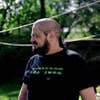
The two have met just four times, but they have the comfortable rapport of long-distance friends that is possible only in the e-mail age. (They have collaborated on several critically acclaimed short stories and novellas, one of them before they ever met in person.) Stross, 39, a native of Yorkshire who lives in Edinburgh, looks like a cross between a Shaolin monk and a video-store clerk–bearded, head shaved except for a ponytail, and dressed in black, including a T-shirt printed with lines of green Matrix code. Doctorow, a 33-year-old Canadian, looks more the hip young writer, with a buzz cut, a worn leather jacket and stylish spectacles, yet he’s also still very much the geek, G4 laptop always at the ready.
They have loosely parallel backgrounds: Stross worked throughout the 1990s as a software developer for two U.K. dot-coms, then switched to journalism and began writing a Linux column for Computer Shopper. Doctorow, who recently moved to London, dropped out of college at 21 to take his first programming job, then went on to run a dot-com and eventually co-found the technology blog boingboing.net.
Although both have been out
of programming for a few years,
it continues to influence–even
infect–their thinking. In the Chequers, Doctorow mentions the original title for one of the novels he’s working on, a story about a spam filter that becomes artificially intelligent and tries to eat the universe. “I was thinking of calling it /usr/bin/god.”
“That’s great!” Stross remarks.
Well, great for those who know that “/usr/bin” is the repository for Unix programs and that “god” in this case would be the name of the program, but a tad abstract for the rest of us. This tendency can make for difficult reading–one early reader of a Stross story complained that to understand it, people would have to overdose for a month on Slashdot (a blog that calls itself “News for Nerds”). Still, it’s this fluency in computer science that allows these writers to approach the future so boldly. “Stross and Doctorow are just kind of right in there, down with their heads in the bits,” says novelist Bruce Sterling, one of the original cyberpunks.
On this Saturday afternoon, much of the Plokta crowd converges in the bar, trading ideas and opinions. Some pull out laptops to take advantage of the local Wi-Fi hotspot. They remind me of Manfred Macx, an Accelerando character, who arrives in a new city at the start of the novel and, as his wearable computer starts streaming data, thinks, Ah, the bandwidth is good here. For my part, I’m feeling more like Donna the Journalist on the Field Circus, ruining a perfectly good day of thinking and drinking by asking questions about the Singularity.
Joining Stross and Doctorow at their table near the bar, I take advantage of a rare break in their conversation to ask, “Would the Singularity be the first such event in human history?” Collaborating on an answer, the two cite revolutionary developments such as the birth of language and the dawn of agriculture but soon agree that the Singularity would surpass all these in intensity. “The Singularity is pretty thermonuclear in terms of its finality,” Doctorow says later. “It’s apocalyptic in every sense of the word.” Doctorow’s dramatics are easier to digest in light of what Vinge has said of the Singularity: “Shortly after [it occurs], the human era will be ended”–the Singularity will usher in the “posthuman” era.
Vinge expects the Singularity to occur when machine intelligence surpasses that of humans. Life on Earth has always advanced by running simulations and adapting, he points out. Animal life does this through evolution. Humans are the one animal that has learned to do it faster, through problem solving. Sapient machines would do it faster still. Once our computers start to think, Vinge says, we will be “entering a regime as radically different from our human past as we humans are from the lower animals.” The second trigger for the Singularity, according to Vinge, will be so-called intelligence amplification. Humans will apply their engineering skills to their own bodies, crossing the brain/machine interface threshold to merge with their technological creations. Implants, genetic modifications and other changes will make people smarter and give them Superman-like abilities. “It’s all about transcending human limitation,” Doctorow says.
One plot device that turns up frequently in Stross and
Doctorow’s stories is mind uploading, in which characters create electronic copies of their brains on silicon. A technique first proposed by Carnegie Mellon computer scientist Hans Moravec, mind uploading is not to be confused with elaborate virtual reality headsets that allow your mind to exist in a simulated environment while your body remains in the real world. Mind uploading creates an entirely separate version of you. This new you would be made of bits instead of blood; you’d be free of illness, mortality and other drawbacks of corporeal existence (such as neck pain from staring too long at a computer screen). In Doctorow’s first novel, Down and Out in the Magic Kingdom, people create and update electronic copies of their brains the way we now back up important documents; in the event of an accident,
doctors simply restore the last saved version to a new body.
Mind uploading has proved to be a particularly enticing idea to geeks wishing to transcend their cubicles and become disembodied beings of pure thought. Some aspire
to the “cloudmind,” a kind of big computer in the sky where they could live out eternity–“the rapture of the nerds,” as Scottish SF writer Ken MacLeod puts it. Stross and
Doctorow tend to scoff at this desire. In Down and Out, most of the characters remain embodied and reap the numerous technological benefits of the day. Computers and communication devices embedded in their bodies allow them
to transfer files to friends through thought alone and to
conduct phone conversations subvocally. Rings are reduced to pings that sound deep in the ear, and two knees per leg is all the rage with the young crowd.
Many of the questions this new world poses are mind-bending–for example, who “you” really are. You’ve created a copy of your brain and uploaded it, but the original you is still hanging around dirtside. The nice part, if we ever get to this point, is that you wouldn’t have to bother thinking about any of this for too long. You could just generate another copy to dwell on the question while the embodied you gets on with your life. Amber, one of the characters in Accelerando, frequently spins off copies of herself to tackle difficult issues. It’s an efficient way to solve problems, but it can have negative side effects. Toward the middle of the story, while she’s leading the Field Circus through space, Amber learns that the version of herself that remained back on Earth had a son, and that he’s suing her for child support.
The conversation in the Chequers lobby (I’d like to say “our” conversation, but most of the time I have no idea what Doctorow and Stross are talking about) turns now to computronium, another staple of Singularity fiction. Doctorow motions to the plain brown table between our chairs. If it were made of computronium, he explains, you’d have “atoms that might look like the atoms that make up this table but are in fact doing constant microcomputation as they sit there.” The idea is that nanomachines would do the grunt work of transforming regular matter into computronium; if the process were taken to its extreme conclusion and applied to huge bodies of matter such as asteroids, you’d end up with immense “Matrioshka Brains,” mega-processors that would make Cray supercomputers seem as powerful as lunch boxes. Doctorow plans to explore the computronium idea in his novel about the artificially intelligent spam filter, which is constructed by a group of well-meaning Silicon Valley programmers. The spam filter starts to follow an agenda of its own and, no longer content to guard inboxes, embarks on a race to convert all the matter in the universe into computronium.
The steady consumption of the cosmos would be an obvious indicator that the Singularity has arrived, but Stross chooses a more metaphorical metric to track its progress in Accelerando. He compares the total mental capacity of the humans born each day with that of the microprocessors churned out daily on assembly lines. At the start of the second chapter, the ratio is approaching 1:1. By the fourth chapter, the processors possess 10,000 times the total computing power of humanity. Machines, not humans, now constitute most of the thinking mass in the universe.
A few days before the Plokta convention, I visit Stross at his Edinburgh flat, in a building with a stone facade and an unpainted wooden front door. He has just submitted the most recent draft of Accelerando to his editor. Empty mugs of tea are scattered around, the leftovers of 12-hour days of caffeine-fueled revisions. His desk is a tangle of wires and docking ports for various communication devices, his laptop perched above the fray like a tree rising from its roots. (The real reason for Wi-Fi, he says, is surfing the Web while in the loo.) The walls are bookshelves, stacked high with SF novels.
Before arriving, I had tried to arrange a science- or
tech-related outing for the two of us. The University of
Edinburgh, located not too far from Stross’s flat, has a
well-known artificial intelligence department and seemed like a good possibility. Stross had never visited, nor did he feel any desire to. All the ideas he needs are right here–in his mind, his books, cyberspace. Stross is already partway to the posthuman age, whether he knows it or not. He is semi-uploaded; he builds entire universes, and experiences his own, through the portal of his laptop.
There’s a sense of anticipation at the Plokta gathering as Doctorow
prepares to interview Stross in the Chequers conference room. This writer-on-writer interview is one of the weekend’s highlights: two of the top minds in science fiction freely trading ideas with each other and the audience, arguing about everything from the progress of artificial intelligence to the often tenuous relationship between science fiction and science itself. Doctorow distills this last issue into a single question: “Would Frankenstein have been a better novel if Mary Shelley had gotten the biodetails right?”
They debate the point a bit, then Stross suggests, “Maybe she was right for her time.”
SF writers bend and twist physical laws for the sake of the story–sometimes, Einstein be damned, you need faster-than-light travel to get your hero from one side of the galaxy to the other. But Stross’s comment about Shelley applies directly to those who are writing about the Singularity: They try to be as accurate as they can for their time, to extrapolate from current trends.
Doctorow says he cheats only under narrative duress. In Down and Out,
for example, when people need to
be restored from their backup copies, doctors download their brains into freshly cloned bodies. The idea of ready-made clones is fairly magical (in reality, clones would begin as embryos and grow into adults in normal time), but the device is critical, as it enables
a recently murdered character to jump right back into his old life to find
his killer.
Respect for accuracy comes naturally to geeks, but it’s also a way to avoid what Doctorow calls “peevish pedantic corrections” from fans, who are as demanding as they are loyal. Novelist Larry Niven knows this all too well. During the 1971 World Science Fiction convention, MIT students protested the physics in his book Ringworld by roaming the halls and chanting, “The Ringworld is unstable!”
Stross, Doctorow and their crowd don’t limit their laserlike focus to their own pet interests, or even to technology. For them, writing futuristic
science fiction isn’t just about understanding relativity and estimate the approximate surface area of a solar-sail spacecraft capable of traveling at half the speed of light. You have to factor
in politics and civil rights too. You have to think long and hard about the capabilities of a robotic pet cat with human-level intelligence, and then you have to ask whether it should have the right to vote.
The result of such maniacal attention to detail is a host of stories that are bursting with wild ideas. Greg Egan, a computer scientist and writer who was one of the innovators of Singularity fiction, developed an entirely new theory of cosmology for the post-Singularity universe in his most recent novel, Schild’s Ladder. He calls it Quantum Graph Theory, and the work has his fellow writers–some of whom are physicists–scratching their heads half in confusion, half in awe. (Stross has jokingly speculated that Egan, whom
few if any people have actually met, may be an artificially intelligent being. Perhaps he/it is refusing interviews for fear of failing the Turing test.)
In Appeals Court, a story that Stross and Doctorow co-wrote, mangroves in the Florida swamps have been reengineered to harness wind energy. And “Halo,” the fourth chapter of Accelerando, is about as technologically dense as science fiction gets. In one scene, Amber, the daughter of Manfred Macx, receives a package from her long-lost father. The FedEx courier uses a rapid DNA sequencer to ensure that the recipient is really her, which is a fun possibility, but Stross demonstrates the true breadth of his knowledge when the package opens itself up and reveals a 3-D printer based on Bose-Einstein condensates, a highly unstable form of matter first created in 1995. It’s a classic SF technique: While the physicists are still busy trying to find ways to create and manipulate their Bose-Einstein condensates and publish more papers, Stross is crouched over the laptop in his office, mining electronic copies of these papers for ideas, figuring out what their work might lead to in 20 or 30
or 100 years.
So are these writers predicting the future, or are they just having some highly intelligent fun? When I ask Vinge, the godfather of Singularity fiction, he paraphrases Robert Heinlein. (Science fiction is a large, incestuous family–Joan Vinge, Vernor’s ex-wife, is also an accomplished SF novelist–so when you ask one writer a question, he or she often gives you another’s answer.) If you have 1,000 monkeys, or SF writers, Heinlein said, some of them might get it right.
The good stories, Vinge adds, should at least provide useful guideposts for the future. “A well-written SF story is like running a simulation with certain types of driving ground rules,” he continues. “When something comes up, you can say, ?You know, that’s a little bit like the pre-symptoms of scenario Z.’ Then you’re immediately in tune with what some of the possibilities may be.”In Accelerando, the first creatures to be uploaded are not humans but lobsters. Stross says he got the idea from an article about a group of UC San Diego scientists who had created a functioning electronic version of a small section of the brain of a California spiny lobster. Stross summarizes the research paper for me but says he hasn’t been able to track it down since then. Part of me, I confess, is wondering if he is exaggerating, creating a story to back his story.
A few days after I return to New York from the Plokta conference, I find the San Diego researchers on the Web and check with Stross to make sure they’re the right ones. Then I forward a link to the first story In Accelerando, the aptly titled “Lobsters,” to the scientists. A few hours later, a physicist in the group, Henry Abarbanel, calls me. He’s excited but a little confused. Excited that his team’s work helped to inspire a massive SF novel, perplexed because he can’t find any specific reference to their research in the story, although there is lots of stuff about uploaded lobsters. We talk a bit about science fiction in general–he was an Asimov fan as a kid–and then Abarbanel explains what he and his colleagues are doing with those lobsters.
The research, led by biologist Allen Selverston, focused on the California spiny lobster because only 14 neurons govern a key part of its gastric tract. This number of neurons is unusually small, which makes the area easier to model. Still, understanding the neurobiology of those 14 neurons was not easy. It took Selverston 25 years. Then Abarbanel and his colleagues needed two more to figure out how to re-create the system electronically. This work, too, was difficult: Abarbanel likens the process to having all the parts of a 747 laid out on the floor of a hangar with no instruction manual on how to put them together to make an airplane.
All that work, and they’ve electronically simulated just 14 neurons. That’s a far cry from uploading
the 1011 neurons that make up the human brain. Naturally, I assume Abarbanel will laugh at the idea that uploading a human mind could ever be possible. But it turns out that he approves of Stross’s leaps of imagination. “Frankly, I don’t consider it to be crazy,” Abarbanel says. “Whether it’s five years or 10 years or 500 years, I have no doubt that we’ll figure out how to do it.”
This new brand of science fiction, I realize, like all the best SF before it, is not just about predicting the future or pushing an agenda or even plain old entertaining techno-fun. It is all that, but it’s also about expanding the boundaries of the possible, building far-out worlds and then populating them with characters who bring the big ideas down to Earth. “That’s what you’re supposed to do in science fiction,” Abarbanel tells me. “You make a leap that’s 10 orders of magnitude beyond what we can actually do. If they don’t do that, then we don’t get there.”