Tiny Motor, Giant Leap
Researchers in Germany have turned a single molecule into a sort of motor.
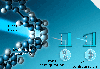
Illustration by Mika Grondahl
The azobenzene molecule has two configurations (above): the trans-configuration and the shorter cis-configuration. It changes from one to the other when hit by light of different wavelengths. Scientists have used it to build a molecular motor.
In the race to build ever-smaller devices, a new entry appears to have burst into the lead. Researchers in Germany have turned a single molecule into a sort of motor.
Azobenzene, a polymer molecule, has a unique characteristic: It changes from one shape to another when exposed to light of different wavelengths. Scientists led by Hermann Gaub, a professor of physics at the University of Munich, have used this quality to build a tiny gadget. They attached the molecule to a glass plate on one end and to a miniscule silicon spring on the other (see graphic). Then they exposed the azobenzene to alternate wavelengths of light. As the molecule bent and straightened, it pulled on the spring and then released it, rather like a firing piston.
Gaub hopes that these results will eventually lead to the development of molecular pumps, valves, and motors. But he cautions that “we don’t really have a technology yet.” It will take several years of research before scientists master the basic principles of construction and many years more before the machines go into use. For now, Gaub is focusing on making the motor durable. The light that fueled it wore it down in less than a day.
-Harald Franzen