Nicotine Surprise
It's not that bad.
med1001nico_A.gif
James Jang was down in the dumps. As a student at Stanford Medical School, he had been studying nicotine’s effects on veins for a while, but he wasn’t getting anywhere.
“He came to me and said his project was a failure,” says associate professor John Cooke. “I asked, ‘Is the equipment working?'”
“Yes,” Jang said. “But the data is a little screwy.”
Actually, the data wasn’t screwy at all — just completely unexpected. Cooke and Jang had assumed that since smokers suffer from narrowed veins and poor circulation, nicotine was the culprit.
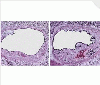
However, Jang’s study revealed nicotine actually stimulates division of cells. And when Cooke’s associates tested nicotine in lab mice with artery disease and lung cancer, they discovered it promoted growth of new blood vessels in the mice.
Cooke says this discovery suggests that nicotine could be used to heal wounds or treat other disorders in which blood flow is impeded, such as diabetes (he’s already found that the chemical helps wounds heal faster in animals). It’s also being tested to help people with neurological disorders like Parkinson’s disease and Tourette’s syndrome.
But if it’s not nicotine that causes poor circulation in smokers — giving them dull skin and a drawn look — what is it? Hard to say: Tobacco contains more than 4,000 chemicals.