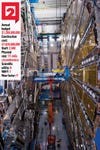
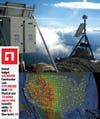
To improve our view of a vast and complex universe, scientists are creating increasingly ambitious new tools. The work is not easy. Truly big science requires decades of expensive commitment from multiple nations. But the instruments that result are nearly as awe-inspiring as the new worlds they help us discover. Check out our ranking of the 10 most epic.
How We Did It
Like anything that’s large and involved, big science is not easy to measure. For our rankings, we took into account four objective factors: the construction costs above all, but also the operating budget, the size of the staff and the physical size of the project itself. Even these were hard to compare on an apples-to-apples basis, though, so we also used a tiering system. Then we added in three subjective factors, weighing them more heavily to reflect their relative importance: the project’s scientific utility, its utility to the average person (“what will it do for me”) and the always essential “wow” factor. For a complete explanation of our scoring, click here.
Enough talk. Click here to jump into our gallery of the ten craziest, most ambitious, and most amazing big science projects around.
10: The Relativistic Heavy Ion Collider
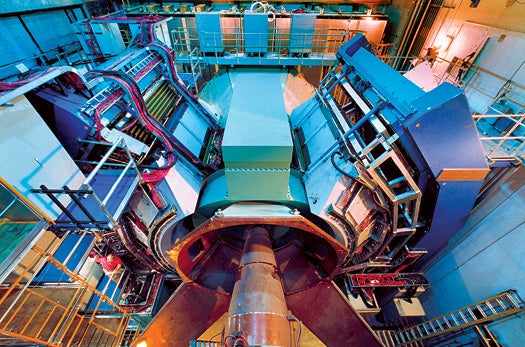
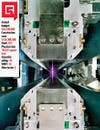
A time machine to reveal the origins of the universe When gold ions speeding inside the Relativistic Heavy Ion Collider on Long Island, New York, smash into each other, these collisions can produce temperatures of up to 7.2 trillion degrees Fahrenheit, so hot that protons and neutrons melt. As those particles disintegrate, the quarks and gluons of which they are comprised freely interact to form a new state of matter, called a quark-gluon plasma. As the material cools after the collision is over, protons and neutrons re-form, producing 4,000 subatomic particles in the process. Using the RHIC, scientists are trying to re-create the conditions that existed during the first millionth of a second after the big bang. Scientific Utility To better understand how matter has evolved in our universe, physicists at the RHIC send gold atoms through several accelerators, stripping away their electrons so they become positively charged ions. Those ions launch into two circular tubes and race at up to 99.9 percent of the speed of light before they collide. In examining the remnants of these collisions, the scientists have found that particles at this post-big-bang stage behave more like a liquid instead of the predicted gas. What’s In It For You RHIC scientists are currently developing devices that accelerate protons and more precisely guide them to irradiate and kill cancerous tumors in humans. Engineers have also used the heavy ion beam to punch tiny holes in plastic sheets, making filters that can sort substances at the molecular level. Down the line, we might see more-efficient energy-storage devices based on the superconducting magnet technology used in the RHIC.
9: Neptune, The World’s Largest Undersea Observatory
Oceans cover nearly three quarters of the Earth’s surface and contain 90 percent of its life, yet they are almost entirely unexplored. Neptune, an ocean-observatory network that consists of some 530 miles of cable and 130 instruments with 400 sensors, all of it connected to the Internet, will provide the first large-scale, around-the-clock monitoring of an ocean system, including animal life, geology and chemistry. Scientific Utility Neptune’s battery of instruments, which lie as far as 220 miles off the coast of British Columbia on the Juan de Fuca tectonic plate, offer a real-time view of the area. A tethered float, outfitted with radiometers, fluorometers and conductivity sensors, ferries up and down the 1,300-foot water column from the seabed to the surface, sampling the column’s chemical and physical conditions to determine how it changes over time. A remotely operated vehicle called ROPOS installs instruments and gathers data. Its high-definition camera provides still photographs and video of animals and their behaviors, which scientists could use to gauge changes in the local ecosystem. Hydrophones positioned on the seafloor record dolphins and whales to track their numbers and migration routes. And a remotely operated crawler named Wally drives over the seabed to monitor underwater methane deposits, which could exacerbate global climate change and also be a potential source of energy. What’s In It For You Armchair (and professional) scientists worldwide can tune in over the Internet to see streaming video of Wally the crawler rolling over the seafloor, watch deep-sea tubeworms waving in the currents of a hydrothermal vent, or listen to a humpback-whale song.
8: The Very Large Array
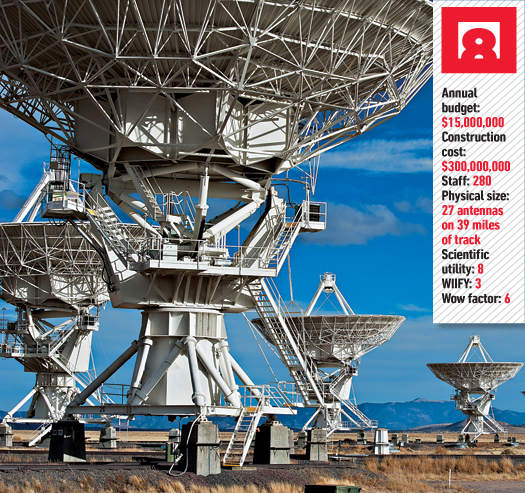
Radio telescopes listening to the cosmos Positioned on hundreds of square miles of desert outside Magdalena, New Mexico, the Very Large Array (VLA) is one of the largest telescopes in the world. Its 27 individual radio antennas, each of which is 82 feet in diameter, form a Y with arms 13 miles long and gather signals from some of the brightest objects in the universe. Its sister project, the Very Long Baseline Array (VLBA), is a line of 10 radio antennas that extends 5,531 miles from Hawaii to the Virgin Islands. The VLA and VLBA create detailed images of celestial objects as close as the moon and as far away as the edge of the observable universe. Scientific Utility Because radio waves can penetrate the cosmic dust that obscures many objects, the VLA and VLBA can see things that optical telescopes can’t. Using the VLA, scientists have studied the black hole at the center of the Milky Way, searched for the origins of gamma-ray bursts in faraway nebulae and, in 1989, received radio transmissions from the Voyager 2 satellite as it passed Neptune, giving us the first up-close photos of the gas giant and its moons. The VLBA measures shifts in the Earth’s orientation in the universe. By focusing on distant, virtually fixed objectsasuch as quasarsaover time, scientists can detect any apparent changes in Earth’s orientation in space. This orientation can be thrown slightly out of place during major earthquakes, like the one that struck Japan earlier this year. What’s In It For You Pick a chapter in a modern astronomy textbook, and you will find some material or theory based on data collected by the VLA and VLBA. The VLBA also gathers data on the paths of near-Earth asteroids, which could help scientists predict if one is on a collision course with our planet.
7: The National Ignition Facility
A giant laser fusion experiment Considered the world’s largest and most energetic laser, the National Ignition Facility, located in Livermore, California, stretches the length of three football fields, stands 10 stories tall, and generates two million joules of ultraviolet energy. That blast can cause the laser’s target to reach temperatures of more than 100 million degrees and pressures of more than 100 billion times the Earth’s atmospherea€”similar to conditions found in the cores of stars and gas-giant planets. Scientific Utility When the 192 individual beams that make up the NIF laser converge on a target that contains atoms of deuterium (hydrogen with one neutron) and tritium (hydrogen with two neutrons), the atoms’ nuclei fuse and create a burst of energy. NIF scientists are trying to refine this process to produce, for the first time, a net energy gain from fusion reactions. They are also using their research to study what happens to nuclear weapons over time, a crucial question when judging the safety and reliability of the U.S. stockpile. Finally, because conditions in the laser’s target mimic those in the cores of massive stars, scientists hope to understand how fusion produced some of the heavy atomic elements, such as gold and uranium. What’s In It For You If you happen to be storing nuclear weapons in your home, NIF data could help you determine whether your stockpile is reliable. Otherwise, some NIF proponents say that it could provide fusion poweraalthough a fusion power plant probably won’t be based on giant lasers.
6: Juno, a Jupiter Orbiter on a Suicide Mission
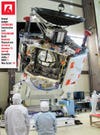
Just before Juno enters Jupiter’s orbit in 2016, the spacecraft, pulled by the gas giant’s tremendous gravity, will reach speeds of 134,000 miles an hour, making it one of the fastest human-made objects ever built. Once in orbit, the craft will make 33 passes around the planet and then dive directly into it. On its suicide run, it will plow through Jupiter’s hydrogen atmosphere until it burns up like a meteor. Scientific Utility While Juno circles Jupiter, a suite of nine instruments will study the planet’s many layers. Jupiter was the first planet in the solar system to form, and because it is so large, its gravity has retained original material found in the early solar system, primarily hydrogen and helium. This characteristic makes the planet a valuable window into the solar system’s origins. Measurements of Jupiter’s magnetic field could finally resolve the debate over whether the planet has a rocky core. Juno’s magnetometers will characterize the depth and motions of the metallic hydrogen ocean found in the interior, which generates the strongest magnetic field in our solar system aside from that found around the sun. Finally, a microwave radiometer will measure the amount of water in Jupiter’s deep atmosphere, a key to understanding how the planet was originally formed. What’s In It For You Study of Jupiter’s complex weather patterns could help us predict our own, but for the most part this is pure scientific research.
5: Advanced Light Source
The ultimate microscope Since 1993, researchers at the Advanced Light Source, a particle accelerator in Berkeley, California, have been sending a photon beam a million times as bright as the sun’s surface into proteins, battery electrodes, superconductors and other materials to reveal their atomic, molecular and electronic properties. Scientific Utility The ALS is one of the brightest sources of soft x-rays, which have the right wavelengths for spectromicroscopy, a scientific technique that reveals both the structural and chemical makeup of samples only a few nanometers wide. In 2006, scientists at the ALS helped determine that dust captured from the tail of a comet formed near the sun very early in the solar system’s history, showing that the cosmic ingredients that originated in our corner of the universe started mixing earlier than we thought. That same year, Roger D. Kornberg of Stanford University won the Nobel Prize in Chemistry for work at the ALS on the 3-D structure of RNA polymerase enzymes. The structural data allowed him to describe how DNA is translated into RNA during a process called transcription. What’s In It For You Work at the ALS on a protein associated with melanoma aided the development of a novel medication to combat the disease. The drug is currently in Phase II and III clinical trials. Other data from ALS could lead to high-capacity lithium battery electrodes, which would increase the battery’s charge capacity. Finally, understanding the physical and electronic structure of flat sheets of carbon, called graphene, could spur the development of atomic-scale transistors and much faster computer processors.
4: The International Space Station
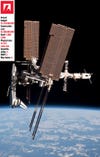
An orbital laboratory It takes $2 billion a year and thousands of employees to keep the lights on at the International Space Station. So far, 201 people from 11 countries (and seven well-heeled tourists) have visited the ISS, which has supported the longest continuous human presence in orbit: 11 years this November, with about a decade more to come. The ISS also plays host to the Alpha Magnetic Spectrometer (AMS), the largest, heaviest instrument ever to be flown in space. Scientific Utility On the ISS, scientists and astronauts from NASA and its international partners test spacecraft components and support systems that could be used for long-distance human spaceflight. They also examine human physiology, studying the effects of weightlessness on bone density and red-blood-cell production and how the immune system changes during long periods in space. As of May, researchers have had access to the AMS, an instrument capable of detecting strangelets, quarks that have been made in particle accelerators but have never been observed in nature. What’s In It For You Research performed on the ISS led to the discovery that salmonella bacteria become more virulent in space. That discovery, and the identification of the genes that cause the change, are fueling the development of the first vaccines to combat salmonella and methicillin-resistant Staphylococcus aureus (MRSA) bacteria, the staph infection that has plagued thousands of hospital patients.
3: Spallation Neutron Source
A movie camera for molecules Every month, the Spallation Neutron Source in Oak Ridge, Tennessee, draws between 25 and 28 megawatts of power from the electrical grid and uses about 8.5 million gallons of water to stay cool. During operation, the particle accelerator in the SNS sends bursts of two quadrillion neutrons per pulse down into a target chamber. These dense clouds of neutrons deflect off materials to reveal how atomic structures change over time. Scientific Utility The SNS sends neutrons hurtling toward a sample at up to 97 percent of the speed of light. But unlike particles in a collider, neutrons do not create large explosions when they hit their sample. Because they are small and have very little energy, neutrons interact only weakly with matter. As the neutrons pass through a sample, they scatter off the atomic nuclei in the sample. That interaction changes the energy and direction of those neutrons, and 14 different instruments, positioned a few feet from the sample, record those changes in trajectory. Software then adds up all the scattering data to produce the atomic structure of the sample. Because the SNS sends packets of neutrons at a rate of 60 pulses per second, it can record how structures change over time, like shooting individual frames of a movie and then stitching those together into motion. What’s In It For You Better batteries. Scientists are using these atomic-scale movies to monitor batteries as they charge and discharge in real time. It will also be used to study protein structure.
2: The Large Hadron Collider
A proton accelerator to find the elusive god particle Buried 330 feet beneath the border of Switzerland and France, the Large Hadron Collider is the world’s largest particle collider. The facility requires 700 gigawatt-hours of energy and some $1 billion annually to run. More than 10,000 researchers, engineers and students from 60 countries on six continents contribute to the LHC’s six standing projects, which are designed to unlock the fundamental physics of the universe. Scientific Utility What exactly is dark matter? Are there extra dimensions in space? Does the Higgs boson, commonly referred to as the aGod particle,a exist? How did the universe form? The LHC’s six particle detectors record and visualize the paths, energies and identities of subatomic particles, which may answer some of these questions. The ATLAS project’s detector, for example, is searching for collision events in which there appears to be an imbalance of momentumaan indication of the presence of the supersymmetric particles thought to make up dark matter. The Compact Muon Solenoid project complements ATLAS by searching for supersymmetry and the elusive Higgs boson. LHC-Forward will simulate high-energy cosmic rays, and LHC-Beauty will provide information on why the universe is made up of matter rather than antimatter. TOTEM tracks proton collisions and provides data on the proton’s inner structure. And ALICE will track quark-gluon plasmas, similar to experiments conducted at the Relativistic Heavy Ion Collider (also on this list). What’s In It For You Though the LHC has brought black-hole alarmists out of the woodwork, the project will have little effect on our day-to-day lives, unless your family and friends are the type to discuss the origins of the universe over dinner.
1: The Earthscope
A telescope to peer deep into the heart of our planet Designed to track North America’s geological evolution, EarthScope is the largest science project on the planet. This earth-sciences observatory records data over 3.8 million square miles. Since 2003, its more than 4,000 instruments have amassed 67 terabytes of dataa€”that’s equivalent to more than a quarter of the data in the Library of Congressa€”and add another terabyte every six to eight weeks Scientific Utility Researchers are using EarthScope, which consists of many kinds of experiments, to examine all facets of North America’s geological composition. Across the continental U.S. and Puerto Rico, 1,100 permanent GPS units track deformations in the land’s surface caused by tectonic shifts below. Seismic sensors next to the active San Andreas Fault in California record its tiniest slips, while rock samples pulled from a drill site that extends two miles into the fault reveal the grinding and strain on the rocks that occur when the two sides of the fault slide past each other during an earthquake. And over the course of 10 years, small crews have hauled a moveable array of 400 seismographs across the country using backhoes and sweat. By the time the stations reach the East Coast next year, they will have collected data from almost 2,000 locations. What’s In It For You Collectively, EarthScope’s measurements could help explain the forces behind geological events such as earthquakes and volcanic eruptions, leading to better detection. So far, data from the project has shown that rocks in the San Andreas Fault are weaker than those outside it and that the plume of magma under Yellowstone’s supervolcano is even bigger than previously suspected.