How do we decide how rare an animal is? How do we figure out how long before it goes extinct? And how do we stop that from happening?
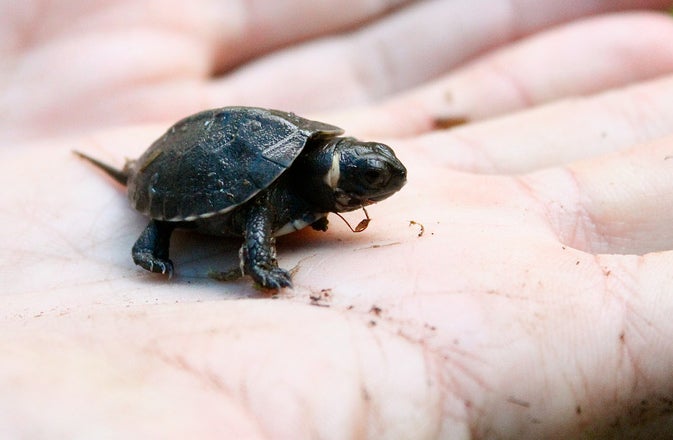
Bog Turtle
Bog Turtle Wikimedia Commons

There's a conservation-biology rule of thumb that, for a species to survive for another century, it must have a stable population of about 5,000. Want to settle Mars? Bring 4,999 other unrelated humans with you and populate it.

And yet a recent study finds that the bog turtle--the rarest turtle in the continental US--could survive with only 40 members, including 15 breeding females. The study's authors want this to change how legislators protect flora and fauna. But will it be for the best?

The bog turtle is North America's smallest and rarest native turtle. It's primarily found in New York, New Jersey, and Pennsylvania, though there are isolated populations in North Carolina, and estimates of its population range from about 2,000 to 10,000, a loss in population of 80 percent in the past 30 years. George Amato, a conservation biologist at the American Museum of Natural History, told me that the turtle lives in a very specific and disappearing habitat called a fen. Fens are a particular kind of wetland, sort of but not quite like a marsh or a bog (yes, these are all different, ecologically speaking). The predominant theory about these turtles is that they used to be very widespread during the later part of the Late Glacial Maximum, about 10,000 years ago, when the ice sheets that covered North America began to melt. As they melted, they turned the land incredibly soggy, forming lots and lots of wetlands, including fens--a happy time for the bog turtle, which spends most of its time submerged in fen mud. But as the continent dried out and temperatures continued to rise, there were fewer and fewer fens, so now the bog turtle is patchily distributed in increasingly rare and specific environments. "As the temperature changed, that environment has become kind of a relic," says Amato. "They probably weren't isolated before, but they are now."

It's also a victim of the pet trade--Amato says that when the species was written about, biologists "wouldn't actually put the exact location of studied populations" in their articles, to keep collectors in the dark about where to find them. And, of course, there's encroaching human development and invasive species of plants which choke out its food sources.

It's estimated that there are about 570 populations of bog turtle in the world. The turtle is hardy and long-lived, but it doesn't travel, which makes it hard for populations to interact, and it's estimated that half of those populations aren't exactly "populations" in the way you might imagine--they consist of, well, one turtle. Only 15 of those populations consist of at least 50 turtles.

There's a significant effort on the part of legislators, conservationists, and zoos to boost the turtle's population. But this study, published in this month's issue of Conservation Biology, finds that as few as 15 breeding females (and about 25 males) could be enough to sustain the bog turtle's population for another 100 years. The bog turtle lives for decades--up to 50 years--and gives birth to one offspring per year with a nearly 33 percent chance of survival, which is quite high. That's a major shakeup to the idea that a given population needs thousands to survive.
Bog Turtle In Grass
Bog Turtle In Grass:  Wikimedia Commons

When biologists want to get more precise than the 5,000-individuals rule, they can calculate a number called the Minimum Viable Population, or MVP, the result of computer simulations to figure out the lowest possible number of members of a species that would result in a 90-95 percent probability of survival after 100 years. The game is to balance the number of lost specimens (due to death or leaving the group) with the number of new specimens (being born or coming in from another group).

Those simulations take into account how long the species generally lives, how often it breeds, the size of the litter, and the probability of young surviving into breeding age. Then it adds in external sources of stress, which could include inbreeding, natural disasters, climate change, encroaching human development, poaching, or any other event that could have an impact on a population. You come up with a few hundred or thousand possibilities--what if the temperature rises 2 degrees, what if poachers snag one female from a population per year for the pet trade, what if it loses 7 percent of its habitat due to construction of some awful beige McMansion--and see how often the species will survive to see the year 2113. Weight them and average them and you've got your number. But these simulations are basically possible futures for the species, like a sci-fi writer discussing the near future. They're well-researched guesses, but they're guesses, and they're extremely important for deciding what kind of protection to give each species. According to George Amato, "there's been a lot of discussion [about MVPs]; it's a little controversial."

The bog turtle is highly protected, and any statement about its long-term survival will necessarily have an impact on how it's protected. Kevin Shoemaker, the author of the paper, told me that "the point I'd like to make is that in a larger context, these very small units are very, very important for conservation. We don't want to discount very small populations just because they're so small." Populations in the double-digits are sometimes seen as lost causes--but this study also indicates that maybe that's not the case. It takes issue with the problem that conservation resources are often shifted away from populations with numbers as small as the bog turtle's, when in fact, as Amato says, "protection of small and fragmented populations may constitute a viable conservation option for such species."

I spoke to Dr. Alison Whitlock of the U.S. Fish and Wildlife Service to see about the legislative effects of the study. Under the Endangered Species Act, each threatened species is given a recovery coordinator--a kind of czar who's in charge of that species' well-being. Dr. Whitlock is that person for the bog turtle, and she was thrilled about this study. "This actually gives me more hope," she said, as soon as I asked her about the paper. "For those of us who've been working with bog turtles for years, we've had a gut feeling that they're holding on in these small populations, but they're still there and still worth saving."

The bog turtle is protected federally. If you're a developer in Pennsylvania or New York or wherever else, you have to take your prospective project to your individual state agency so they can check with Dr. Whitlock (or another expert) and make sure the project won't violate the federal protection. Each state can make their laws stricter than the federal law, but the federal law is the minimum. I was concerned that this study would have the reverse of its intended effect--that legislators would see that the MVP is only 40, and think, well, why are we wasting money on protecting this turtle when there are a couple thousand of them? "If people think that you can have stable populations of 40 organisms, I'd be really concerned if managers were thinking 'oh, then we shouldn't worry so much,'" says Amato. Shoemaker echoed the concern; "I definitely don't want to make it sound like a population of 40 individuals is all you need," he said.

Young (But Not Baby) Bog Turtle
Young (But Not Baby) Bog Turtle:  Wikimedia Commons

But Dr. Whitlock thought that an unlikely scenario for the bog turtle. It's not up to local legislators; it's up to her, and people like her. It's a perfect argument for why top-down, federal mandates are so important. This is a very wonky situation, requiring quite a bit of knowledge of conservation biology and this species in particular, and local governments can't possibly be expected to have bog turtle experts on staff. Hell, I spoke to just about every bog turtle expert in the country while trying to figure out what's going on here, and discovered that there are like...four of them. And they're in charge, just the way they should be, even if they may not have as many resources as they'd like.

In fact, Dr. Whitlock believes that this study is going to have only positive effects on conservation efforts for the bog turtle. The federally mandated minimum conservation is not always ideal; Dr. Whitlock works for the government, and was not entirely willing to criticize her employer, but made it clear that the federal laws are only the bare minimum. With this extra data, she and other conservationists can go to the state agencies and make a stronger case than ever before. "Sometimes it's hard to go to the next step and argue for land preservation or resource protection," she said. "This gives us a little extra backing to not just protect but also restore."

16 Comments

While I feel we do need to put some effort in to protect certain species, we really need to let the vast majority go extinct. This turtle is a perfect example.

It can only live in a very specific environment which relied on a very specific and temporary situation, these environments are now long separated from each other, and the turtle rarely if ever crosses between them. This is a perfect storm for natural extinction. Too many people forget that the norm is for a species to go extinct, not survive. This is also good for life as a whole. It is the entire basis of natural selection, and we would not be here if some alien species had decided to preserve the species on the planet sometime in the past.

Again, there are some species that are worth trying to save, but only if the species itself is potentially stable if you remove humans from the equation. This turtle will go extinct either before the next ice-age, or during it. With such small populations, it will also have significant in-breeding problems in not too long.

Pandas are another example of a doomed species. When a species has a single food-source, they are in significant trouble. Now, add in that they are notoriously picky about that food and you make things even worse. Finally, to really top things off, they are also famous for being slow breeders.

If we focused our efforts on those capable of long-term survival, such as tigers and lions ( and many other species), then we would have far greater success with less effort.

Save the animals, turtles included! YEA!

zechio beat me to it.
Instead of trying to save everything, why don't we think more in terms of not interfering with their survival? Something like the Prime Directive.
Is anyone taking into account that by "saving" everything we are actually interfering with evolution? Suppose those turtles were about to evolve into a better adapted version until we stepped in an protected the maladjusted ones from dying off?
Now instead of the fittest ones surviving, they are all equally doomed.

Natural selection has created and customized this particular turtle over thousands of years to create a specific genetic code that may contain keys to diseases now and in the future. Species adapt to their surroundings for survival. These adaptations may be unique to this species and could provide insight into technologies in the future. Every species we let go extinct is throwing away tens of thousands, maybe even Millions of years of data that we will never be able to get back. Think of venomous species and their anti-venom. Some of the complex biological processes involved with a particular species may provide a cure for a deadly illness. Are you willing to throw this away to provide space for another McDonalds? Is it not worth the effort to sustain a population so that we may benefit from it in the future. I understand where you are coming from as if humans never existed they very well may have gone extinct. But since we do exist, we may be able to benefit from their survival in ways you can't even imagine.

Rubix, sensationalism doesn't help your argument. This turtle's future existence and McDonald's are unrelated. Man is the new guy on the block. Species were going extinct before man walked the face of the Earth.
Your plan of action is to spread available resources as thin as possible to 'protect' as many species as possible for mans benefit and that is as unnatural as meeting an octopus walking down the street.
Neither yours nor my imagination are the issue at hand. I have a VIVID imagination and it appears that you do as well. A logical, targeted use of resources is required unless you want the resources to run dry before 'saving' anything.

It's man's fault they are going extinct, morons. Therefore it's our duty to reverse it. The idiots above would deny life to an entire species. Their lives should be denied.

Prove it, Jackson, you pompous ass. Nature is running 'her' course. You want to 'deny life' to people who disagree with your opinion, because nature is operating in the same manner 'she' did before man arrived?

Little man, you just made an open threat on my life - not the smartest move you could have made today. And YOU are calling US "morons"? ROFLMAO cubed!

The Bog Turtle seems to be a pretty good mother for a turtle that does not protect its nest like an aligator does.

Would artificially shuffeling the gene pool by moving a randomly selected male from each habitat to another habitat help save the species? Sort of an artificial migration?

Hardly a threat to you. I never expressly threatened you. Sure, vaguely I guess I did. Not smart, yes, but can't quite take me to court for it...lol.

Man is the one who fragmented and destroyed their habitat, so yes it is actually our fault. Stupidity on a science comment section just gets me angry. My apologies.

@Jackson0458: You sir, are an idiot. Maybe next time your open your mouth about something, you could actually research it just a little. Or maybe thats just too much to ask of you. The article clearly says their habitat and populations are disappearing due to the Earth warming after the last ice age. Yes, it also says a few are taken as pets but I'm sure we are not responsible for its dwindling populations. And about that threat you made... Do you want to personally come deny me my life? Would make a great story I can tell my friends about later on.

I appreciate Dan writing pro articles to save animals!
Thanks DAN!

Warming is part of it. But humans have fragmented their population through habitat destruction. No I'm not going to deny you your life, I'll let you go with a warning....lol.

"Intensive development pressure in all portions of the bog turtle’s range has caused the draining and filling of wetland habitat."

Google anything about the bog turtle and you will find humans are the cause of decline.

JacksonsHole...er...um...Jackson0458 proclaims: "Stupidity on a science comment section just gets me angry." and yet it appears that he/she excludes their own words.

"My apologies."

Always to late. Never enough. The idea is to THINK before you speak. Your future posts will indicate your sincerity.

zechcho I agree.I hate people saying that the amount of resources we is unnaturerly.WE ARE NATURE

Aww these little turtles are soooo cute! Should we be the ones to chose who should survive or go extinct? If it was about deciding which species is really worth to live another hundred years on Earth then the first species that would need to go would be us humans because we are the ones who disrupt the natural processes and harmony on Earth. Anyhow, this is not the question. The question is: What is evolution? Why have all these species evolved on Earth? What is the real benefit of biodiversity? And the answer is: Biodiversity means resilience. Every species on the planet has evolved to play a certain key role within the complexity of our ecosystem. The Earth is a living organism and every living part of her including all species are perfectly adapted within this gigantic ecosystem. Darwins statement "survival of the fittest" has been misunderstood by so many. It's not about who is going to get a promotion and is selected for survival and who isn't. It's important that one reads Darwin's message clearly and doesn't misinterpret his insights into nature. In Darwin's view life is about peaceful coexistence, not struggle. Darwinian species are programmed to specialise and contribute to the whole of the existence by staying away from competition with neighbours of other species and by supporting the whole ecosystem through its existence and way of living. The fittest is the one that may adapt best in its niche without having to waste energy for itself nor other species or without destroying, polluting, etc. It's about life in total harmony. Natural selection is harsh only to the deviant aggressor who seeks to poach on the niche of another. The peaceful coexistence between species, is a result from evolution by natural selection. This is an important fact in the workings of the great ecosystem that we and all other species are part of. Every species represents a niche, each single one evolved together with everything it's embedded in as a whole. Each one is perfectly adapted and formed in its own way to avoid competition with the other lifeforms around itself. You can imagine this like we are all part of one gigantic being and one species evolved to look after the other. E.g. the rainforest is the lung giving off oxygen and you breathing the oxygen in. Now we can save the pog turtle before it's too late... this are lessons that mankind has to learn to find our real role within this Earth lifetime, so we can evolve ourselves without destroying our own source and our own species and all life on Earth... "We can't solve problems by using the same kind of thinking we used when we created them." Albert Einstein


July 2013: The Future Of Flight

The incredible innovations, like drone swarms and perpetual flight, bringing aviation into the world of tomorrow. Plus: today's greatest sci-fi writers predict the future, the science behind the summer's biggest blockbusters, a Doctor Who-themed DIY 'bot, the organs you can do without, and much more.


Online Content Director: Suzanne LaBarre | Email
Senior Editor: Paul Adams | Email
Associate Editor: Dan Nosowitz | Email
Assistant Editor: Colin Lecher | Email
Assistant Editor: Rose Pastore | Email

Contributing Writers:

Kelsey D. Atherton | Email
Francie Diep | Email
Shaunacy Ferro | Email

circ-top-header.gif
circ-cover.gif