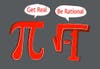
You know we had to.

Actually kinda looks like a centipede
Actually kinda looks like a centipede SnorgTees

1. What do you get when you divide a Holstein's circumference by its diameter?

A: Cow pi!

Variations: What do you get when you divide a jack-o'-lantern's circumference by its diameter? What do you get when you divide green cheese's circumference by its diameter?

2. What do you get when you divide the sun's circumference by its diameter?

A: Pi in the sky.

3. √-1 2^3 Σ π ... And it was delicious.

4. You can't spell happiness... Without pi!

5.

Chattin'
Chattin':  SnorgTees

8 Comments

so... terrible.... 8|

to mars or bust!

That tee looks like a Hex Bug!

Oye, these joke pine me. Pun intended, lol.

My favorite is #3...very cute. =)

My last pay check was $9500 working 12 hours a week online. My sisters friend has been averaging 15k for months now and she works about 20 hours a week. I can't believe how easy it was once I tried it out. This is what I do,..business3.MEL7.Com

I have made a number of discoveries in several fields of mathematics, from a simply defined algebraic sequence whose distribution function is close to a constant multiple of the distribution function of primes over ranges of up to trillions of integers; a matrix representation of topological kno9ts which differs from conventional attempts; and an elementary derivation of most facets of Stirling's formula. I tried submitting material on a number of these items to mathematical and general science journals and received reaction that ranged from the insulting to no response at all. I have tried then just submitting what I discovered in the form of letters to the editor, wondering if various journals would provide it for others to proceed from. But, again, I received no interest. I discovered an interesting fact about primes and the number pi recently and I am providing it here. I looked at the result of taking the sine of prime numbers from 2 on upward, as radians. The resulting curve is rather jagged and apparently uncontrolled, but if you forego the curve and look just at the scattershot points, you'll find they fall on two overlapping sine curve, apparently offset from each other by about pi/4 radians. Wondering if there was a connection to pi itself, how close the average prime number , p(i), comes to a multiple of pi, I looked at the decimal portion of the ration p(i)/pi, where p(i) is the ith prime. That is, I looked at the scattershot graph of points for p(i)/pi – [p(i)/pi]. If these vales are close to1 or 0, they would represent values that are near multiples of pi. Unsurprisingly, values fell in many places in between, but on very nearly straight lines, all angles at about 30 degrees. What is most significant, however, is that there is a region from about .41 to.59 that has only one entry, the first one. For every other prime, there is none where the decimal portion of p(i)/pi falls in that region. Too, when that segment on the graph reaches 1, it immediately begins again at 0. The same is not true for e or sqrt(10), for example. Apparently, it is a distinct and unique connection between primes and pi.

eta beta pi (sorry, can't write greek letters here)

Julian Penrod, I'm surprised u did not notice, i isn't rational
i comments to pi that pi isn't rational, but i isn't rational itself


June 2013: American Energy Independence

Five amazing, clean technologies that will set us free, in this month's energy-focused issue. Also: how to build a better bomb detector, the robotic toys that are raising your children, a human catapult, the world's smallest arcade, and much more.


Online Content Director: Suzanne LaBarre | Email
Senior Editor: Paul Adams | Email
Associate Editor: Dan Nosowitz | Email
Assistant Editor: Colin Lecher | Email
Assistant Editor: Rose Pastore | Email

Contributing Writers:

Kelsey D. Atherton | Email
Francie Diep | Email
Shaunacy Ferro | Email

circ-top-header.gif
circ-cover.gif