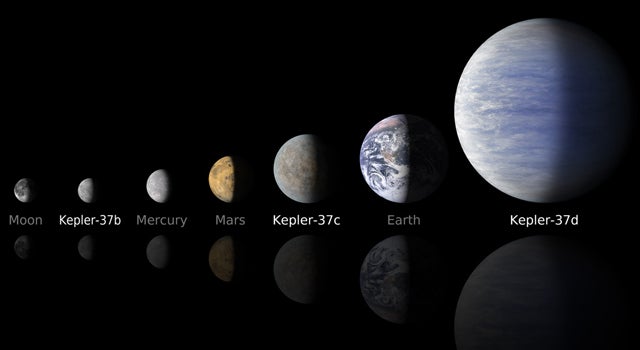
NASA announced a fun new finding from its Kepler mission today--the smallest planet we've ever seen, and it's orbiting a sun that resembles our own. It orbits a star, slightly cooler and smaller than our own but in the same basic category, in the constellation Lyra, about 210 light-years away from Earth. And it has fellows: two other planets, both relatively rocky and small.
The planet, named Kepler-37b, was discovered as part of the Kepler project, dedicated to finding particular kinds of exoplanets--planets of a similar size to Earth, orbiting stars of a similar size to our sun, with the theory that life or at least water might exist on those planets. Due to the difficulty in spotting celestial bodies as small as planets, most of the findings so far have been giant, much bigger than Earth. So Kepler-37b and its two sister planets are definitely something exciting and new.
Of course, that doesn't mean the tiny planet is habitable. NASA suspects the surface temperature on the small, rocky planet could be upwards of 800 degrees Fahrenheit, considering it orbits much closer to its star than even Mercury does to ours.
Read more about the finding here.
Five amazing, clean technologies that will set us free, in this month's energy-focused issue. Also: how to build a better bomb detector, the robotic toys that are raising your children, a human catapult, the world's smallest arcade, and much more.


Online Content Director: Suzanne LaBarre | Email
Senior Editor: Paul Adams | Email
Associate Editor: Dan Nosowitz | Email
Assistant Editor: Colin Lecher | Email
Assistant Editor: Rose Pastore | Email
Contributing Writers:
Rebecca Boyle | Email
Kelsey D. Atherton | Email
Francie Diep | Email
Shaunacy Ferro | Email
I thought it was already named KPAX.
Suppose we do find what looks like a perfectly habitable planet. What do we do about it?
Because apparently we have no intention of attempting to build a star ship any time soon, and future generations will surely be better equipped to build a database of planets.
If an asteroid we cant defend against doesn't destroy us first we will most likely have to start from scratch and rescan the skies with better tools.
Finding another Earth is pointless unless we intend to go there, or you just want to rub it in the face of christians.
the kepler telescope favour the equalient strata of hubble telescope and give us a fair idea about the space exploration and nature of spacious body.
@killerT
There's plenty of people thinking of building starships, such as at Project Icarus for example:
http://www.icarusinterstellar.org/
The problem is that with an ISS that cost $100 billion, any realistic [and honest] projection for a starship is probably in the trillion dollar range. Considering Congress has cut NASA's budget recently and the debt/deficit problems we have, I just don't see it happening anytime soon. Businesses are welcome to do it on their own, but since their goal is making a profit and doing so consistently on a quarterly basis, I don't see many big, well-capitalized businesses convincing their shareholders of this either...the market will respond negatively immediately.