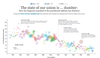
Yesterday, as a run-up to Obama's State of the Union address, The Guardian published an interactive infographic called "The state of our union is … dumber: How the linguistic standard of the presidential address has declined."
The chart plotted the reading level of every SOTU address since the country's founding along a timeline. Each bubble represents a single speech, with the height of the bubble indicating grade level, and the bubble's size indicating speech length. With the exception of a few outliers--Madison blew everyone away in 1815 with a speech targeted for an audience in grade 25.3; Lincoln delivered an address in 1862 of exceptionally low standard--the trend is indeed clear: the annual State of the Union had gotten progressively dumber over time.
Pretty scary, huh? At least, it would be scary if the chart were actually showing the declining linguistic standard of presidential speeches. But, in fact, it's the graphic itself--or, at least, The Guardian's packaging of the graphic--that is doing the dumbing-down, by using the simplistic Flesch-Kincaid readability test as a metric for the "linguistic standard" of presidential rhetoric.
In reality, the Flesch-Kincaid readability test measures two things: the length of the words in a piece of prose, and the number of words per sentence. As columnist and linguist Ben Zimmer explains, the test was developed in the 1970s, not as a metric for the intelligence, complexity, or lingual eloquence contained in a text, but as a "rough and ready analytical tool" for assessing the appropriateness of texts for different grade levels. If a book or article or written speech scores a 5, a fifth-grader should be able to get through it without getting lost in a sea of clauses and semicolons.
So, what does this graphic really tell us? Words and/or sentences have been getting shorter. And what does that mean? Well, it could mean that the English language is being reduced to an ugly nonsense heap of monosyllabic words. Except, when you break the State of the Union addresses down by both word length and sentence length, as linguist Mark Liberman did a while back in response to another linguistic hell-in-a-handbasket Guardian article, the actual trend becomes a lot clearer:
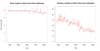
Okay, so word length has decreased slightly over time, and sentence length has decreased dramatically. That trend may denote a stylistic shift in political rhetoric, says Zimmer, but it tells you very little about the quality or intellectual prowess of each sentence's content. Instead, it probably reflects the fact that politicians have caught on to the idea that audiences don't really want to walk away from a speech in awe of the orator's masterful use of the semi-colon; they want to walk away knowing what the orator was talking about.
Maybe The Guardian knew that it was grossly overstating things with its "declining linguistic standard" headline; perhaps it knew that its audience didn't want to click on an article called "The State of the Union: Sentences Just Keep Getting Shorter And Easier To Follow Over Time."
Instead, The Guardian chose to reinforce the ancient, cherished myth of cultural/societal degeneration, because that's what people wanted to hear. Responses to the graphic on Twitter yesterday reflect people's readiness for the news that we're all getting lazier and dumber: "Wow, proof intelligence is on the decline"; "pretty scary"; "exactly what I'd expect."
Next time, how about reprinting an excerpt from "A Proposal for Correcting, Improving and Ascertaining the English Tongue"? It was written by the exquisite grammarian Jonathan Swift back in 1712, when the English Tongue was much Purer:
Five amazing, clean technologies that will set us free, in this month's energy-focused issue. Also: how to build a better bomb detector, the robotic toys that are raising your children, a human catapult, the world's smallest arcade, and much more.


Online Content Director: Suzanne LaBarre | Email
Senior Editor: Paul Adams | Email
Associate Editor: Dan Nosowitz | Email
Assistant Editor: Colin Lecher | Email
Assistant Editor: Rose Pastore | Email
Contributing Writers:
Rebecca Boyle | Email
Kelsey D. Atherton | Email
Francie Diep | Email
Shaunacy Ferro | Email
"Instead, it probably reflects the fact that politicians have caught on to the idea that audiences don't really want to walk away from a speech in awe of the orator's masterful use of the semi-colon; they want to walk away knowing what the orator was talking about."
So you're saying...
-that people have trouble understanding long, complex sentences with lots of content?
-that reducing the use of said long words and complex sentences improves comprehension?
-therefore the complexity of the speech is in fact being reduced to improve the number of viewers comprehending the message?
Can you give me a definition of "dumbing-down" please? Because your article now seems like a contradictory piece of tripe that was just a reflexive response to someone criticizing your lord and savior's sermon.
"Dumbing-down" - a common after-effect of reading popsci articles like this.
On the chart showing the sentence word lengths, the bend in the curve seems to come very near 1913, when the "speeches" ceased being written submissions to Congress and started being actual speeches (according to the annotation about Woodrow Wilson on the original Guardian graphic).
That's a very interesting factor, as well.
Brian144, you really need to see a doctor about that jerking knee. You obviously didn't even look at the graphic, or you'd have seen that the president with the lowest "score" was George HW. So this story is as much or more about defending a man I presume you respect as one you clearly don't. And no, 'making your message easier to understand' is NOT the same as 'dumbing down'. Clearly this was a message too co0mplicated for you to understand, at least.
Anyone read the appendix about language in 1984?
Notice the particularly sharp decline during the age in which Fitzgerald is replaced by Hemmingway, as the last of the long senence writers is replaced by the new style.
They are correct that linguistic change over time is merely language adaptation (compare Paradise Lost to any contemporary work) as long, convoluted, sentences gave way to more independent sentences.
That said, the dumbing down of America is much clearer if you look at the content of the words said rather than the words themselves.
@Katie Peek: Interesting! There's the bend in work length AND the drop in sentence length right there.
@brian144: I would define "dumbing-down" as a simplification of meaning rather than a simplification of sentence structure. Long sentences are not necessarily smart sentences.
Linguists carried out this same analysis on articles in the journal Science and found the same trend. Are scientists dumbing down their findings for fellow scientists?
@ terrycollmann
You misapprehend my meaning, sir. I liked some things Bush did. And hated some other things he did.
I don't care if he had the lowest score. I don't terribly care about the score or the deliverance of the state of the union. I care about the content.
And there are several different reasons for a decline in complexity. But the primary driver I suspect is the advent of Radio-broadcast and television, which makes the state of the union an address to the people, rather than to the Congress.
But what is undeniable is that there has been a steady decline of the complexity of the state of the union addresses. Regardless of reason, it has been systematically dumbed-down over the past century. To deny that the requisite intelligence to understand the address has decreased, and the simplicity in which points are described has increased, it in direct contravention of fact.
I don't particularly care which president gave the smartest-scoring address. What I do care about is that this website has again posted something that seems to be motivated by their love of the current president, rather than objectivity and quantification (ie, science).
The writer himself even admits it, and gives a rational. People don't like it as complex. Ergo, they like it simpler. And the politician makes it simpler. That is the very definition of dumbing something down. 'dumbing-down' and 'making simpler' are synonymous.
I couldn't care less how complex the state of the union is. I could care less about how popsci is politically motivated to an annoying level. And this hypocritical article is a prime example I am pointing to.
@brian144 The writer himself is a she.
Yes, The Guardian's infographic (like so many polls, incidentally), arrives at a conclusion that has nothing to do with the data.
What would be more interesting is an infographic on how much bs is delivered in SOTU's. Has it increased or decreased over time? Or are politicians as dumb and/or deceitful now as they were a hundred years ago?
@laurenra7 Yes, I agree. I think it would be great to come up with a measure of Orwell-style obfuscation in language. George Orwell wrote at length about how politicians will intentionally avoid straightforward language to cloud the meaning of what they are saying in his "Politics and the English Language."
There were phrases in Obama's speech last night that were definitely Orwellian in this sense. When talking about pulling troops out of Afghanistan, Obama said that we are "changing the nature of our commitment." What does that mean? Does it mean we are leaving or not? Unclear. And that's the point.
(Incidentally, I think this example provides a good counterpoint to @brian144: "changing the nature of our commitment" as a phrase would register at a much higher reading level than "leaving." But "we will be leaving Afghanistan," isn't a dumbed-down version of "we will be changing the nature of our commitment in Afghanistan." It's just a lot clearer.)
It would be a challenging thing to do (and would involve a lot of pretty arbitrary judgement calls), but I think it would be great to see a tally of Orwellian phrases like this in SOTU addresses — and see how their use has changed over time. It would certainly be a lot more interesting than the Guardian's misled reading level analysis or a simple tally of the number of times a president used the word "god" or "nation" or "taxes."
brian144:
>That is the very definition of dumbing something down.
No, it isn't.
>'dumbing-down' and 'making simpler' are synonymous.
No, they're not. That's sort of the whole point of this piece.
You seem unable to grasp the relatively simple concept that is quite clearly conveyed in this piece, which contains no self-contradiction whatsoever. This, even after your muddled apprehension has been pointed out to you.
As is nearly always the case when someone accuses a writer of being politically motivated when there's nothing in the writing to indicate that, the accuser in this case is actually the one motivated by witless ideology, even if he has fooled himself into thinking otherwise.
Flowery bombastic speech -- with heavy use of long words with latin roots -- has long been on the decline, both in common speech and in political discourse.
I think that's a good thing.
Rudolf Flesch, E.B. White, and William Strunk would all think it's a good thing.
I just got paid $6784 working off my laptop this month. And if you think that's cool, my divorced friend has twin toddlers and made over $9k her first month. It feels so good making so much money when other people have to work for so much less. This is what I do,
jump30.com
It really is a simple thing to comprehend. The average american can probably grasp that overall intelligence is on a decline because of poor education and over-population. Dumbing down is an obvious requirement to speak to the growing number of people whose reading and comprehension level is on a discouraging decline. Not to mention that the leaders of this country reflect the people and their greatness can no longer be measured in intelligence.
Microsoft Word (amongst other programs) will analyze a document and report on the reading ease, and reading grade level.
FWIW, here are the results for this P.S. article:
Passive sentences = 14%
Flesch reading ease = 45.3
Flesch-Kincade Grade Level = 12.2
You know what's wrong with this article? That it should never have been written. I don't think it's good journalism, or speaks highly of the publisher, when they are wasting effort on an article to sway opinion of another publishers publishing. See how meta that sounds? It would just be easier to read, and hopefully easy for the staff of POPSCI to write, articles that are of original content that could very well be the antithesis of a Guardian posting without being so overt as to almost don their news with a POPSCI asterisk that explains why nobody should listen to it. It's a complex form of journalistic trolling that gives too much insight into the personal opinions of the writer; subjective writing if you will. I prefer my journalistic readings to be objective, especially when they deal with science.
@danmitchell: Mere nay-saying of another's argument coupled with a pair of conclusory (at best) paragraphs does not an argument of its own make. Your post amounts to an electronic "uh-uh."
According to Merriam-Webster, "dumbing down" means "to lower the level of difficulty and the intellectual content of (as a textbook); also : to lower the general level of intelligence in " www.merriam-webster.com/dictionary/dumb%20down
Webster goes on to define "simplify" as (in relevant part): "to make simple or simpler: b : to diminish in scope or complexity." www.merriam-webster.com/dictionary/simplify
These definitions, by their very nature, make brian144's original post a legitimate condensation of the article itself. Of course, there is room for honest debate (hopefully a thing embraced by all with an interest in science), but surely not for such argumentative failures as your response.
I am confident that you can do better.
--------------------------
ignorantia legis non excusat
Thomas Jefferson's 1801 SOTU address consisted of a hand-written 1/2 page.
http://www.archives.gov/legislative/features/sotu/images/jefferson-m.jpg
When you compare that to Obama's incoherent, rambling 1-hour-plus SOTU address, it becomes obvious that there is a direct inverse relationship between the length of a presidential SOTU address and their intellectual capacities.
If only Popular Science were as interested in the integrity of the methods and conclusions of their own published infographics/statistics as they are of those on other websites...
If only...
Ms. Elert, may I suggest you review and comment on the statistical methods of the many Popular Science pieces? Clearly your editors are not very interested in vetting the studies and the conclusions their writers draw from them...
If you've ever read anything from the 1800s, you know they just love to make agonizingly long and complex sentences and even use multiple sentences for something that can be said in 5 words.
Spit out what you want to say. Say it so we understand it the way you mean it. Ain't got time fo yo eloquent BS.