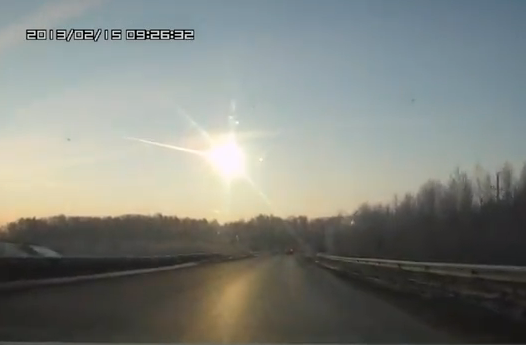
Friday morning’s meteor, the largest object to strike Earth in more than a century, took the whole planet by surprise. But maybe it didn't have to.
There's a chance the space rock that careened into Earth’s atmosphere over Russia could have been spotted if the right telescope happened to be looking in the right place. That's happened exactly once before. But it's highly unlikely it could have been spotted in enough time to sound an alarm--at least not with our planet’s existing warning systems.
International scientists say it’s unrelated to the asteroid 2012 DA14, which flew past Earth today. That rock was found in a ground-based sky survey, but at roughly half a football stadium in width, it is much larger than the meteorite.
2012 DA14 was hard enough to find, but the chances of spotting something like this morning's meteorite are really dismal, said Laurie Leshin, dean of science at Rensselaer Polytechnic Institute and former research director of the Center for Meteorite Studies at Arizona State University.
“The rocks themselves tend to be very dark. Most meteorites reflect only a couple percent of the light that hits them,” she said. “A lot of them are filled with carbonaceous materials, like coal, basically, so they can be very black.”
The unnamed rock packed a gigantic 300-500 kiloton punch when it exploded in the air, blowing out windows, damaging hundreds of buildings and injuring at least 1,200 people. That's a good 20 times the power of the atomic bomb dropped on Hiroshima. The rock was probably about 50 feet in diameter, an estimate derived from two infrasound stations near the impact, according to Peter Jenniskens, a SETI Institute scientist and principal investigator of the Cameras for Allsky Meteor Surveillance at NASA's Ames Research Center. He said that although small, this space rock could have been seen, at least in principle.“This asteroid could have been detected if we would have been searching for it,” he said. “It was not, as far as I know, seen coming in, and there was no prediction that this could happen. But that could have a lot to do with the fact that a survey, at any given time, only covers a small area of sky.”
There is one example in the scientific record of an incoming meteorite being discovered before impacting Earth. In the middle of the night between Oct. 5 and Oct. 6, 2008, Richard Kowalski was manning a 1.5-meter telescope belonging to the Catalina Sky Survey near Tucson, Ariz., when he spotted an object ultimately named 2008 TC3. This space rock was only 7 to 16 feet in diameter, much smaller than the one that hit Russia today, and incredibly faint--a magnitude 19 object. His observation came 20 hours before the rock exploded an estimated 23 miles above Sudan’s Nubian Desert. The explosion created a 1.2 kiloton shock wave, Jenniskens said.
“(Friday’s explosion) was 300 times bigger," he noted. "We could have seen it. It is quite possible that it did go through someone’s survey field, or maybe an amateur’s telescope." Astronomers will no doubt be combing their records from the past couple of days--probably the earliest it would have been seen--to check if anything crops up.
Randy Korotev, a meteorite expert at Washington University in St. Louis, said many meteorites are agglomerations of non-reflective material that are too tiny to reflect much light. This helps explain why they disintegrate when they enter Earth’s atmosphere--they’re crumbly.
“When these things hit the atmosphere, from the point of view of the meteorite, it’s like hitting concrete. It compresses the air so fast,” he said. “Most meteorites can’t stand the internal shock themselves. That’s why, toward the end, they typically fall apart.”
The overwhelming majority of the time, that’s how meteors become visible--by turning into a literal fireball, in Leshin’s words. “They are glowing from fire, because they are going so fast when they come through our atmosphere,” said Leshin. That’s true right at their surfaces, she added--inside, meteorites are still ice cold.
Philipp Heck, assistant curator of Meteoritics and Polar Studies at the Field Museum of Natural History in Chicago, said a denser network of small ground-based telescopes and sensitive cameras could theoretically detect a small asteroid like the one that became today’s meteor. Or an infrared telescope, which can detect very small items, might be able to spot them.
“A combination of both makes sense. Now, after today, I think people will be more aware of the threats that exist,” he said.
Five amazing, clean technologies that will set us free, in this month's energy-focused issue. Also: how to build a better bomb detector, the robotic toys that are raising your children, a human catapult, the world's smallest arcade, and much more.


Online Content Director: Suzanne LaBarre | Email
Senior Editor: Paul Adams | Email
Associate Editor: Dan Nosowitz | Email
Assistant Editor: Colin Lecher | Email
Assistant Editor: Rose Pastore | Email
Contributing Writers:
Rebecca Boyle | Email
Kelsey D. Atherton | Email
Francie Diep | Email
Shaunacy Ferro | Email
Oh GOG here's a Warning not just to you, but the world! the time is now! The Anti is here, the tribulation of revelations is BOUT TO BLAST! MANY WARNINGS WILL WE HEED!A LOT IS COMING ALL OVER THE WORLD! CAOS IS COMING AND MANY TROUBLE WILL COME TO EARTH! Wake and see. Or keep denying GOD is real . Jesus is the only truth! All else fails.
up to I saw the draft which had said $5486, I be certain ...that...my sister woz like they say actually making money part-time at there labtop.. there moms best frend started doing this 4 only six months and as of now took care of the dept on there apartment and bourt a new Fiat Multipla. we looked here, pie21.ℂom
Correction, the fireball is from the plasma created by the meteorite ripping through the atmosphere at such high velocity. Read the articles on the Navy Railgun experiments. Same phenomenon.
Why is there always so much spam in the comments?
To wakeandsee. Oh GOG here's a Warning not just to you, but the world! the time is now! The Anti is here, the tribulation of revelations is BOUT TO BLAST! MANY WARNINGS WILL WE HEED!A LOT IS COMING ALL OVER THE WORLD! CAOS IS COMING AND MANY TROUBLE WILL COME TO EARTH! Wake and see. Or keep denying GOD is real . Jesus is the only truth! All else fails.
Time to fix your post...
Oh God! Here's a warning not just to you, but to the whole world! The time is now, the Anti-Christ is here, the tribulation of revelations is about to come! Many warnings we shall heed! A lot is coming all over the world! Chaos is coming and much trouble will become the earth! Wake up and see or keep denying God is real. Jesus is the only truth and anything else other than him fails.
Just as an afterthought please remember to use a grammar and spell check before you spit out your stupidity on the internet thank you.
I'm still curious if anyone has estimated how fast it was moving? It didn't take long for it all to end once it was visible.
Neanderthal, I've heard 65,000 mph prior to contact with atmosphere, 40,000mph at impact.
@shadedlotus
Please keep your religious nonsense to your self. You are harboring stupidity.
@popsci
Please keep your opinions to yourself and stick to the facts. You are creating ignorance.
@shadedlotus; you are obviously a troll who knows nothing about God much less believes and thinks those who do are as stupid as you seem
@Contoria; they only way to protect Earth from this type of threat is to detect the object years before it hits and intercept it in deeps space. There is absolutely nothing ground based that could do spit again event a small rock like this.
What I want to know is once it was seen by people on the ground, why did they continue driving?
Why didn't they step on the brakes at least?
Didn't they have any clue what was about to happen?
Suppose it had exploded closer to the ground? They could have been vaporized.
There were some men working in one of the videos who didn't even stop when the flash happened.
Nobody in those videos made any attempt to seek safety!
I am truly dazzled by PopSci's inability to monitor comments and remove/block the get-rich-quick and other spam comments that have nothing to do with the articles. Hey- maybe I could make money from Posci removing these from the comments on each article! I could get rich quick doing it!
I think this is just only the start. No one are telling us truth... Maybe and this one was a sign to see that really truth are being hidden to not make panic. Everyone try to explain why this phenomenon happens, but why they don`t say about this to people ? I think that there would be less injuries than now are... everyone attention is for the biggest meteor not for the smalls.. forgetting the fact that they may cause problems, deaths too ! :/
Why did NASA not see the Chelyabinsk meteorite?
1) because it came out of the daytime sky. These are nearly impossible to find ahead of time because telescopes can only spot asteroids during the night
2) The Russia meteor is estimated to have been less than 20 meters in diameter, which is considered a tiny asteroid
3) The small asteroid hit the atmosphere moving at a blistering 40,000 miles per hour. That's more than twice as fast as asteroid 2012 DA12 is moving. The space rock lasted about 30 seconds in the atmosphere before breaking apart 12 to 15 miles above Earth's surface.
following this story using the Facebook platform - http://www.facebook.com/photo.php?fbid=10151748294638677&set=a.453208868676.239413.805278676&type=1