Physicists Probe The Deep Earth For A Fifth Fundamental Force
Electrons' spin may give rise to a force that allows particles to interact over very long distances.
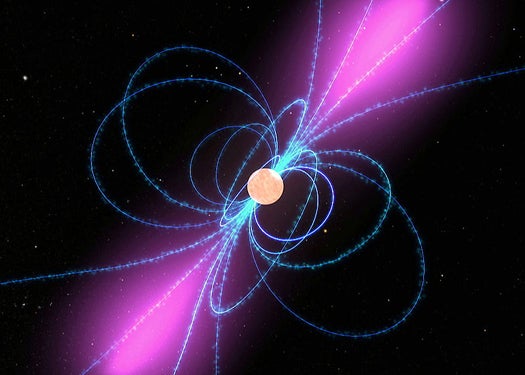
In general, people tend to use the phrase “force of nature” loosely, as in “she’s a real force of nature.” But physicists are pickier–they reserve the phrase for just four separate, universal forces they call the “fundamental forces”: gravity, electro-magnetism, and the strong and weak nuclear forces, which hold the nucleus together and are involved with radioactive decay, respectively.
That doesn’t mean physicists rule out the possibility that other forces exist. Since the models they have for explaining everything are incomplete, there’s a fairly good chance that there’s something else out there, pulling matter apart or pushing it together in a different way than all the forces identified so far.
A team of physicists at the Amherst College and the University of Texas is looking for one potential fifth force–one that might arise from the spin of electrons interacting with the spins of other subatomic particles. We experience the short-range effects of electron spin every time we snap two magnets together–a result of the fact that iron contains electrons that line up with each other–but scientists think that particles’ spin may cause them to interact over very long distances, too.
The problem is, even if this long-range force, called “spin-spin force,” does exist, it’s incredibly weak, and therefore extremely difficult to detect. Larry Hunter, chief scientist on the Amherst team, calculates that the long-range spin-spin force must be at least a million times weaker than the gravitational attraction between a neutron and an electron. Since gravity is the most obvious force in our lives, it seems like a strong one, but on the scale of individual sub-atomic particles, it’s almost completely insignificant (the electrostatic force between two electrons is a million trillion trillion trillion times stronger than their gravitational attraction).
But Hunter’s team has come up with a clever way to address the difficulty: instead of trying to detect the incredibly faint force acting between two particles, they are aiming to detect the net force of all the spinning electrons locked up in iron atoms in Earth’s deep interior.
Since the electrons in iron tend to line up with the magnetic field, Hunter realized it might be possible to estimate the net spin from all the iron atoms in the mantle–the thick layer between Earth’s crust and core that makes up the bulk of our planet’s volume.
Hunter worked with a geophysicist, Jung-Fu Lin of the University of Texas at Austin, to calculate the strength of the magnetic field in different regions of Earth’s interior and the net spin of electrons throughout the mantle. The researchers realized they could use the planet’s quarry of iron atoms to increase the long-range spin-spin force on the neutrons inside Hunter’s lab by more than a quadrillion-fold.
Still, there are lots of challenges: the test chamber containing the atoms of mercury gas the team is studying has to be completely isolated from all interference from the four known fundamental forces, and the tools the team uses to detect changes in the gas need to be perfectly calibrated. “It’s a little like playing whack-a-mole,” Hunter jokes. “You fix one problem and then another one pops up.”
Hunter thinks he and his team can increase the sensitivity of their set-up by at least a couple orders of magnitude. Whether that increase will be enough for the physicists to make a detection–if this force really exists–remains to be seen.