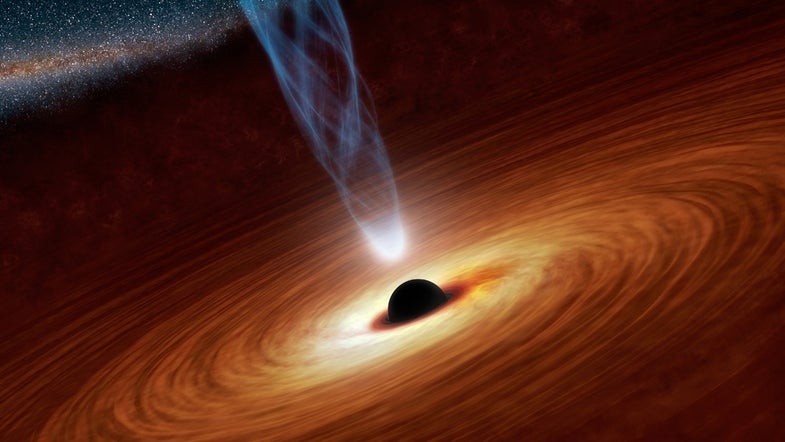
Nothing can escape a black hole, even light, because to wrench away from its titanic gravitational pull, you’d have to move faster than light is capable of traveling. And nothing can do that, as far as anyone knows. As matter falls into a black hole’s gaping maw, it superheats to millions of degrees, screaming a final cry of X-rays as it is torn apart. At a specific point called an event horizon, the matter disappears and is never heard from again.
A pair of X-ray telescopes recently watched some of these X-ray death gasps and were able to figure out how fast a black hole is spinning. This is “hugely important” for black hole science, according to researchers working with NASA’s Nuclear Spectroscopic Telescope Array, or NuSTAR space telescope. One particularly cool finding: The black hole is spinning almost as fast as Einstein’s theory of gravity says it possibly could. It’s spinning at almost the speed of light.
The galaxy in question is called NGC 1365, which is about twice the size of the Milky Way and located about 60 million light years away. The black hole is about 2 million times more massive than the sun. Scientists using NuSTAR and the European Space Agency’s XMM-Newton satellite wanted to measure how fast it is spinning. This is a key feature of black holes that is related to their size and the way they gobble up stars, gas and even other black holes.The problem is that black holes are hard to study, because, you know, not even light can escape them. To measure them, you have to measure their effect on their surroundings--like the X-rays emitted by dying matter. This is hard to do because objects between us and them can get in the way, however, making the X-rays look distorted. There have been two competing models explaining why the X-rays look warped: Either gravitational distortion caused by black hole gravity, or distortion caused by intervening clouds of gas and dust.
In this new study, NuSTAR and XMM-Newton set out to determine which one is right. The telescopes carefully traced the X-rays emitted at the very, very edge of the black hole, right near the event horizon, or the point of no return. By combining their distinct viewing abilities, the two telescopes were able to see a wide range of X-ray energies, and figure out that the X-rays are not actually distorted by intervening gas clouds. They look distorted because the black hole is spinning, and its immense gravity warps spacetime as it swirls around. This information was used to tell just how fast the black hole is spinning: Just below the universal speed limit.
Along with new information about this particular black hole, this study suggests that black hole observations can remove a little bit of ambiguity. This will help astronomers continue to unravel the mysteries of these galactic monsters. A paper describing the findings is published this week in Nature.
[NASA]
Five amazing, clean technologies that will set us free, in this month's energy-focused issue. Also: how to build a better bomb detector, the robotic toys that are raising your children, a human catapult, the world's smallest arcade, and much more.


Online Content Director: Suzanne LaBarre | Email
Senior Editor: Paul Adams | Email
Associate Editor: Dan Nosowitz | Email
Assistant Editor: Colin Lecher | Email
Assistant Editor: Rose Pastore | Email
Contributing Writers:
Kelsey D. Atherton | Email
Francie Diep | Email
Shaunacy Ferro | Email
Santa Claus. Easter Bunny. Black Holes.
Pick your fantasy.
It is interesting CONJECTURE, but really, these guys take there imaginative 'realities' way to seriously!
In the good old days, people used to discuss things in terms of theories and ideas, and not pretend they were anything more. Then, positive and informative discussions could be enjoyed in context.
@blovel
IF YOU HAD TOLD A PERSON IN 1900 THAT IN LESS THAN 100 YEARS WE WILL BE ABLE TO TALK TO A PERSON WITHIN SECONDS ANYWHERE AROUND THE WORLD THEY WOULD HAVE RESPONDED -
"Santa Claus. Easter Bunny." Long Distance Communication
"Pick your Fantasy."
Its all about statistics and probability. We may be far off of the mark visually speaking but certainly not conceptually. It is based around simple math deriving from the constant activity surrounding this massive "thing" in space (In layman terms).
@ gmbusiness213
at no point were those caps necessary...
anyway i guess i can agree with you, saying something isn't scientifically possible is a fools game because truly anything is possible its just a matter of how long we will take to get there.
-Power Corrupts-
@gmbusiness213
I know this isn't the point of what you were saying, but just for fact's sake, there was a transatlantic telegraph cable in use as far back as 1858. So people in the 1900's wouldn't have been too taken aback by the idea of near instantaneous communication.
There's no such thing as "spins [near] the speed of light" what EXACTLY is supposed to be traveling "near the speed of light"? The surface of the "singularity"? the surface of the "schwartzchild radius"? the contents of the accretion disk?
Some SERIOUS further information is badly needed here?
@neilxt
Thanks for mentioning that, I want to ask the same question.
"In this new study, NuSTAR and XMM-Newton set out to determine which one is right. The telescopes carefully traced the X-rays emitted at the very, very edge of the black hole, right near the event horizon, or the point of no return."
So where did they measure the speed? And in the same breath of course, what is the diameter?
@blovel
I was surprised you didn't include 'God' at the end of your list of things people like to conjecture about...
C'mon, guys, this isn't the website where the observations are being discussed among the scientists. It's a journal that takes current Stuff from many disciplines and distills it into an abbreviated form for popular consumption. This process introduces obvious errors, but the writers aren't research scientists, and we aren't talking peer review papers. Give 'em a break, and if you want to know more than what you see here, you could start with Google..