When animal behaviorists want to study animal skills, they often work with animals living in the nation’s zoos and aquariums, testing problem-solving and other traits. But a new study suggests this may not paint an accurate picture. Animals in captivity act much differently than animals in the wild, and their ability to face new problems is no exception.
Researchers at Michigan State University found dramatic differences in how wild and captive spotted hyenas figure out a puzzle problem. Sarah Benson-Amram, who led the study when she was a grad student, tested wild and captive hyenas on the same food puzzle. They were presented a steel box with some tasty meat inside, and they had to figure out how to open it.
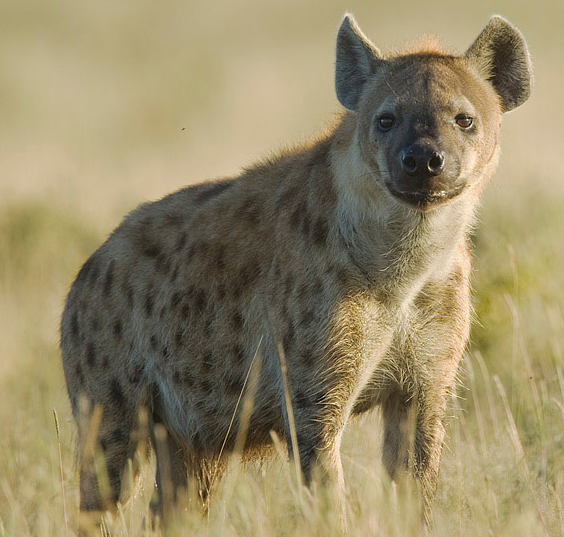
The captive hyenas bounded into their enclosures and had no problem biting, chewing and opening the steel cages to get the treats. They were very creative, according to the study, trying various possible solutions. But the wild hyenas were much more timid. They approached the cage and sniffed it cautiously, looking around nervously before interacting with it at all.
The authors say the captive animals were more successful because they were more exploratory, and more willing to tackle the problem. They don’t think it was because the captive animals had more time or energy to figure it out. Could it be that they were bored and welcomed a challenge for once? That’s not clear, but the results do show that captive animals are not necessarily a useful analogue for studying their wild counterparts.
Five amazing, clean technologies that will set us free, in this month's energy-focused issue. Also: how to build a better bomb detector, the robotic toys that are raising your children, a human catapult, the world's smallest arcade, and much more.


Online Content Director: Suzanne LaBarre | Email
Senior Editor: Paul Adams | Email
Associate Editor: Dan Nosowitz | Email
Assistant Editor: Colin Lecher | Email
Assistant Editor: Rose Pastore | Email
Contributing Writers:
Kelsey D. Atherton | Email
Francie Diep | Email
Shaunacy Ferro | Email
I wish I could own oNE or Two!
..........................................
See life in all its beautiful colors, and
from different perspectives too!
If the goal is to test the intelligence of the animal, then I would think tests on the captive animal would be more relevant than test on wild animals.
The captive Hyenas are used to smelling and getting food from humans. So they have no reason to question the puzzle, or the food inside.
A wild hyena is not less intelligent, but understandably more cautious.
The potential for higher intelligence could have been there all long from the belief\perspective human. When given a less stress free life, positive encouragement and intelligent stimulating new environment for the Hyena, might appear more intelligent to the human, because now the human instills upon it more things in common, they both could relate to, then gages the animal to be more intelligent. When in fact, biologically nothing really has change in the Hyena.
Besides, in the wild an animal always has to worry about being eaten itself. If you remove this stress, it then opens up more time to concentrate more on solving problems.
..........................................
See life in all its beautiful colors, and
from different perspectives too!
I agree with Democedes, the animal in the wild will be more trimmed due to more danger in the wild. Duh!
StoStatus,
Trimmed, as it has a short hair cut?
Or the animal in the wild would be more timid in the wild.
I think the Hyena hair length would be the same, lol.
I wonder if there will be a point where Hyenas will be domesticated. They seem like they would be a unique companion. I know that there are foxes that have been domesticated through selective breeding based on behavior favorable to human companionship. I'm not saying we should do it. But maybe prolonged captivity can do this, albeit more slowly, if at all. Just a thought.
------------------------------
I reject your reality, and substitute my own.
Anyone remember that scene from Jurassic Park? "T. Rex doesn't want to be fed, he wants to hunt. You can't just suppress 65 million years of gut instinct."
Captive hyenas have gotten used to being FED for years. Wild hyenas have never seen a prepared meal like that in their lives. Hell, for all we know the captives have eaten their meals out of metal bowls, just like my own dogs do, and associate metal itself with eating. Maybe the wild hyenas aren't stumped as to how to get at the food; maybe the wild hyenas are stumped as to whether they really want the prepared meal at all.
Imagine if they ran a similar experiment, gathering children from Italy and children from Japan. They present each one with a puzzle box containing sushi. Would it really be fair, or scientifically valid for that matter, to conclude that the Italian children aren't as smart when they ask for a plate of pasta while the Japanese children open the box and hungrily eat the sushi?
Shame on the National Science Foundation for helping fund this pointless experiment (per the link at the bottom of the article) at a time when our fiscal outlook is so fraught!
Of course captive animals react differently: Their lives and experiences are nothing like they would have living natually in the wild. Captivity takes a huge toll on anyone, whether human or hyena, and causes psychological changes -- many captive animals go insane from the distress and unnatural conditions.