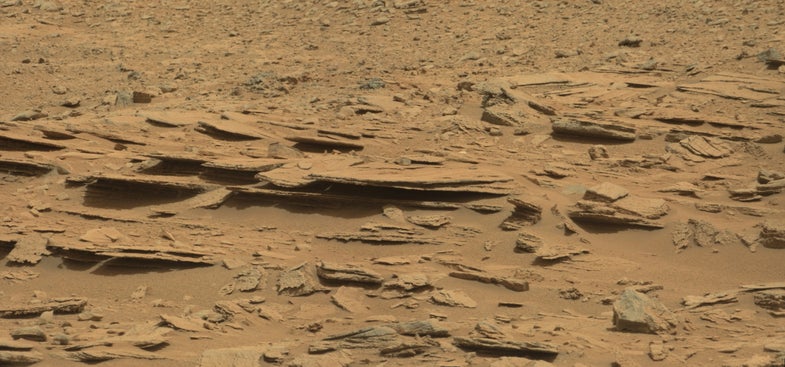
A species of hardy bacteria found anywhere from human skin to plant roots can survive in a Mars-like environment, a new study says. The finding has implications for extraterrestrial life, but maybe more importantly, there are implications for planetary protection. Could stowaway microbes hop off the Mars rover Curiosity (or its descendants) and make a new life on the Red Planet?
Astrobiologists like studying extremophiles, those bacteria and other creatures that live in horrid temperatures or pressures, because they could conceivably live in the hostile environs of other planets. But Serratia liquefaciens is a generalist, as the authors described it--it evolved probably at sea level and lives in plant, animal and aquatic worlds.
To understand how well future human missions might imperil Mars with our filthy life forms, microbiologists led by Andrew Schuerger at the University of Florida set out to test how well common Earth bacteria could survive in Mars-like environments. There’s a surprising lack of data on this matter, the authors say in their paper, which was published this week in the journal Astrobiology.They worked with 26 strains of 22 types of bacteria that have been recovered before from spacecraft, and would therefore be the likeliest to hitch a ride to a hospitable spot on Mars. Importantly, the researchers assume the bacteria would survive the harmful radiation to which they would be subjected on the journey--but still, the study has some important findings.
The team grew bacterial colonies in dishes and then turned down the heat, the pressure and the oxygen. Hyperbaric chambers reduced atmospheric pressure down to just 7 millibar, with many strains perishing as the conditions worsened. (Earth atmospheric pressure is about 1,000 mbar.) S. liquefaciens was able to survive at 7 mbar, freezing temperatures, low oxygen and increased carbon dioxide--just like the conditions on Mars. Interestingly, two known extremophile species did not make it.
The studies do not prove that life could grow on Mars, the authors warn. The radiation hazard is one major key that would probably prevent spacecraft stowaways from colonizing Mars. But still, the hardiness of these bacteria--especially one that was not considered an extremophile--is a sign that more work needs to be done to try and answer that question.
Five amazing, clean technologies that will set us free, in this month's energy-focused issue. Also: how to build a better bomb detector, the robotic toys that are raising your children, a human catapult, the world's smallest arcade, and much more.


Online Content Director: Suzanne LaBarre | Email
Senior Editor: Paul Adams | Email
Associate Editor: Dan Nosowitz | Email
Assistant Editor: Colin Lecher | Email
Assistant Editor: Rose Pastore | Email
Contributing Writers:
Rebecca Boyle | Email
Kelsey D. Atherton | Email
Francie Diep | Email
Shaunacy Ferro | Email
How about also testing to see if the bacteria could also survive the vacuum of space for the duration of time that it takes to send a probe to mars? This research is really only relavent if your talking about sending pressurized probes or space craft to mars, and then setting them free to the open atmosphere. Correct me if i'm wrong, but the probes that have been sent thus far are completely exposed to the vacuum of space, and have not yet carried any kind of pressurized cargo.
Life was already found in the Mars Phoenix Landers Microscopic imager here:
http://youtu.be/LUHZ-aMbZHw
Ron Bennett
@dameatman
www.popsci.com/technology/article/2010-08/bacteria-survive-553-day-exposure-exterior-iss
Every bit of good science and observation to date would suggest, if there is any life on mars (or anywhere else) we put it there.
Am I the only one that thinks that we should be intentionally seeding Mars with life?
If life was ever widespread Mars' past, we would be overwhelmed with evidence by now. How much longer do we have to poke around there before its safe to say that Mars has always been devoid of life?
Agreed.
We have had enough first dates with Mars. We know what all her favorite everythings are and we have inspected her enough to know that she is about as pure as any girl we are likely to find close enough to date.
We should go ahead a seed her. It will be fun and we have never done that before. After all, we all know you can't spawn planetary life on your first time!
Mars seems willing enough (well, as least I don't think she will protest loud enough for Jupiter to come knock on the door).
Give it a go, already - it is the human way!
Oh! Maybe we can send algae there too. That kind that lives in the rocks at Greenland. It might work, similar environments. And the atmosphere is mostly carbon dioxide.
--------------------------
I reject your reality, and substitute my own.
I say we sent a fleet of variety green packed algae to mars and begin the oxygen making process!
It's time to create EARTH2!
Huh. If we could find a way to grow things like plants on mars and have like an automated planting/harvesting/shipping system it might take some strain off producing food here. We should explore the possibility of us putting life on mars more thoroughly,
I think terraforming Mars is a good idea, we are already terraforming the earth for the Venusians. On Mars all we have to do is melt the south polar ice cap where most of the CO2 is stored. Since we like hydrocarbons so much global warming on Mars would be a good thing......
Ron Bennett
Jeez rib2 thats a bit depressing. I'll admit we as a species aren't doing much good for the planet right now but a little optimism that we'll get better never hurts.
Beside if we drive ourselves to terraform mars we'll probably see a lot of benefits from it. It will probably force use to create a more efficient way of generating electricity and make stuff more energy efficient.
Makes you wonder if wrecking space probes, landers, ect. into Mars and other planets is a good idea. Plus, we started sending probes and landers to other planets before we even knew about this stuff, let alone worried about it. Contamination is already there. Wasn't there an article a while back about algea growing between the lenses of a video camera that was left during the moon landings. There's my proof, life finds a way.
@rlb2
Let us not forget, adding a new atmosphere would be pointless. Mars lost its magnetosphere ages ago, so any new atmosphere that we would get from the polar ice caps or generated by algae would be blown away by the solar winds. Oxygen is lighter than carbon dioxide, thus the atmosphere would expand if the algae get to work. But it would be ages before that might happen.
An interesting project would be to find out how to restart Mars' core. It would be the best chance (albeit difficult) to terraform Mars.
--------------------------
I reject your reality, and substitute my own.
If you think Rhonda`s story is impressive..., five weaks-ago my brother's mom in law basically also got a cheque for $6503 working 10 hours a week an their house and the're classmate's sister`s neighbour has been doing this for 4 months and got paid more than $6503 part-time at their computer. applie the guidelines on this web-site, http://www.bit90.com