Curiosity has found some intriguing stuff in the Martian dirt, but it's not clear whether trace organic material is from Earth.
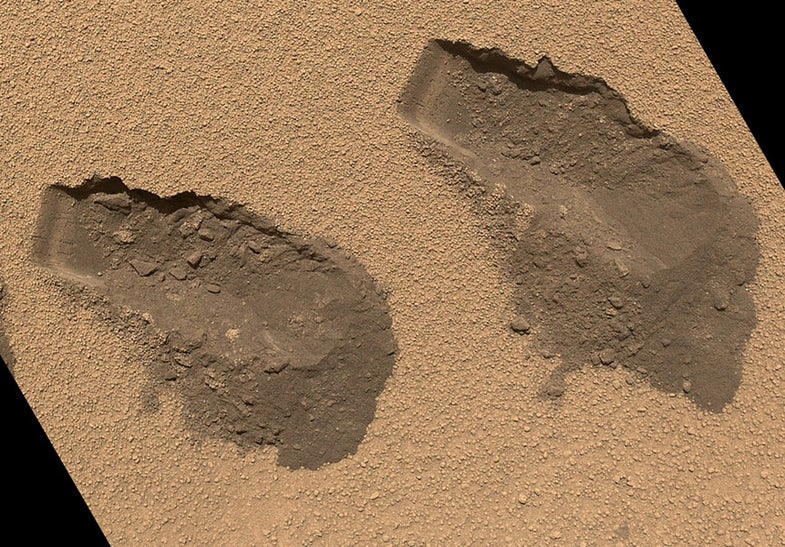
Scoops At Rocknest
Scoops At Rocknest This is a view of the third (left) and fourth (right) trenches made by the 1.6-inch-wide scoop on NASA's Mars rover Curiosity in October 2012. The image shows some of the properties of the "Rocknest" wind drift sand. The upper surface of the drift is covered by coarse sand grains approximately 0.02 to 0.06 inches in size. Beneath the crust surface is finer sand, which is darker brown. NASA/JPL-Caltech

NASA’s Mars rover Curiosity can’t yet confirm any organic compounds on the Red Planet, NASA scientists said today--but the rover is seeing some intriguing chemicals, which will lead to further careful analysis about whether its home in Gale Crater could have played host to life.

“SAM has no definitive detection to report of organic compounds,” said Paul Mahaffy, the principal investigator for the SAM instrument, which stands for Sample Analysis at Mars. The instrument did see some carbon-containing material--it’s just not clear whether the carbon in it comes from Mars, or whether Curiosity toted it from Earth. What’s more, at least some of the detected material was most likely created in chemical reactions inside Curiosity’s belly, as the SAM instrument’s oven baked sand samples.

The results mark the first soil sample analysis from the SAM lab suite, the most complex chemistry lab ever sent to another world. “We really consider this a terrific milestone,” Mahaffy said at a news conference Monday.

The presence of perchlorate may be the biggest news from the press conference, which kicked off the day at the American Geophysical Union’s fall meeting in San Francisco. The Mars Phoenix lander also saw evidence of this chlorine-oxygen compound, which could conceivably be used as an energy source by Martian microbes. The analysis of these chemicals--which involves baking samples inside SAM’s oven and measuring the vapors that come out--in and of itself created new chemicals which the sensitive instruments picked up. Among those newly formed chemicals were some chlorinated methane compounds.The chlorine is from Mars, Mahaffy said. The carbon’s origin is still unclear. Scientists will try to figure it out by measuring isotope ratios and making other measurements.

Other results from Curiosity’s first few months on Mars include some analysis of the soil and rocks, which are apparently very similar in both chemical composition and appearance to rocks in other spots on the planet. The Pathfinder, Spirit and Opportunity rovers saw very similar soil in different locations. At Curiosity’s present location, a site in Gale Crater called Rocknest, the soil is about half volcanic material and half crystalline materials, like glass. Interestingly, the water bound up in this soil is much, much heavier than water in Earth’s oceans, Mahaffy said.

Scientists, Curiosity followers and Marsphiles around the world eagerly awaited Monday’s announcement because of earlier rumors and speculation that the rover team was about to share something “Earth-shaking.” Curiosity is not designed to find life, just evidence of environments that could have played host to it at some point. Finding organic molecules would be an interesting step toward an eventual life-finding experiment. Organic compounds in this case means carbon-containing complex molecules, not something alive (or formerly alive). These compounds rain down on all terrestrial planets and are found throughout space, and they do not necessarily indicate the presence of life.

For one small drift of sand, the SAM and CheMin (for Chemistry and Mineralogy) instruments did a whole lot of work, said Curiosity’s project scientist, John Grotzinger of the California Institute of Technology in Pasadena. “We used almost every part of our science payload examining this drift,” he said in a statement.

A couple weeks ago, Grotzinger was quoted in a story by NPR saying some freshly downloaded data from SAM would be “one for the history books.” This fed speculation about what the results could be, although the agency tried to tamp down expectations. Grotzinger said today he was misunderstood, and that he meant that the continuity of data from SAM, and the mission as a whole, would be historic in its breadth and depth.

“I’ve learned that you have to be careful about what you say and even more careful about how you say it,” he told reporters Monday. “We work at the speed of science. The rest of the world works at the speed of Instagram.”
Chlorinated Compounds On Mars
Chlorinated Compounds On Mars:  NASA/JPL-Caltech

24 Comments

"Earth-Shattering".....bah!

Bagpipes, stop posting. Also what is your real name? Post nothing else before you tell me your name.

In our cosmic adventurous dreams we like to settle on Mars one day. How would this desire be affected, if we do find life on Mars?
The one place we did visit in space, the moon, and the astronauts had a difficult time with the moon dust and it getting into everything. Just imagine we go to Mars and our Earthly bodies will carry billions\trillions of bacteria’s\virus\parasites to mix and interbreed\corrupt with the Mars organisms if they are found, mutate\contaminate and perhaps later kill our astronauts or us on Earth as our astronauts venture home.

I have the feeling if we actually do find on life on Mars, this will put the brakes on any Earthly settlement to Mars.

So they have not found evidence of life,

-They have seen some carbon but it might be from earth
-Even if it is from Mars it doesn't really mean there was ever life either
-And even then the heating up of the sand to hundreds of degrees might have created the carbon as well

pfff...What a let down.

And especially since they trown everything curiosity has on this. How on earth will it get any better. I recall this European experiment that showed the radiation is enough to kill all microbial life on mars onto at least billions of years back.

@Jackson0458

1. Who are you to hinder scientific discussion?
2. What is your obsession with silencing scientific discussion? You would have gone after Copernicus wouldn't you?

Complex chemicals?! YESSS!!! That's the coolest thing ever! Totally worth the wait.

I wouldn't call it a scientific discussion, I would call it a creationist monologue.

You provide no alternative, you just bash what is written. So what is your scientific opinion? Also, your name.

Baby steps to admitting to find complex organics and finding life. Maybe now they will admit to finding life on Mars at the Viking Lander site and Phoenix Lander site.

See
http://www.youtube.com/my_videos?feature=mhum
http://www.newmars.com/forums/viewtopic.php?id=6232

Ron Bennett

From my observation of the picture in this article, the powder-ish material in the article looks a lot like the powder I use for chocolate milk and you know chocolate milk powder is organic and that can only mean, the Nestle Quick Rabbit is really a martin! ;)

lol, you know I meant Martian... He is Nestle Quick Martin, Martian Rabbit. The rabbit suit is a disguise and without those long ears, he displays long antenna.

Wooo, I am glad I cleared that up. ;)

effin moron

Greg_NJ,
Big hugh...... squish!

"... the soil is about half volcanic material and half crystalline materials, like glass."

Glass is not a crystalline material, it is amorphic. Get your facts right, PopSci!

"Baby steps to admitting to find complex organics and finding life."

No it`s not. If you actually read the stories about this you would know these discoveries even if confirmed don`t prove any life at all. They only could have aided the development of life. That`s what it means. That doesn't mean life ever started on mars. Or that it actually developed further. Or that i still exist. Or is even possible of being detected in the top 10 feet of soil due to radiation destroying it.

Looking at the perfect texture of the dirt, minus the two robotic scoops, I imagine to see the landscape of Mars must be wonderous to SEE!

Like WoWzers!

@Jackson0458

You jump to all sorts of conclusions about other people while not bothering to state the reason you believe what you do.

Do you have reasons? Call me names all you want, but if you don't have a reason for believing what you do.....maybe you ought to think about that. I'm sorry you feel so distraught about the lack of evidence for your position, but that doesn't require you to demand opposing views to be quiet.

And why on earth would I or anyone else give their name over the internet to random people who I don't know?

Glass is not a crystalline material! Glasses are, definitionally, amorphous, and have no long-range structure. There exist glass-ceramic materials that share many properties with crystalline ceramics, but the glasses are NOT crystalline.

I never said I believed anything. So it is you who jumped to conclusions. I simply said you bash everything written, and call it scientific discussion. And I never called you names, unless you count creationist.

Now provide a scientific alternative to what is written here, or be quite.

Unless you produce facts first hand for yourselves, everything learned or gleaned on the internet comes under hearsay. Oh it might be insightful, but I will not sell the farm, until you confirm and find you facts first hand. So for all you attacking each other, it's really a lot of wasted breath.

"......I wouldn't call it a scientific discussion, I would call it a creationist monologue...."

Jackson0458-

Any legitimate "scientific" discussion should also include the science of economics, right? Let's imagine for a moment that the Mars rover confirmed the existence of water, or methane, or some other organic chemical compound that would imply the existence of biological activity during the history of the planet. Given the fact that the US government is currently over $16 trillion in debt, how would you justify NASA spending another $2B of taxpayer money launching another rover to Mars? And how would this affect the average American taxpayer's quality of life?

OK. Great. There was bacteria once living in the dirt on the surface of Mars. Seriously, is that tidbit of information worth a couple billion dollars?

@Jackson0458

Science is not a religion....but it can't be done outside the bounds of a particular religion. Atheism, theism, pantheism, polytheism, etc. You need to make some basic assumptions before you can do science, and religions provide those assumptions.

But that's neither here nor there really.

The point is, exo-life, evolution, abiogenises etc...either don't fit, or have failed the scientific method in any of the religions they have been tried in.

Bagpipes100,

Yes science and religion are different and both work in harmony when a person pauses and considers religions purpose and what it presents and the perspective it is given from.

Well, here goes another decade of waiting for signs of life. I get older and more pessimistic of the idea altogether every time I hear about it.
I wonder...will they find someone with the courage to either die or live as the first human on Mars? I say we need to shoot a crap-load of paint in a VW sized robot that can paint the words: "No life here-we looked already!" that can be seen through a telescope from Earth.
Then, when human survivors repopulate the Earth once again (after our being mostly obliterated over oil & religion of course)they wouldn't need to waste so much time, effort and money. They might just go for it and start a Mars outpost.
What's next if they find the signs of life? Bring it here to contaminate our terrestrial immune systems, what else?
In all honesty though; I'm damned proud of all responsible for the Mars missions...every single one. Kudos!


June 2013: American Energy Independence

Five amazing, clean technologies that will set us free, in this month's energy-focused issue. Also: how to build a better bomb detector, the robotic toys that are raising your children, a human catapult, the world's smallest arcade, and much more.


Online Content Director: Suzanne LaBarre | Email
Senior Editor: Paul Adams | Email
Associate Editor: Dan Nosowitz | Email
Assistant Editor: Colin Lecher | Email
Assistant Editor: Rose Pastore | Email

Contributing Writers:
Rebecca Boyle | Email
Kelsey D. Atherton | Email
Francie Diep | Email
Shaunacy Ferro | Email

circ-top-header.gif
circ-cover.gif