The string of atolls has switched fully from expensive and environmentally harmful diesel generators to solar energy.
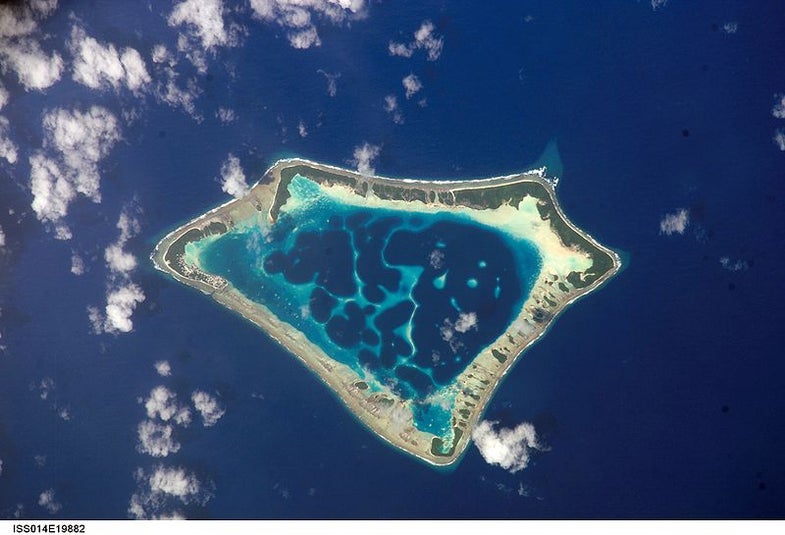
The Tokelau Atoll Of Atafu, From Space NASA Johnson Space Center

The remote island chain of Tokelau, positioned between New Zealand and Hawaii in the Pacific, suddenly has a significant claim to fame. Tokelau has become the first territory able to meet all of its electricity needs with solar power, officials say, completely weaning the string of atolls off of the diesel generators it has relied on for decades.

Tokelau--which is made up of the Atafu, Nukunonu, and Fakaofo atolls--is administered by New Zealand, and it was New Zealand that made the $7 million investment in the territory’s energy future. With solar stations on all three atolls (the last of which was completed this week) the three main atolls now have the renewable energy capacity to meet the electricity needs of all of Tokelau’s 1,500 inhabitants.

That doesn’t necessarily make Tokelau a model for the future, but it is significant for a few reasons. It’s true that a remote, sunny island chain with 1,500 inhabitants is not a fair analog for the world’s densest cities, or even its less dense regions that are more developed. But remote regions of the world need energy too, and they often get it through running dirty, inefficient diesel or gasoline generators that suck up economic resources while adversely impacting the environment. Plus there are high transit costs--financial and environmental--associated with the transport of liquid fuels to remote areas (like the middle of the Pacific Ocean).

So the investment in solar, should the maintenance costs remain below a certain threshold, will not only pay environmental/ecological benefits but will also free up economic resources for social and economic development on Tokelau. It’s not a cure-all or a model for the rest of the world, but a demonstration that in the right situation renewables like solar can make perfect sense.

[BBC]

9 Comments

I wish these islands well. I wonder how this strings out on the true balance sheet of energy produce verse the cost for installation, life expectancy of the solar panels and replacement parts and batteries. Over all, when all things are considered, I hope this works!

Congrats Tokelau! You are free from your oil addiction.
Enjoy your freedom!

you know I really tire of people saying these kind of projects can't be done cuz of the cost. Well hate to tell all you of retard logic people it does not matter the cost if we have no planet to worry about it on. Just saying.The ONLY reason this entire world is not running on 100% clean renewable energy is greed period bottom line.

Well, when the shape of your atoll forms the outline of the Superman logo, how can you help but go wrong?

Also, I wonder if they've implemented wind power there at all? Seems like that area of the world might find wind generation quite beneficial due to abundance and consistency.

Maybe this is obvious but . . . what keeps the lights on at night?

SteelyJoe22,
Solar panels send a 12vdc or 24vdc or 36vdc to batteries to store power. It depends upon the installation and configuration. The stored power later when utilized is put through a power converter to make 120vAC or 220vAC at 50 Hz or 60 Hz as needed. The power converters come in varieties too.

So to answer your question of what keeps the lights on at night, the on switch to the chosen light fixture and the stored power from batteries sent to the light bulb via a power convertor.

Solar energy always does better on smaller scales.

Solar's greatest weakness is flux, and smaller scale systems have less quantity of flux (even if they have a greater percentage of flux in usage).

Since power storage is a primary concern, an island chain of three islands with a total 1,500 population (with rather low per-capita consumption, since AC/Heat are not commonplace) has an easier time with the facilities necessary to store power for peak consumption and low production periods.

Still, this is not solar competing with typical municipal power. This is solar competing with high cost import diesel generators. If your choices were to run your house on a diesel generator or solar - solar would look more attractive.

A applaud the domestic energy production, however, as domestic production is a necessary global step for improving energy consumption efficiency.

At least the article, at the end, does make mention this model is not transferable to developed areas. A Google map of the island and I see no industry, heavy industry, hell not even an airport! just simple homes and what looks like a few Tiki Bars. The houses are not McMansions, little less than summer Florida huts. Easy to have battery backup for a low demand system like that. Further the assurance that the next day will always be sunny (310+ days) makes solar a good fit. Try this in Seattle, WA!
Nice to see many comments show an understanding that what works in one unique situation cannot be applied everywhere.
So to recap...IF you live on a REMOTE island, and the diesel fuel for the generators has to be shipped in...solar may be a good alternative. If you can get others (new zeland) to fund the upfront costs. Else each man, women, and child on the island owes about $4,700 for purchase and installation cost.

Like with many electronics, these solar panels will expire one day, the batteries and power converter systems. I do hope they plan the cost to remove these items in the future and DO NOT pollute their own environment and waters.

Oh, to those who praise and adore nuclear energy and draw a blank face on the accounting and environment problems when taking in the cost and practicality of waste.

Yes, there are cleaning ways to use nuclear energy and I hope they do come into play soon.

Planning needs to done from not only the beginning of energy production, but also the end life of energy, clean up of the environment needs planning too!


June 2013: American Energy Independence

Five amazing, clean technologies that will set us free, in this month's energy-focused issue. Also: how to build a better bomb detector, the robotic toys that are raising your children, a human catapult, the world's smallest arcade, and much more.


Online Content Director: Suzanne LaBarre | Email
Senior Editor: Paul Adams | Email
Associate Editor: Dan Nosowitz | Email
Assistant Editor: Colin Lecher | Email
Assistant Editor: Rose Pastore | Email

Contributing Writers:
Rebecca Boyle | Email
Kelsey D. Atherton | Email
Francie Diep | Email
Shaunacy Ferro | Email

circ-top-header.gif
circ-cover.gif