There are lots of different kinds of animal intelligence, and actually a lot of debate about what “intelligence” even means. According to The Smartest Animals on the Planet by Dr. Sally Boysen, recently revised and updated with new studies and sections, you can break down animal intelligence into a few categories: social learning, mirror self-recognition, numerical abilities, language comprehension, cooperation with others, and altruism.
Most of the animals in the book are the ones you’d expect: apes, monkeys, dolphins, and parrots. But there are a whole mess of highly intelligent animals you might not expect. What we’re saying is, if you really want a smart pet, don’t get a dog or cat. Get a domesticated raven.
Click to launch the gallery.
New Caledonian Crow
The New Caledonian crow is a member of the corvid family, which also includes ravens, jays, and magpies. Corvids are considered the most intelligent bird species, and their tool-making abilities rival or surpass those of great apes–in fact, their puzzle-solving skills are about on par with a 5-year-old human child. Crows are the only non-primates to consistently complete the “stick and tube” puzzle, in which a piece of food is placed halfway down the length of a clear tube. A long stick is placed nearby. To get the food, the animal has to use the stick to poke the food out of the tube. Crows complete this task easily and spontaneously, without having to watch another crow do it first–and even without having seen a clear tube before. The New Caledonian crow is also the only non-human species to invent new tools by modifying existing tools. It then passes those new creations onto other crows in its social group. The crow is able to use tools to retrieve other tools, and it can create tools out of materials it has never seen in the wild–again, the only non-human to do so. In an experiment at the University of Oxford, two crows were presented with two types of wire, one hooked and one straight. The hooked wire was needed to retrieve a tiny pail containing food from a tube. But when one of the crows grabbed the hooked wire and “made off,” the second crow bent the straight wire into a hook and snagged the food. These crows had never seen wire before.
Monitor Lizard
We tend to not think of lizards as particularly intelligent, and many aren’t–but the scary dinosaur-like monitor lizard is highly intelligent. Studies have shown that it can “count” to six: in an experiment, lizards were given a sequence of snails–four at first, then up to six–to condition them to expect that number. After they’d eaten all four snails, they’d be let into another room with four more. But when given only three, lizards conditioned to expect four snails continued to search for the remaining snail, even with the room with bonus snails now accessible. Monitor lizards are also known to work in concert with each other to secure food: one will lure a female crocodile away from her nest, while another starts chomping on some delicious alligator eggs. The decoy will then sneak away and back to the nest for some eggs of its own. Oh, and Komodo dragons, a type of monitor lizard, at the National Zoo in Washington, D.C. seem to recognize their keepers. Reminder that Komodo dragons are 10 feet long and sometimes eat people.
Portia labiata
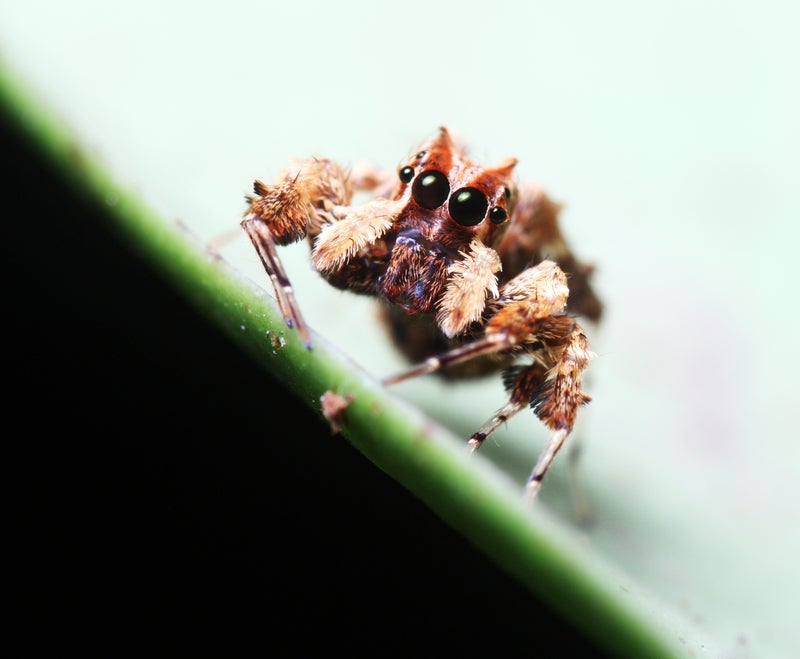
Say hello to Portia labiata, a species of jumping spider mostly found in Southeast Asia. Or, don’t, because it’s an evil genius hunter and why introduce yourself to something that would and could murder you if it were just a little bit bigger? Frequently called an “eight-legged cat” due to the cleverness and ingenuity of its hunts, Portia can improvise hunting techniques and then, by trial and error, remember which are most effective against which kind of prey. And its techniques often demonstrate a fairly high level of intelligence, or at least craftiness–it mostly hunts spiders, which are generally clever hunters, so its intelligence is all the more impressive. It’ll take detours around dangerous prey to find the best attack angle, even if it requires hours of work and means the spider loses sight of the prey. Perhaps its scariest technique is the “pluck.” All web-weaving spiders use the web as a sort of extension of its senses–it can feel the vibrations of all kinds of possible prey and recognize what might be tasty and what might be dangerous. But Portia is a talented mimic–it can “pluck” a web with near-limitless variance, able to make a sound that can lure a spider out into the open. But what that poor spider thinks is a delicious fly is actually Portia, which pounces.
Common Rat
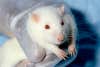
Rats aren’t just classic lab animals because they’re common: they’re also chosen because their social structures resemble those of humans in many ways. And since our understanding of “intelligence” is heavily informed by our own intelligence, we tend to classify smart animals by how much they behave like us. Rats are able to count. In one experiment, rats had to learn that food is in the fourth of a line of boxes. After learning this, no matter how many boxes were placed, no matter the size or color or shape of the boxes, the rats were able to pick out the fourth one and retrieve the food. Another study tested their numerical abilities as timers: most animals can’t measure time intervals, but rats, when conditioned to press a button to retrieve food every 15 seconds, can accurately keep time in their heads. Rats also demonstrate altruistic behavior, a key element of social intelligence. In this study, rats freed other rats from cages, even when there was no obvious reward.
African Hornbill
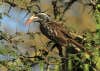
The African hornbill is one of the few species of animals that can understand the language of another. More specifically, the hornbill is conversational in Diana monkey. A study at the University of St. Andrews found that African hornbills are able to understand the warnings of the chatty Diana monkey. The monkey gives distinct warning calls to other monkeys based on possible predators it sees. The warning for a leopard is different from the warning for a crowned eagle, for example. Researchers noticed that the hornbills would scatter upon hearing the warning for the eagle, but not for the leopard, because the leopard isn’t much of a threat to an animal that can fly. Researchers tested this by playing back recordings of both of those calls, and sure enough, the hornbills only responded to the eagle warning.
Live-Bearing Tooth Carp
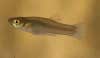
The live-bearing tooth carp, otherwise known as the mosquitofish or gambezi, is a small freshwater fish that’s commonly introduced in mosquito-heavy areas to eat the larvae. It also demonstrates the ability to distinguish between group sizes–in other words, it can count. Up to four, at least. In an experiment conducted by the University of Padova in Italy, female mosquitofish being harassed by males were found to retreat to the largest group of other mosquitofish, up to four–it would always choose a group of four over a group of three. After four, its choice seemed to be random. That might seem simple, but most animals (and certainly most fish) have no numerical sense at all. The finding is similar to one made while studying lions–lions can count the number of roars of unfamiliar lions, and react accordingly by sending more or fewer lions to investigate. A two-lion roar will call for a two- or three-lion investigating committee, while a three-lion roar will call for four.
Vampire Bats
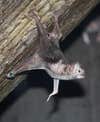
The nightmarish vampire bat might not seem like a team player, given that it’s a parasite and all, but in fact it demonstrates some pretty advanced social intelligence. It’s in the best interest of a small animal like the bat to maintain a healthy and large community, and vampire bats, as it turns out, are capable of reciprocal altruism–basically, doing favors. Research by Gerald Wilkinson showed that bats share food (fine, they regurgitate blood. Happy?) with bats who are hungry, regardless of whether the hungry bats are close relatives. In fact, writes Boysen, “the bats seemed to keep track of who had shared with them in the past, and they were much more likely to reciprocate with those who had been generous to them on a previous occasion.”
Squirrel
Most animals that have managed to adapt to cities are pretty intelligent; raccoons, for example, are curious and bright animals. But even the ubiquitous grey squirrel shows a great deal of cunning–and it’s mostly shown through its finely honed sense of paranoia. Grey squirrels have been shown to engage in fakery–they’ll make elaborate burials, like the ones they’d make to store food, only they’ll have no food in them. A Wilkes University study found that about a fifth of all squirrel food burials are fake-outs, and that percentage goes up when the squirrel is being watched. It’s the only study to show behavioral deception in a rodent. Wild ground squirrels in the western United States show altruistic behavior as well. Ground squirrels have two kinds of alarm calls: a “whistle,” for avian predators, which causes all squirrels to dash into their burrows, and a “trill” for ground predators, which causes all squirrels to “post” and look around to see what’s going on. The whistle is selfish; with all the movement, a predator can’t really tell who gave the alarm. But a trill brings the most attention on the alarm caller. As it turns out, females are the only ones who give the dangerous trill alarm–and often when near vulnerable youngsters.
Anole
Puerto Rican anoles–a very common type of lizard, even sold in pet stores–was the subject of an experiment at Duke University that indicated its ability to learn is much higher than previously thought. The anole was presented first with two small wells, one empty and one with a worm, but covered by a cap. The anoles quickly learned to bump the cap out of the way–a behavior they’ve never exhibited in the wild. Then the wells were both covered, one with a bright cap and one with a dull cap, with food consistently under the bright cap–and the lizards managed to figure that out and go for the bright cap each time. Even after switching that experiment so the worm was under the dull cap instead, the lizards un-learned what they knew before after only a few trials and went for the dull cap. Most birds–generally more intelligent than lizards–were unable to solve this test as quickly as the tiny anole.
Honeybee
The honeybee has one of the most complex social systems of any animal, and has been studied more than most invertebrates, but much is still unknown about its intelligence. The most controversial element is the “waggle dance.” When returning to the hive after finding a source of food, honeybees perform an elaborate dance before collecting others to go retrieve the rest of the food. Dr. Karl von Frisch, working with Konrad Lorenz and Niko Tinbergen, won the Nobel Prize for Medicine in 1973 for their findings about the waggle dance. They suggest that the dance is an encoded message, telling other honeybees exactly where and how far away a source of food is, based on the angle of the dance, the speed of the waggle, and the time of day. Another side, not mentioned by Boysen in The Smartest Animal on the Planet, insists that the dance merely attracts attention, and that an “odor plume” is the real communication–so the bees can just follow the scent of the food to its source. But, honeybees are smarter than you’d think outside of their communication skills: they’re possibly able to form cognitive maps (so they can recognize landmarks to find their way to a food source, even when placed somewhere they’ve never been) and can complete color discrimination tasks. One study placed a specific color at the entrance to a tunnel with a fork midway through. At the fork, one option has that same color, while the other option has a different color. The matching fork is the one with food at its end. Honeybees were very quickly able to figure out this pattern, even when presented with new colors. By lengthening the tunnel before the fork, researchers showed their short-term memory is roughly five seconds–about the same as that of birds.