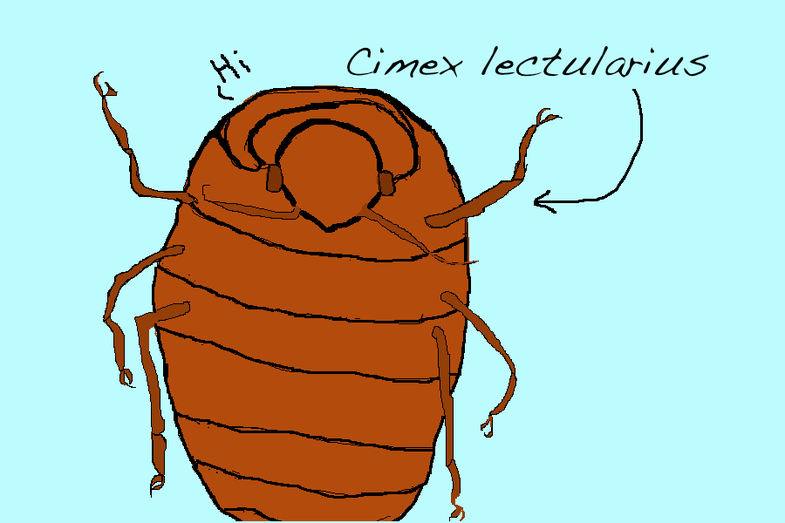
You probably know someone who has had bed bugs--or you’ve had them yourself. If not, chances are you will: since the late 1990s, bed bugs have spread across the U.S. and other parts of the world, making their way from coastal cities and travel hubs to inlands and smaller towns.
If you were born post-World War II in the U.S. or any other industrialized country, the news reports about bed bugs have likely left you scratching more than your heads. What are these things? Why haven’t they bothered us before?
Turns out they have. 3,300-year-old preserved bed bugs have been found in tomb builders’ sleeping quarters in an Egyptian archaeological site. The ancient Greeks even ate them. The most popular theory suggests early hominids lived with the bugs in bat-infested caves tens of thousands of years ago, and that the pest has been following us, its main food source, across the world ever since.
So why did bed bug numbers crash after WWII in some parts of the world and why did they swell again sixty years later? Now that the bug is back in our beds, what is it doing to us psychologically, socially and economically?
I try to answer these questions and more in the book I'm writing (University of Chicago Press ~2014). But I need your help. I have a Kickstarter page going to help raise extra travel funds to go to bed bug labs at universities, to public housing hit hard by the pest and maybe even to Ebola-tainted caves. Rewards include signed copies of the book, original bed bug artwork and more.
Brooke Borel is a contributing editor at Popular Science and is writing a book about bedbugs for the University of Chicago Press. Follow her on Twitter @brookeborel.
Five amazing, clean technologies that will set us free, in this month's energy-focused issue. Also: how to build a better bomb detector, the robotic toys that are raising your children, a human catapult, the world's smallest arcade, and much more.


Online Content Director: Suzanne LaBarre | Email
Senior Editor: Paul Adams | Email
Associate Editor: Dan Nosowitz | Email
Assistant Editor: Colin Lecher | Email
Assistant Editor: Rose Pastore | Email
Contributing Writers:
Rebecca Boyle | Email
Kelsey D. Atherton | Email
Francie Diep | Email
Shaunacy Ferro | Email
Bedbugs are back because evolution is real. So much for faith.
Q: Why Are Bedbugs Back?
A: Give me $25 and I'll tell you in 10 months!
Wow
Could it be they are back because DDT has been banned?
I can't believe POPSCI signed off on this as an article, mentioning your kickstarter/upcoming book is one thing, but cutting off mid-article for pandering is just embaressing.
By the way everyone, I'm starting to feel angry about this article, but I need your help. I have a Kickstarter page going to help fund my disgust. Rewards include original bed bug artwork, CDs from my band "The Bed Bugs", and more.
@yosifcuervo
You echo my exact thoughts. DBrigner, so did you. Ever since PopSci got a new editor, I've noticed a significant decrease in article quality.
This isn't an article, it's an ad. You put an ad in as an article?
this "article" is bad and you should feel bad....
I have said this before on many of the recent articles. PopSci is going downhill.
I agree with everything that has been said above about it.
They were never really gone.
So, if I kickstarter, say, my mortgage and promise to write a very nice "thank you" note to all who donate, and post it here, I would be banned for marketing.
Seriously, Pop-sci - are you getting a cut of the book? Free real articles from this writer? A satisfying oral performance?
She can post ads because she works there. I think I saw a yard sale article written by another contributor on the main page.
Here's a question for you...why does this "article" look like an ad for your book?
I agree with Newbeak5. They're back for the same reason that malaria is once again killing millions of children - the well meaning but erroneous banning of DDT.
The bedbuy has a 'diet' , just like humans are SUPPOSED to have a 'diet'. The diet of most pathogens and creatures is high in a metal. The metal is iron. This iron , as many have pointed out , is required by all lifeforms. The PROBLEM is man is a herbivore eating meat , a highly absorbable form of iron. Normally , the human body contains a 'small' amount of iron and when that is full the body simply downregulates the percentage of iron absorbed from a meal to keep that storage just 'topped up' , absorbing very little , enough to offset the measly 1 mg a person loses through skin loss and sweat. Meat iron , though , 'sneaks in the back door' , and builds in the body , age-related iron accumulation , it is called now , and it causes the body to have high levels of iron in the skin which allows the bedbugs , which eat the skin , to survive and propogate , out of control. Pretty simple. THAT is why they are now adding iron chelators to deodorant to bind up the iron , keeping it away from the bacteria.
"Starving the bacteria that cause body odour of the iron they need to grow may soon arm deodorants with an extra stink-stopping weapon."