Failure is supposed to be a bad thing. In materials science, however, understanding and predicting how a new fiber, composite material, or type of plastic breaks, snaps, melts, fractures, or rips can mean the difference between life and death. Engineers need to know if an armored steel plate will stop a high-velocity bullet or whether a specialized car-seat foam will effectively absorb the impact of a crash.
Destructive testing can also help scientists figure out how to enhance a given material’s properties, as with composites for aircraft wings or polymers used in electronics. Across the U.S., dozens of labs concoct elaborate and sometimes genuinely perilous tests in the name of safety and knowledge. PopSci spoke with materials scientists, CEOs, and researchers to find four of the most extreme labs in the nation.
Click here to enter the gallery
Man On Fire
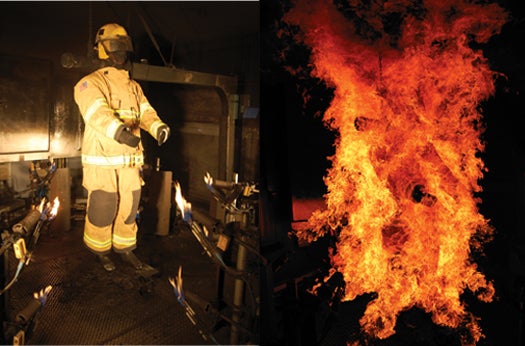
When DuPont debuted its Nomex flame-resistant fiber in 1967, people were curious to see how it performed. So in the early ’70s, DuPont created Thermo-Man, a six-foot-two mannequin surrounded by a dozen propane torches, to demonstrate the material’s abilities. The company has been regularly updating Thermo-Man ever since, using it to test the properties of new textile fibers such as Protera, which debuted in 2009 and protects industrial workers against electric arc exposure. Today’s Thermo-Man can reach temperatures up to 3,500°F and has 122 sensors that constantly relay data to a nearby computer; it is sometimes used as a testing tool for the designers who incorporate DuPont’s fibers into garments. In one trial, DuPont senior research chemist Richard Young says Thermo-Man revealed that the sleeves on a first-responder’s uniform might hinder Protera’s ability to prevent burns. A typical Thermo-Man test lasts between 3 and 10 seconds, but rarely goes longer than that. “At 20 seconds, we’ll start melting metal,” Young says.
Warehoused Lightning
Earlier this year, a direct lightning strike forced the pilots of a private jet carrying French president Françoise Hollande to make an emergency landing in Paris. Though the jet, upon inspection, was only minimally damaged, the risk was serious: Lightning can melt a hole through a plane’s wing or short-circuit its electronics. Aircraft designers prepare for strikes with the help of companies like National Technical Systems (NTS). At its Pittsfield, Massachusetts, facility, NTS researchers pit wing sections, other aviation components, and scale-model aircraft against artificial lightning. When a researcher activates a Marx generator, a bolt of electricity jumps the gap between an electrode and the test object. The bolt passes through the object and terminates on an aluminum plate. The results are dramatic. “We’ve had hinges weld. We’ve had panels and structures punctured through, and engineers have had to rework a design,” says NTS general manager Mike Dargi. “Plenty of times, our customers have to go back to the drawing board.”
Crash Sled
Side-impact crashes account for only 25 percent of car collisions involving children, but they inflict a disproportionately high number of injuries upon kids in car seats. To better understand how a seat’s foam padding affects the occupant, the Dorel Juvenile Group, a company that specializes in car seats and strollers, designed a crash test specifically for side impacts. At its Technical Center for Child Safety in Columbus, Indiana, an 80-foot-long air-powered sled accelerates car seats, padded with experimental foam cushioning, to speeds between 15 and 25 miles per hour, and hurls them sideways against a mock version of an oncoming car. When the company experimented with a new shock-absorbing foam, says Dorel design engineer Dave Amirault, the tests revealed that denser foam transferred too much force to the occupant too quickly, as did a foam with excess porosity. Through repeated crashes, the designers settled on an ideal density, and they have since incorporated the foam, G-Cell HX, into one of Dorel’s infant car seats.
Ballistic Birds
In 2009, birds sucked into the engine of US Airways Flight 1549 forced Captain Chesley “Sully” Sullenberger to land the plane in the Hudson River. Since then, the engineers at Element Materials Technology, a test lab in Jupiter, Florida, have seen interest in the company’s bird-strike tests spike. To re-create a strike, technicians stuff a chicken carcass inside a fiberglass casing known as a sabot and then ram it down the barrel of a 22-foot-long air cannon. When launched, the bird flies out of the barrel at speeds between 100 and 300 miles per hour and slams into the target. Element’s Jeff Lucas has seen poultry punch through new carbon-fiber wings. He says that Lexan, used in aircraft windshields, holds up most consistently. But Element scientists may find Lexan’s limit yet: They plan to chill one side of the nose of a plane with liquid nitrogen to simulate flight conditions.