A Stanford professor is trying to teach doctors and scientists how to write manuscripts that aren't dusty and jargony.
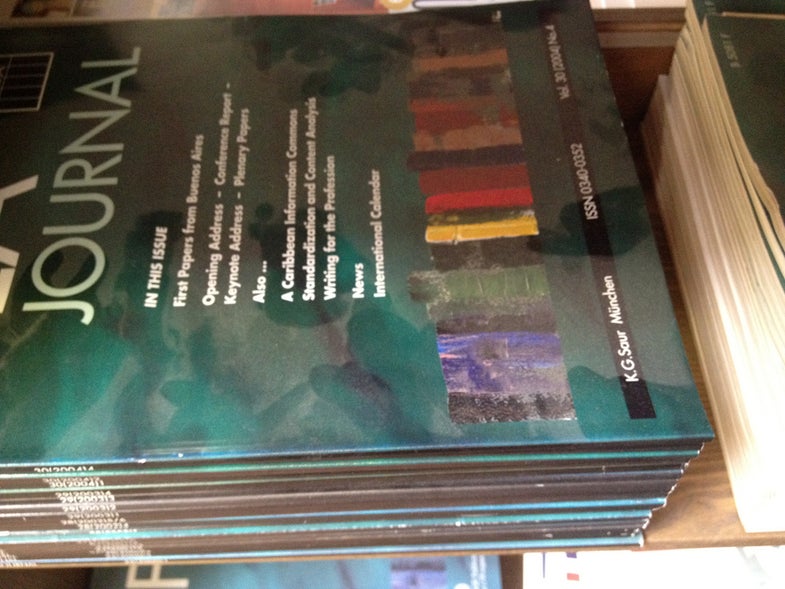
Dusty Academic Journals Mace Ojala via Flickr

Reading through scientific papers can be a terrifying experience, and not just because of the jargon. Take, for example, this string of words: “We classified injuries as initial or subsequent injuries. An initial injury was defined as the athlete’s first injury incident during the season. Subsequent injury was defined as any injury that occurred after the initial injury, including re-injury to the same body part or a subsequent new injury to a different body part. Total injuries included all injuries recorded, initial and subsequent.”

Eyes bleeding? It should be so much simpler than that!

Stanford University epidemiologist Kristin Sainani is on a mission to improve matters, turning scientists into people who can communicate their research in actual English. “Academia has a way of writing that can be very challenging to read,” she said. “It keeps a lot of people from being able to read it. Scientific literacy in this country is a whole other topic, of course, but part if it is that it’s really hard to read science.”

In a new massive open online course called "Writing in the Sciences," Sainani--who is also a science writer--aims to teach budding scientists some things that may seem obvious to writers and readers, but aren’t in a science grad student’s typical curriculum. “They sit down to write their first manuscript and they’re like, 'OK, now what do I do?'” Sainani said. Here are some takeaways that can apply to anyone:

Research has shown that the use of the passive voice is ineffective.

Scientists, use active voice instead! Put your object first: "Why did the chicken cross the road?" Not "Why was the road crossed by the chicken?" Sainani said some students believe passive voice sounds more authoritative, but it doesn’t. “There’s a tradition in academia of using a lot of nouns instead of verbs, and of using the passive voice. You’re exposed to that, so you think, ‘If I don’t sound this way, I’m not going to be part of the club,’” Sainani said.


There’s no need to pepper otherwise clear prose with unnecessary jargon and repetitive, clutter-inducing sesquipedalian verbiage.

“For students, when you are joining an academic field, it’s quite intimidating. You feel like you need to throw in all the big words and the jargon to show that you’ve mastered it,” Sainani said. But shorter and clearer is usually better. If your paper is about something like somatostatin-expressing inhibitory neurons, you probably have to use that jargon, but it helps to steer clear of thesaurus words when they’re unnecessary. In one homework assignment, Sainani asks students to find substitute words for important-sounding jargon.

Example: “Give a short word that means the same thing as ‘utilize.’”

Verbs should have some kind of action inherent in them.

Action words speak louder than passive constructs. Say what happens in an experiment: The bacteria are multiplying, the particles are speeding, the stars are exploding. A homework assignment asks, “What is a single verb that means the same as ‘have a discussion’?”

Don't verb.

Writers should nose around for verbing, and table any word that turns a noun into a verb. Sometimes this can work well, especially when the verbification happens to a proper noun (like Ronald Reagan). But generally, this is ill-advised. The opposite is also true: Verbs should not all be nounized. The next time I hear the phrase “I have a deliverable,” I’m going to scream.

Paragraphs should have a focused structure, centering on a Big Idea.

“A lot of scientists are never taught this. You learn to write the way you are exposed to in other papers,” Sainani said. “It propagates this idea that you are supposed to write in this obscure language that is hard to read.”

She said students often tell her they think their work doesn’t sound official enough if it uses active voice and employs clear language, parsimony and brevity. But scientific research says the opposite is true. Take this fantastically titled paper by Daniel Oppenheimer at Princeton. “Consequences of Erudite Vernacular Utilized Irrespective of Necessity: Problems with Using Long Words Needlessly” examined subjects’ perception of an author’s intelligence based on his or her vocabulary. As other studies have, it showed you’ll be perceived as more intelligent if you can write clearly and simply.

So far, about 35,000 people have registered for the free online course, but Sainani thinks many of them are casual observers. Some are professors considering building their own similar programs, she said. She hopes scientists realize it’s important not only to be clear and concise in their research, but also in conveying that research to others.

“There has been this idea that the science is paramount, and all the other little details, like how do you communicate, you’re expected to just pick that up as you go along,” she said. “But people are starting to realize effective communication is important.”

8 Comments

This article makes me very sad.

Is the paragraph “We classified injuries....recorded, initial and subsequent.” hard to read? Not in the slightest. It very clearly and succinctly defines the vocabulary they are going to use for the rest of the paper in such a way that you cannot possibly confuse what it is they mean. I can't possibly see a reduction of that paragraph that would give the same concreate definition of the terms being evaluated.

Beyond that, it's not like there are any complicated words in that paragraph. I would expect a reasonably competent middle-schooler to be able to understand that paragraph without too much trouble. When did words like "utilize" become "big words", to move further along in the article? There are tonal and professionalism reasons to use "utilize" instead of, well, "use." But it's all contextual. There are situations where it's just as valid, and easier to read, to use "use." Or "employed."

Moving on, the 'assignment' “What is a single verb that means the same as ‘have a discussion’?”. .... Last I checked, "discussed" means the same thing as "to have a discussion". In fact, if you look it up, that is the DEFINITION of "discussed." If you don't know which to use and when, you have gramatical problems, not jargon problems.

As a graduate Robotics Engineering student, I certainly understand the need to educate scientists and engineers on proper writing techniques, because they really are a mess sometimes. But to attack jargon itself seems a large stretch. If you know how to write well, you'll know when to use jargon when it is required, and it will make your paper clearer than needlessly simplifying it in the name of making everything "easy to read."

Finally, a deliverable is actually a very well defined term in most engineering fields. It actually very frequently has legal definition in contracts. There's even a wikipedia page on the term: http://en.wikipedia.org/wiki/Deliverable. If you can give me a word that conveys the same meaning without name-mangling some other term that is also used commonly in project management and engineering, I'll be impressed. It's not just a verbification for the sake of verbification.

aruisdante, I think you're missing the point.

These are all well-known tips from Strunk and White's Elements of style.

At the end of the day, I work in a multi-disciplinary field. It wastes my time having to learn new jargon from 5 different fields AND wade through unnecessary, complex wording.

Its just a complete, utter waste of time.
Plus, it discourages regular people to be up to date on research.

And it's pure BS to think a middle schooler would enjoy and understand that wording, pure BS. Just because you get it, doesnt mean the average person will comprehend and doesn't mean its worded terribly.

I know, I know, nerd cred is given based on how well you can comprehend this stuff. And being forc-fed drab literature doesn't help, but aruisdante, you're DEAD WRONG!

I agree with your general point, aruisdante, but I think you're nitpicking. The examples in the article might not be the most illustrative, but I don't see how you can argue that the advice being given is wrong. It all boils down to: get your point across, but do so as simply, clearly and succinctly as possible. That's good advice.

Grandiloquence that eschews brevity obtains. Verily, the thoroughfare was transversely transected by the wayward pullet.

Yes, they could have picked a better example but I totally agree with making the material more readable, not dumbing down the material but communicating it in a manner that doesn't make me want to quit reading after the first paragraph. Has anyone every had the pleasure of reading a professional psychological study? Yeesh!

Aruisdante was right we he said that PopSci is not exactly using the best examples for this. 'Utilize' is not verbose jargon at all, I used it all the time when I was in middle school. However, the main idea, the big idea of this article (and they did say that keeping the big idea clear is important) is clear: 'Nerd cred', as loveandchunkybits called it, is not worth having people give up on reading your article and look at the pretty visuals instead. Redundancy and repitition may look fancy and professional, but no amount of technical jargon is going to save you from getting a terrible grade in an English course. Scott Adams, cartoonist of Dilbert comics, once made a comic about how mismanagement occurs when managers resort to using jargonish garbage to make themselves seem smarter instead of communicating properly.

While an argument can be made for there being unnecessary complexity and jargon in articles, we also are in an environment where academic standards have been so compromised that even technologically agile people are hard pressed to understand sophisticated writing or express themselves adequately. Frequently, vital content with all its needed sophistication can be lost by dumbing it down. There cannot be a meaningful "Cognitive Neuroscience for Dummies". The fast food approach to conveying technical information, where a whole paper can hang on a concept or expression written in an explicit manner usually is devastating. Daily we can see how the media not only writes about science poorly but often inaccurately because of its effort to simplify for the masses. The answer is not pandering to the lowered educational standards but to present to the world the need to raise them. A number of subjects with their complex vocabularies and concepts require years of education to understand properly, and a disciplined and mature society realizes this. Yet, education has gotten short shrift (e.g.: low funding, ill prepared teachers, school board staffed by scientific illiterates), and it does not command the respect as in other countries. The problem in the U.S. is that we have "babyfied" everything. I am in accord with several of the other commentators that there really isn't anything especially convoluted or difficult about the passages cited.

@JeremyHornePhD

Awesome comment. I think it's besides the point, though. The above article doesn't state that we should dumb down scientific texts, it merely suggests "rules" to keep in mind when writing a scientific text. In effect, its message isn't "be dumb"... it's "try to be clear and concise". The operative word being "try". Your comment presents no arguments against trying to be clear.

You rile against pandering to the "lowered educational standards", but resisting the idea of trying to be clear and concise in one's writings is in itself lowering the educational bar. Knowing how to clearly express complex ideas is a higher standard which we should all aspire to.


June 2013: American Energy Independence

Five amazing, clean technologies that will set us free, in this month's energy-focused issue. Also: how to build a better bomb detector, the robotic toys that are raising your children, a human catapult, the world's smallest arcade, and much more.


Online Content Director: Suzanne LaBarre | Email
Senior Editor: Paul Adams | Email
Associate Editor: Dan Nosowitz | Email
Assistant Editor: Colin Lecher | Email
Assistant Editor: Rose Pastore | Email

Contributing Writers:

Kelsey D. Atherton | Email
Francie Diep | Email
Shaunacy Ferro | Email

circ-top-header.gif
circ-cover.gif