For the first time, scientists can actually observe the remnants of flowing water on Mars.
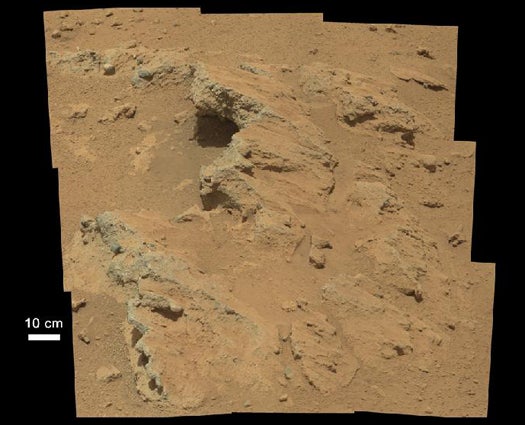
Observable Evidence Of Water On Mars NASA/JPL-Caltech/MSSS

Scientists have known that water flowed on Mars at one point, but until now, what that flow looked like has remained educated speculation. Now a discovery changes that. Mars rover Curiosity has found gravel that was once part of an ancient stream. This image shows the Martian rock outcrop where that gravel is.

There's a few facts we already know. Scientists started taking a closer look, and from the size of the gravel, we know the speed of the water in the stream (about three feet per second) and its depth (between ankle- and hip-deep). The roundness of the stones in the gravel even indicate they traveled long-distance, from above the rim of the Gale Crater (the slope of the crater is Curiosity's destination). We can also tell it wasn't a rare event; the stream flowed for years.

The bits of gravel varied in size from grain of sand to full-on golf ball, according to a statement from NASA. That means it couldn't have just been blown over by wind. Water made it happen.

So now that it has this find under its belt, what else is Curiosity searching for? More evidence of life. From NASA's statement:

The slope of Mount Sharp in Gale Crater remains the rover's main destination. Clay and sulfate minerals detected there from orbit can be good preservers of carbon-based organic chemicals that are potential ingredients for life.
"A long-flowing stream can be a habitable environment," said Grotzinger. "It is not our top choice as an environment for preservation of organics, though. We're still going to Mount Sharp, but this is insurance that we have already found our first potentially habitable environment."
During the two-year prime mission of the Mars Science Laboratory,esearchers will use Curiosity's 10 instruments to investigate whether areas in Gale Crater have ever offered environmental conditions favorable for microbial life.

[NASA]

8 Comments

Water flowed as recently as 100 million years ago on Mars? perhaps much longer. So with this much time frame, the above theory is just that a theory and inconclusive.

NASA best send me to Mars to check this out!
I'll start packing!

Get in line, Robot, I'm up there first. The stream could have been from Mars's earlier life, if my hypothesis is correct, and Mars actually is an exo-planet that miraculously survived a supernova, the frozen expanse of space, and then miraculously hit Earth and deposited the one-in-a-millionth-chance archaebacteria onto some lava mat.

If it turns out to have been a real river, than I suspect it's somewhere nbelow the surface. We need an excavator drone, or, even better, me and a few hundred mining consultants. Robot to, of course.

Get your facts first, then you can distort them as you please.
Mark Twain

Is it conceivable that one day in the 100 million year past a comet (composed of mostly water) slammed into Mars and existed for a time, causing run off, until the water eventually evaporated into space again. Of course, I am just day dreaming. I wonder how many different environmental things could happen over 100 million years.

Look at how much has changed in just the last 1000 years here, hell just the last 100. Now if the magnetosphere failed (which we know it did) and allowed the solar winds to shed the atmosphere, how long do we think it would take for Mars to *look* as if it had been 100 million years since water flowed, my guess, about is that 100,000 years of unsheilded solar exposure would create that 100 million year look.

Playing Devil's Advocate since 1978

"The only constant in the universe is change"
-Heraclitus of Ephesus 535 BC - 475 BC

Most water on rocky planets comes from chemical reactions during the formation of the planet as their magma cools. From chemistry, rocks have oxygen as a primary ingredient. Hydrogen, being the most abundant element in the universe is also present in the magma. The original magma is too hot for the hydrogen and oxygen to combine into water. As it the magma cools, separates into layers and makes new compounds, water is released from the chemical reactions.

Water can also be created in an oxygen rich atmosphere if a solar flare sends a coronal mass ejection towards the planet. The high energy particles of a CME are mostly hydrogen and helium. When the hydrogen reaches an oxygen rich atmosphere, it reacts to make water and reduce the oxygen concentration of the atmosphere. An average CME could produce about an inch of rain across an area the size of Texas.

Water can also arrive to a planet in the form of ice when a comet strikes.

Some say that all of a planet's water will evaporate into space if the atmospheric pressure is too low. After watching the triple-point of water in the vacuum training class, it seems more likely that the water would freeze into ice and stay.

Maybe that is true.

Thanks,
-Tony

While it seems a liquid errosion may of cause this, we do not know if it was water.

Mars has two polar ice caps. The northern ice cap is mainly composed of frozen H2O. The southern ice cap is mainly composed of frozen CO2.

i still kinda hope that there used to be water and possibly even life on mars

I think that there is a better chance of venus having it though, if not for its speed of rotation

The concept of water on Mars is the same as the concept of water on the moon. In reality, it means nothing. Instead it's just an excuse to keep pumping tax money into NASA projects. Think about it for a second- even if evidence of life was found on Mars, would it really have any effect on your personal life?


June 2013: American Energy Independence

Five amazing, clean technologies that will set us free, in this month's energy-focused issue. Also: how to build a better bomb detector, the robotic toys that are raising your children, a human catapult, the world's smallest arcade, and much more.


Online Content Director: Suzanne LaBarre | Email
Senior Editor: Paul Adams | Email
Associate Editor: Dan Nosowitz | Email
Assistant Editor: Colin Lecher | Email
Assistant Editor: Rose Pastore | Email

Contributing Writers:
Rebecca Boyle | Email
Kelsey D. Atherton | Email
Francie Diep | Email
Shaunacy Ferro | Email

circ-top-header.gif
circ-cover.gif
bmxmag-ps