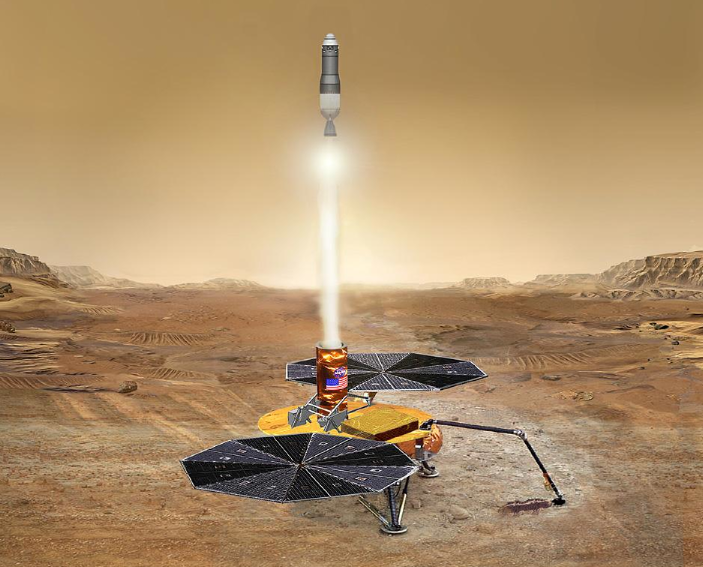
NASA’s next Mars moves should focus on bringing chunks of Mars back to Earth, possibly in a hand-off between a robot and an astronaut, according to a new planning document. Involving humans in a space-based rock swap would ensure the sample is protected and Earth is protected — and it would probably make sense anyway, given the timing and budget constraints for NASA’s Mars plans.
NASA's Mars Program Planning Group final report, released Tuesday, lays out several options NASA could pursue to bring samples of Mars rocks to Earth-based scientists, one of the key goals outlined in a major 2011 scientific priorities list. NASA is weighing those options but won’t announce its choice until early 2013, when the president releases his fiscal 2014 budget request.
Orlando Figueroa, who led the MPPG team, told reporters that NASA could start planning the mission’s overall architecture in the 2018 or 2020 launch windows, when Mars is close enough to Earth for a favorable journey. That’s likely to include a new Mars orbiter, in part because NASA has just $800 million to work with through 2018, not enough to launch another rover. The MPPG was created earlier this year in response to cuts in NASA's robotic exploration programs.
Mission pieces could include fleets of mini-rovers, two-axle vehicles that spool from landers and roll down hills, and even a supersonic sky crane for delivering cargo.
NASA also has to decide how many pieces to launch — a sample return mission could be a one-shot deal with a soil-collecting rover, a rocket to blast off Mars, and an orbiter to rendezvous with a craft in space or bring it back to Earth, or it could include those stages in two or three separate steps. The individual pieces are all still in design stages, and could include small landers; fleets of miniature rovers; two-axle vehicles that spool from a lander and can roll down slopes; an orbiting atomic clock for better telecommunications relays; and even huge supersonic-capable sky cranes for delivering heavy cargo.
Whatever it looks like, a sample return mission could very well involve people, said John Grunsfeld, associate administrator for NASA’s Science Mission Directorate and a former astronaut. Planning a sample return concurrently with human exploration could reduce costs and add redundancies that could make a mission safer. If NASA follows the timeline it’s on, it could be the late 2030s or even 2040s before a sample comes back from Mars — but that’s about the same timeframe President Obama set for sending humans there, Grunsfeld noted.
“If we can get a sample either in Mars orbit or coming back toward Earth, we can find almost serendipitous, just by planning, opportunities where a human can grab the sample,” he said. “Now that’s probably not a guy in an EVA suit with a baseball mitt grabbing a rock.”Rather, a sealed capsule, already protected with one or two levels of containment, would fly from Mars orbit or en route to the Earth-moon system and rendezvous with a space capsule, where humans could grab it with a robotic arm and put it in a protective bay.
“Returning the humans is part of the requirement. So you put a high degree of redundancy and effort into making sure the crew gets back safely. That would be an effective way of making sure the samples get back safely,” he said.
Deciding where to go get the rocks would also require debate. To date, NASA has avoided landing in any potentially warm, wet or salty locations on the Red Planet where life might be found, or at the very least where it might survive once it landed — but rocks for those environments could be precisely the ones scientists most want to get their hands on.
“We know there is life on Mars, because we’ve sent the life there on our rovers,” Grunsfeld explained. “If we want to go detect potential Martian life in a current habitable environment, we need to work a lot harder to not contaminate Mars with microbial life that we brought with us, and that is still a challenge.”
The clock is ticking, and now NASA officials will pore over Figueroa’s document and decide how to set priorities for the new budget, Grunsfeld said.

Five amazing, clean technologies that will set us free, in this month's energy-focused issue. Also: how to build a better bomb detector, the robotic toys that are raising your children, a human catapult, the world's smallest arcade, and much more.


Online Content Director: Suzanne LaBarre | Email
Senior Editor: Paul Adams | Email
Associate Editor: Dan Nosowitz | Email
Assistant Editor: Colin Lecher | Email
Assistant Editor: Rose Pastore | Email
Contributing Writers:
Rebecca Boyle | Email
Kelsey D. Atherton | Email
Francie Diep | Email
Shaunacy Ferro | Email
“...We know there is life on Mars, because we’ve sent the life there on our rovers,” Grunsfeld explained. “If we want to go detect potential Martian life in a current habitable environment, we need to work a lot harder to not contaminate Mars with microbial life that we brought with us, and that is still a challenge....”
It’s a disturbing comment, learning we have contaminated Mars. Following that logic, should we return material from Mars to Earth, we may contaminate Earth with a Mars microbial life. Now that life form may have null effect or could it kill all human life on Earth. And should that microbial life from Mars do its dirty killing say over several hundred years, we humans would probably do nothing as much as so many humans continue smoking, polluting the Earth, consuming Earth’s resources and continuing making Earths animals go extinct.
Sigh... science is working so hard towards suicide, I wonder.
You're such a debbie downer.
johnt007871,
I looked over your profile sir. I appreciate you have comment so much and for so many years. Well done!
I wish more people would comment. Take care. ;)
I want to have the first pet rock from mars! LOL! On a serious note, I can't wait to see what turns up when they actually get core samples and excavator robots up there.
We are jumping the shark a bit on Mars.
Not that Mars is not great or that NASA should not reach for far out goals - but their are plenty of interesting planets (and planet-like objects) in the solar system that we could put our RVs on as well.
In the short term, however, utilizing space resources (meeting, moving, refining, and crafting from space objects) should be a higher priority. I know that there are already private ventures looking that direction, but NASA could be leading the charge on grabbing big rocks, putting them into our orbit, and building the technologies to break them down and build them back up into useful - already in space - materials.
Once you are building your rovers IN SPACE, then the cost plummets for them and the size capabilities explode.
comon bubba gump ! if it was so dromatic you wouldnt be on this site... we all know you like science, so might as well enjoy it a little once in a while...
---
bored? lets go mine the stars... ^^
I see no hope. It's all gloom and doom, once we bring back life from Mars, we're all gona die. Life will be with no cookies or milk or anything MAN!.... arg!
It's sad to think that the USA, the great nation that it is, was able to pull it's massive amount of man power together and get to the moon. Yet now, the government is content with spending over 500 billion a year on military expenses, while giving NASA, the people who are driven to advance the human race, 800 million dollars over the course of what 6 years?
Our race needs to get its priorities straight...
I would love to see a robot-to-human handoff in Mars orbit.
Why do we still have drones on Mars? We have had PLENTY of time to put men on Mars, and Mars would be a better position to mine the asteroid belt (tip of the hat to you, Oakspar77777, and to vt007), and then we can simply just ship the processed raw materials to Earth. Rovers should be on the mons of JUPITER by now.
We put men on the moon with the tech I carry in my pocket. It's sad that we cannot have a global space agency that is focusede on the solid fact: We need Mars.
Get your facts first, then you can distort them as you please.
Mark Twain
The problem is, when we sent people to the moon, we were willing to kill some people to get there.
Two world wars had taught us that some goals, like peace, were worth the price of blood.
Now we exist in a liability hell that demands triple redundancy for EVERYTHING, sending cost through the roof in every way (materials, R&D, transport and fuel, etc).
The risks involved in the Apollo missions would never be tolerated by NASA today - and every occasional, unavoidable tragedy makes them more gun-shy.
Why do you think it is so much cheaper to go up with the Russian (or even private enterprise)? They don't mind kicking some rust off of a tool and using it.
If we cared, we could probably put a rocket together and put somebody there inside of a month (dust off some old tech, patch together some new). There is no longer the will for such endevours any more.
We could also likely put someone on Mars next year if we wanted to, though the odds of getting them there and back would not be great if we did.
It could be advantageous to first create a rocket that can land safely and return to orbit, since that technology will have to be developed before either sample return or manned missions (or both) can actually be completed. A first rocket capable of returning to orbit might simply drop a clamshell bucket to the surface and hoist samples up to the cargo chamber until it is full.
Subsequent unmanned missions of that kind could deploy one or more prospector rovers for the purpose. Or, a larger rover could be landed near an already placed return rocket, collect rocks in an chamber designed for the ascent vehicle, then withdraw from the launch area while the rocket ascends to orbit. The rover would continue its mission. Martian orbital rendezvous techniques could be developed for these missions also.
Manned missions are not an urgent priority, though of course pride and ambition are always ready for the sacrifices. The long-range fundamental technological errors in even such local craft as the Shuttle fleet have to be worked out also. There are millions of years beginning in this currently much coveted thousand-year new millennium. The third, that is.
I'd suggest patients; time results in superior energy resolutions, aka h >= E * t.
First of all, we already have geological samples from Mars, in the form of meteorites.
Second of all, for the billions of dollars in US taxpayer money it would cost to bring these rock samples back from Mars, would that cost be justified? Probably not.
Whether or not there was liquid water present on Mars millions of years ago, or even some primitive form of life, it will have no real effect on my personal life. However, the additional tax burden on me from the project will definitely have a negative impact.
The fact is that neither the US nor NASA want to just hand out all geological, mineralogical, and chemical information. This is about detailed mining information. These first detailed investigations shouldn't mix if they don't have to include life issues, because it's not the question of, or limitations borne out of life being on that world. The question is how to gain resources, now.