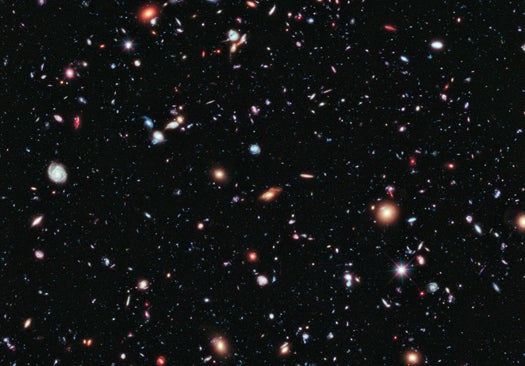
Take a deep breath, stargazers: this is the farthest we've seen into the heart of the universe. The eXtreme Deep Field, or XDF, as the photo's called, shows about 5,500 galaxies, although some are as much are only one ten-billionth of the brightness needed to be seen by human eyes.
The photo is actually something of a mosaic: there are 10 years' worth of photos from the Hubble Space Telescope. The Hubble Ultra Deep Field, an image showing a slice of space in the constellation Fornax, was assembled in 2003 and 2004 with data from Hubble; it was a major leap toward seeing the edges of the universe, but with help from an infrared camera attached to Hubble in 2008, along with use of visible light, we got what you see here, an image of what it's like closer than ever to the first galaxies.
[NASA]
Five amazing, clean technologies that will set us free, in this month's energy-focused issue. Also: how to build a better bomb detector, the robotic toys that are raising your children, a human catapult, the world's smallest arcade, and much more.


Online Content Director: Suzanne LaBarre | Email
Senior Editor: Paul Adams | Email
Associate Editor: Dan Nosowitz | Email
Assistant Editor: Colin Lecher | Email
Assistant Editor: Rose Pastore | Email
Contributing Writers:
Kelsey D. Atherton | Email
Francie Diep | Email
Shaunacy Ferro | Email
Did anyone else hear the Star Trek theme in their head when they looked at that picture long enough? lol
How much of the sky is represented in this image? Is this the relative up, down, or around the axis from our solar system, or could you wrap this around you in a sphere? Or is it just one direction out into the abyss?
Still, 5.5k galaxies, with countless stars each, with planets beyond imagining in each - and all so painfully out of reach as the moon was to the first man who saw it rise.
We have a long way to go as a species to even begin thinking about how to best use the resources of our one little rock and are just starting to scratch others.
Makes me wonder why people whine about peak oil, peak food, peak water and the like - when there is a universe THAT big and THAT rich just waiting for us to grow clever enough to harvest it.
If you look up the image on HubbleSite there is a nice comparison image showing the relative size of the area compared to the moon.
I be so happy the day we look out across the cosmos and we see a hand waving back! ;)
After looking this up, those 5.5k galaxies in the above mosaic, that's less than 1/10th of 1 degree of horizon. That's so small it's not funny, the moon takes up 1/2 of a degree of horizon (give or take a 10th. That boggles the mind with the potential amount of habitable planets in our universe. And the farther away we look, the older those galaxies are, makes one wonder when we'll reach the end of the time spectrum as Hawkin's predicted.
Playing Devil's Advocate since 1978
"The only constant in the universe is change"
-Heraclitus of Ephesus 535 BC - 475 BC
I'll bet that if you planted the Hubble telescope in the middle of the deep field and took the same type of
picture looking further out you would see just as many
galaxies as they are now. This deep field picture in my
opinion is nowhere near the end of the universe.
Oakspar77777
This planet and every resource on it is only valuable because we are stuck here.
The day we start branching out watch how everyone remaining here start to play nice with each other, because their enemies can just pick up and leave. THEN lets see if they don't need each other.
I have to keep reminding myself these aren't stars, they are galaxies.
And then you realize because of the massive distance from these galaxies that some of these galaxies might not even exist now or are light years away from where they appear.
Is that actually the visible spectrum or are those colors added??
So, everywhere we look it's all the same. Are we at the center of the universe then, back to where we thought we were at the center of the solar system?
I hope this type of knowledge makes people expand their horizons. Sometimes we choose to limit our perspective because it boggles our minds.
What a sight to behold.I get "I Ran" from A Flock of Seagulls, when i look at this.
Somewhere in Cyberspace
Seeing one of those tiny dust specks could represent our own galaxy the Milky Way containing 200 – 400 billion stars with 200 - 400 billion planets.
Infinite space could have a infinite universe, like the above opinion from margsbro, This deep field picture is nowhere near the end of the universe.