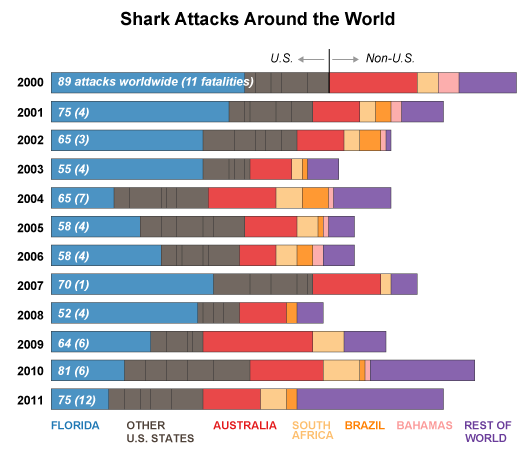
Shark Attacks Around the World Source: International Shark Attack File

At the Florida Museum of Natural History, filling up two five-drawer file cabinets are 2700 detailed accounts of shark attacks that collectively make up what's called the International Shark Attack File. The name of the database might be somewhat misleading—two recent stories suggest that shark-human interactions should be referred to as "incidents" rather than "attacks." But whether we think of them as vicious, violent killers or big, curious fish navigating cloudy waters, one thing is clear from the Shark Attack File: Sharks bite more people in U.S. waters than anywhere else in the world.

According to the File, 39% of the incidents in 2011 involving shark teeth sinking into unwitting human flesh occurred in shallow waters off U.S. beaches. That's way more than Australia, who racked up 14% of shark attacks last year to come in second. And yet, the United States' share of incidents was the lowest in over a decade—between 2001 and 2011, an average of 59% of confirmed, unprovoked attacks took place in U.S. waters.
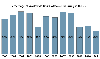
Percentage of Worldwide Shark Attacks Occurring in the U.S. :  Source: International Shark Attack File

Apparently, this trend doesn't have anything to do with the relative deliciousness of American thigh meat. According to an analysis by George Burgess, a shark researcher at the Florida Museum of Natural History and the current keeper of the International Attack File, "the number of shark-human interactions occurring in a given year directly correlates with the amount of time humans spent in the sea."

And that simple fact could explain why attacks in the U.S. have been on the decline. Americans have likely spent less time in the water since the recession, writes Burgess, limiting their exposure. That might not be the whole story, however; Burgess thinks that worldwide overfishing could also mean there are fewer animals out there mistaking a wetsuited human for a savory seal.

8 Comments

The top graph seems to be off or something wrong.
2005 & 2006 (first one) Florida are the same numbers, yet the graph is different for each of them. And the previous year 2004 is higher in number, but lower in length. The more you look, the more indiscrepancies.

@TheArtist - the reason the 2005/2006 Florida ranges are different is because in 2006 there were actually more incidents in Florida than in 2005, even though the overall number of attacks worldwide were the same. So, Florida was a higher percentage of the total in 2006. :))

I do not like to swim in the ocean. Everyone and eveything pee-s in the same pool. Ew! ;)

An average of 59% of confirmed, unprovoked attacks took place in U.S. waters.

I wander what constitutes provocation to a shark.

Interesting that since President Obama was elected, shark attacks in the US have been reduced by a considerable amount. Coincidence? I think not.

Elliot Klein,
I wish to applaud you for your well use of imagination and fantasy to make a point on this article in a completely unrelated way. I too imagine looking at Obama and squinting my eyes really really hard in seeing his disquise fall away and realize he is an outer space alien. Take care. ;)

This chick "The Surf Lady" Veronica Grey spoke about shark attacks on CBS Los Angeles this weekend just some hours ago,
I wouldnt mind if she took a bite out of me!

It's a bit presumptuous to conclude that there's something strange about there being more attacks in the U.S. than Australia. For one thing, there's something like 310 million people in the U.S. compared to around 19 million people in Australia.


June 2013: American Energy Independence

Five amazing, clean technologies that will set us free, in this month's energy-focused issue. Also: how to build a better bomb detector, the robotic toys that are raising your children, a human catapult, the world's smallest arcade, and much more.


Online Content Director: Suzanne LaBarre | Email
Senior Editor: Paul Adams | Email
Associate Editor: Dan Nosowitz | Email
Assistant Editor: Colin Lecher | Email
Assistant Editor: Rose Pastore | Email

Contributing Writers:
Rebecca Boyle | Email
Kelsey D. Atherton | Email
Francie Diep | Email
Shaunacy Ferro | Email

circ-top-header.gif
circ-cover.gif
bmxmag-ps