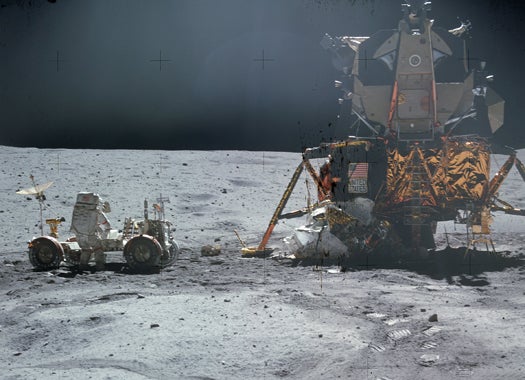
Because we don't spend a large chunk of time up there, we haven't done too much research on the long-term health effects of living on the moon. But a paper titled "Toxicity of Lunar Dust," covering several aspects of the effects of moon dust on the human body, offers some insight: the moon is basically trying to kill you.
Not actively, of course, but there are a lot of reasons to avoid the stuff (and no, a spacesuit isn't going to save you). The big problem is inhalation; even with a suit, dust can end up back in suit-free living spaces. Then the dust can travel inside travelers' lungs, causing inflammation and possibly, asbestos-style, even increasing the risk of developing cancer. The particles might be able to travel through the lungs more easily in the lower gravity environment, and exposure to UV and proton radiation could make the dust even more toxic.
But not to worry, there are still other ways it could hurt you. Without eroding the same way as soil on Earth, the rocky residue can be sharp, even occasionally coated in a glassy shell, causing skin irritation if you touch it. That's especially bad news for your eyes.
Researchers add a caveat for all this: it's only an approximation based on simulated dust particles, as they don't have samples that have been reliably kept in a lunar environment. But just in case, if you make a visit any time soon, exercise caution.
Five amazing, clean technologies that will set us free, in this month's energy-focused issue. Also: how to build a better bomb detector, the robotic toys that are raising your children, a human catapult, the world's smallest arcade, and much more.


Online Content Director: Suzanne LaBarre | Email
Senior Editor: Paul Adams | Email
Associate Editor: Dan Nosowitz | Email
Assistant Editor: Colin Lecher | Email
Assistant Editor: Rose Pastore | Email
Contributing Writers:
Rebecca Boyle | Email
Kelsey D. Atherton | Email
Francie Diep | Email
Shaunacy Ferro | Email
Lunar dust was a nuisance on the Apollo missions, not be overlooked in future habitat design, but it is quite a solvable matter. There have been designs for an airflow-based cleaning system which would be used when returning through airlocks. Many types of terrestrial dust are also unhealthy to breathe in much quantity, especially dust in some mining and factory environments. When outside, an airtight spacesuit is like wearing a full-body gas mask plus NPC suit as a side effect of its very nature, and dust is relatively nothing compared to nerve gas. Mainly, you want entrances designed so you don't do the equivalent of constantly tracking in too much mud (rather dry dust) inside without cleaning it up.
The fundamental showstopper so far is not having step #1 of a space age completed yet: to get beyond rockets costing on the order of thousand times basic propellant costs (with propellant mostly liquid oxygen costing cents per kilogram but thrown-away expendable hardware costing hundreds to thousands of dollars per kilogram). The problem is amortizing multi-billion dollar programs over launch goals of a handful of tons, with millions of dollars a ton cost impractical for most potential applications.
Ironically, the 30 MJ per kg kinetic energy requirement of 8 km/s LEO orbital velocity ("halfway to anywhere in the solar system" in delta v terms, to borrow a phrase from Heinlein), before inefficiencies, is not that much different than a transoceanic airline flight's energy usage (where, for perspective, jet fuel gives around 130 MJ/gallon in a more terrestrial application not counting ambient oxygen mass). However, rockets carry their own oxidizer, burn propellant in minutes instead of hours in a flashier high power-to-mass-ratio manner, have more inefficiencies, and, most of all, so far lack rapid-turnaround reusability like airline aircraft. If such as a 747 was expended on a single flight without reuse or was technically reusable but had a particular design of thousands of ceramic heat shield tiles taking months between flights to refurbish (Space Shuttle analogy), airline travel would be expensive too.
Beyond the Moon itself, for spaceflight in general, health issues from lack of 1g gravity are an artifact of having launch cost around the equivalent of a payload's mass in gold, making extra mass for rotational artificial gravity structures temporarily seem impractical. Likewise, radiation shielding is solvable if not under the same mass constraints, especially via electromagnetic shield options. Working towards an industrial-scale lunar base would be desirable because then ambient material can be used instead of launching all supplies from Earth, which would best synergize with reducing launch costs.
Fortunately, there are alternatives for orders of magnitude improvement in launch costs (although requiring briefly some extra upfront capital investment), several actually but a particularly good one being en.wikipedia.org/wiki/StarTram
With that, the astronomical resources of space could be utilized, from how a lunar mass driver can launch cumulatively a few hundred times its own mass in lunar material each decade, to nickel-iron asteroids almost like giant chunks of stainless steel (not rusted, not oxidized like natural iron became on Earth) to cubic kilometers worth of oil shale in comets ( http://en.wikipedia.org/wiki/Oil_shale#Appendix:_extraterrestrial_oil_shale ), and much else. Most is more valuable and more practical to use in space than trying to return to Earth, with the exception of gold and other platinum-group metals (which, aside from traces we find in the crust, mostly sunk into Earth's core in terrestrial history but are abundant in some asteroids). Yet such would be excellent for space colonies.
If nothing like the Startram is funded, the best hope is for suborbital tourism startups to potentially approach airline-like reusability and economics over time, especially under economy of number, not because suborbital flights are much of orbital velocity in themselves but because very similar technology from rocket engines to launch operations could lead to rapid-turnaround orbital launch vehicles later.
cave johnson proved this first...
to mars or bust!
well guess our lungs will make great surfaces for portals then....
i like the way you think HClark, i just wish we could get a viable fusion reactor going, it would take out the large scale dependence on fossil fuels
This NEWS FLASH is odd. The hazards of space dust were thought about prior to going to the moon and in reality scientifically studied upon the return of the moon. Um, how long have we been to the moon and back now; quite a while now.
But if the topic came up to go make visit to the moon recently, I suppose this would be a topic of conversation now.
Like all obsticals in life, this is just goal to over come. I sure hope we settle on the moon, asteroids, other planets and space!
Dare I say it, lol. Here is an article speaking of the evils of all the extreme fine microscopic dust and none of in on the lunar lander! Now how did that happen, hmmm?!!!
ROFL
Ok, before you beat me up as if I just said we did not land on the moon, I did not say that.
I am asking though, please give a logical scientific reasonable explanation, to why there is no dust on the lander.
Thank you. ;)
I just wanted to say that I enjoyed HClark's post far more than the article. Thanks for sharing :)
@Igot1forya Agreed... POPSCI should put HClark on their payroll.
*
@D13 Why a moon base? It's simple. Unless we start learning to live other places (other than earth), we will become extinct. The moon is our closest and most accessible celestial neighbor. If mankind can take root there, we can go out further into the cosmos with confidence. Baby steps.
Thinking of colonizing the moon or mars is stupid. It is not feasible for long term survival. Maybe for limited research or to extract resources...but a permanent settlement. NOPE. The human body has evolved to survive in earth's gravity, anything less or more is uncivilized. Unless we learn how to travel at the speed of light and then can find a planet about the size of earth, its a pipe dream. The answer is quite simple.
Build large scale space stations that rotate and can simulate earth's gravity. This is much much more feesible.
http://settlement.arc.nasa.gov/Contest/
@Robot "I am asking though, please give a logical scientific reasonable explanation, to why there is no dust on the lander."
Technically, the onus is on you to explain why you expect dust should be there. However I will assume that this expectation comes from observing dust in Earth's atmosphere.
http://www.youtube.com/watch?v=aUQEGVkdex0
Dust behaves very differently in our atmosphere than it does in the vacuum of space. There is no wind to carry it. Dust will not curl into big thick clouds like it does here on the Earth's surface. Rocket exhaust also behaves differently in the atmosphere vs space. It doesn't just move down, it moves outward as it rapidly expands into the vacuum.
Also, the engine is turned off while the landing pads are still 3 feet off the surface. Any dust knocked loose by rocket exhaust would travel away from the lander below the landing pads.
So how could dust come to settle on lander when the only force being acted upon it is pushing down and away?
More related info:
http://www.clavius.org/techcrater.html
democedes,
Also why did the lander engine, with its large nozzel below the lander to control a powerful thrust NOT dig a hole in the ever so soft lunar dust?
The lander foot pads were deside simuliar to camel feet for a soft supportive landing on dust. Looking at this picture, it appears the lander landed on concret and the landing feet are sitting in the center of the rounded pads. Why this is so odd for that tiny tiny soft lunar dust to be so incrediablily hard.
Goofy me, its as if the lander was gently lowered via a crane down onto a hard concrete pad... I guess my eyes are playing tricks on me.... hmm..
ALH,
I like you thinking and comments.
@Robot
This is straight from the Wikipedia entry for Regolith:
"During the early phases of the Apollo Moon landing program, Thomas Gold of Cornell University and part of President's Science Advisory Committee raised a concern that the thick dust layer at the top of the regolith would not support the weight of the lunar module and that the module might sink beneath the surface. However, Joseph Veverka (also of Cornell) pointed out that Gold had miscalculated the depth of the overlying dust,[10] which was only a couple of centimeters thick. Indeed, the regolith was found to be quite firm by the robotic Surveyor spacecraft that preceded Apollo, and during the Apollo landings the astronauts often found it necessary to use a hammer to drive a core sampling tool into it."
You really need to challenge your assumptions.
I ask questions, hence making challenges. Thank you for replying and informing others too. Your answer to my question is a likely possible answer.
Are all likely possible answers to questions, the finally result to the truth or do we on occasionly find another answer and the previous answer wrong?
Thanks slushitee3092, Igot1forya, and democedes ;-)
Eventually O'Neill style space habitats in high earth orbit may be likely, where light-speed lag is moderate, aiding electronic telepresence, not to replace human astronauts but to assist them in early construction (a.k.a. more advanced versions of robonaut.jsc.nasa.gov ). As implied at http://en.wikipedia.org/wiki/Coilgun#Potential_uses and http://settlement.arc.nasa.gov/75SummerStudy/Design.html , the Moon, though, can help for resources, even also close enough to Earth for some telepresence support albeit with more lightspeed lag than earth orbit. One method would be to progress from a lunar base to also bringing in volatiles from icy NEOs. As discussed at http://neofuel.com/index_neofuel.html by Dr. Zuppero, in microgravity, "ice ships," "water balloon spaceships," can transport orders of magnitude more than their own mass in water (and hydrocarbons), a little like how a garbage bag can be filled with many times more than its own mass of water and would not rupture if not for gravitational loading. A stream of raw materials would go from mining outposts on the Moon and NEOs to high earth orbit, ranging from lunar aluminum ore to nitrogen from inactive comets. Some space habitats might not always stay in their original location, using low-thrust but high specific impulse thrusters to provide several km/s delta v over months, as such as the travel time to reach Martian orbit and explore beyond would be no problem for space habitats with rotational artificial gravity in some sections and radiation shielding.
As for why to expand into space, there are direct motivations, like platinum-group metals and an infrastructure allowing everything from telecom satellites to space telescopes to be constructed vastly larger and more capable than before. Even before competitiveness with the regular terrestrial power grid, solar power satellites able to deliver power anywhere on the planet would have applications including compared to how U.S. military bases in remote areas currently pay a huge amount for imported fuel. Many people would pay to experience space tourism at least once in their lifetimes. Similar to the Generation 1 and Gen 1.5 versions of http://en.wikipedia.org/wiki/StarTram with no levitated tube and far less length would be easier to start with than the Generation 2 version. However, for the example of Gen 2 later, as little as $13000 per person to orbit and a launch capability of 4 million people per decade per facility is estimated as discussed in that article, potentially an eventual outgrowth of a space tourism market with roots back to the early endeavors with reusable suborbital rockets now.
But beyond all of those direct motivations, there is the big picture. Like our ancestors back to lesser life forms, starting with when single-celled organisms spread across the oceans, the nature of humankind is to try to voyage out; being locked in place is unhealthy. In terms of geological time, if an imaginary alien observer were to observe this solar system and beyond over the eons, if all goes well, they would see a relative explosion of life outwards from Earth, from humans and our descendants expanding into space, bringing along life from housecats to trees, some original forms and some genetically engineered for partially terraformed environments. It took vast eons for our distant biological ancestors to go from aquatic life to expanding onto land as well, but the next step from terrestrial land to outer space is going to be far faster if we get started.
The next major asteroid impact or supervolcano may perhaps be far away (or not as such could be anytime), let alone when the sun would ordinarily end life on Earth one to two billion years from now (not a red giant yet then but no longer providing habitable conditions). However, without getting more off-topic, without getting into what is unrealistic versus related to actual threats of fictional example dystopias (Twelve Monkeys, Terminator, Idiocracy, 1984, etc.), there are potential negative futures as well as positive ones for society and government which could occur vastly sooner. The only really known window of opportunity is the relatively known future of now and the near-term. If there is not enough space advancement by our generation, there is no true guarantee a society which would not do so now would turn into something doing so much later. A civilization without a frontier, without enough of a positive vision of the future, in practice tends to turn inwards more into negativeness, like contrasting attitudes during the 1950s (even in the archived issues of this magazine) to now (with some exceptions like transhumanists). Dr. Zubrin is right there. Fortunately, companies like Virgin Galactic may well turn out to be heroes for the future of mankind and life itself, operating on relatively shoestring budgets (not 0.01% of world GDP nor remotely as much as spent on cosmetics or conventional art) but potentially paying off astronomically.
Right now, in a way, we are like our distant ancestors living in such as a few caves and contemplating going beyond; fortunately they did, and thus all the richness of civilization came into being, down to the number of computer games we can produce at once now. That is the nature of advancement. Our stone age ancestors often lived in caves for shelter. Then we learned to build artificial caves (buildings). Once we were dependent on foraging for occasional edible plant food and meat. Then we learned farming and ranching. Once we were dependent on pre-existing freshwater. Then we learned how to desalinate seawater, and recently the cost of desalination has dropped to a level affordable for any industrialized country if needed. Now we are dependent on pre-existing living environments. We won't always be if we keep advancing.
There is orders of magnitude more than enough material even in this star system alone to make thousands of times Earth's land area in artificial worlds, in space habitats, obviously not overnight but with room for more work to be done and potential for growth for up to eons upon eons to come. (Any civilization eventually reaching the corresponding power handling capabilities and all else, approaching type 2 on the Kardashev scale, would also find the Oort cloud and interstellar flight far more in reach than we do). The economics of making space habitats may superficially seem implausible, but vapor deposition of metal possible in the vacuum can allow vast voluminous structures to be made with a relatively small number of personnel, alien to terrestrial experience. Once a starting industrial base with some thousands of personnel is obtained, one NASA estimate is:
"If automation permits a moderate increase of productivity to a value of 100 t/person-year, which is twice the value now appropriate for processing and heavy industries on Earth, the large Bernal sphere could be built for an investment of 50,000 man-years of labor. That is equivalent to the statement that 12 percent of the maximum population of one such sphere, working for 3 yr could duplicate the habitat. Automation is much better suited to the large scale, repetitious production operations needed for the habitat shell than to the details of interior architecture and landscape design. It seems quite likely, therefore, that the construction of new habitats will become an activity for specialists who supply closed shells, ready for interior finishing, to groups of prospective colonists."
http://settlement.arc.nasa.gov/75SummerStudy/Chapt7.html
Besides, done right, it would be fun, for those taking part and for their future descendants. (A mountaineer's famous answer as to why he climbed Mt. Everest: "Because it is there"). What we spend most of our work and time on even now terrestrially has little to do with just our most basic "needs" like enough rice to nominally survive. As a thought experiment, pretend one could fly. I don't mean fly as in own a private airplane, file a flight plan, run through a half hour of preflight checks and preparation, go up in a glass cockpit to thousands of feet of altitude, circle around the terrain around the airport for a hour, and then land, to maybe repeat once or twice a week if an avid pilot. I have nothing against such recreation. But that is not remotely the same as if someone could fly like this, indoors, anytime, at a moment's whim, to the ceiling, to a treetop, almost anywhere, in fact relatively starting to live in 3D instead of 2D:
http://images3.wikia.nocookie.net/__cb20070426002835/tmp2/images/8/88/Plate10.jpg
http://www.davidszondy.com/future/Living/leisure.jpg
http://listverse.files.wordpress.com/2007/10/60256-1152359707-large.jpg
http://www.hobbyspace.com/AAdmin/Images/Art/Hardy/lowgswm2.jpg
Not all of those images were of such flight alone, and one was of an exotic swimming pool in low/zero gravity. Yet they give the idea.
Bone loss in astronauts experiencing continuous weightlessness for months occurs from not enough periodic stress, as also seen with people who have months straight of hospital bedrest without being able to get up and walk periodically. However, in both cases, part-time exposure to walking around in 1g gravity eliminates the problem without having to be done 100% of the time. Future space habitats will have some sections with 1g rotational pseudogravity, but the rest may be a mix of lesser gravity and 0g (aside from perhaps some exercise areas well beyond 1g for those into hardcore bodybuilding). Such as a tenth of a g could make human flight easy and let workers be borderline superhuman (i.e. lifting 500 kg with one hand), while being still enough for plants, more convenient eating, etc.
Democedes, and someday fish will walk on land. Baby steps. Yes, with baby steps, even the most bizarre fantasies are inevitable.
HClark (and a few others), you're a science fiction/bizarre fantasy writer and don't know it!
Actually those comparisons aren't entirely bad: Like mudfish today (also apparently catfish sometimes if youtube videos are accurate), fish did change to walk on land, leading to amphibians, reptiles, mammals, and us. Fortunately advancement directed by intelligence operates on far faster timescales than evolution. Science fiction written in 1865 ("From Earth to the Moon" by H.G. Wells) had a 3-man capsule launched from Florida travel to the Moon and back with an ocean splashdown at the end. A century later, Apollo had a 3-man capsule launched from Florida travel to the Moon and back with an ocean splashdown at the end. Of course there were other differences.
I mean Jules Verne, not H.G. Wells.
Has anyone seen what a grass blower does, when pointed at a bunch of sand on the ground?
If you ever seen NASA cartoon scientific depictions of a lander, a lot of dust, sand and debry is blow about in the simulated landing.
I seriously expect to see under the lander picture above, a rounded blown our circler hole and circlur blown debry around the lander. I just do not see it. It so bizzar not to see this.
Consider the power it takes to gently land this vehicle to the lunar surface in a controlled decent. That is a lot of power and thrust, being blown to the surface and in the above picture, I see no actual effect. Yes the gravity is about 1/5 of Eaths, but hey, the lunar dust has no weight really and should of been blown about by the thrust of that rocket engine.
The above picture defies common sense of what a grass blower or the thrust of a powerful rocket engine would do. It is just so odd to see this picture.
Sounds like Arthur C. Clarke was prescient in "A Fall of Moondust."
Dust will always be a problem for space travel, no matter if it's on the moon, mars, even going in between planets. For the moon dust asbestos, just have a decontamination chamber outside the airlock. For the suits, layer them with a light layering of Kevlar for the diamond sharp pieces, and keep the packs a little more airtight. For mars dust, same deal, but just a lot more powerful.
what's to stop us(besides weight, funds) from building a giant 'balloon', vaccuum forming it around the entire lunar surface(whatever color you want, how about 'glow in the dark'?) then, inflating a transparent, larger diameter balloon around the moon (with oxygen content), filling craters with water(because theyre lined with that vaccuum formed moon cover), lunar farming, etc? then the dust would be contained, and mining operations could be shielded from the artificial atmosphere using a room that recirculates water from a,'moat', spraying water up like a bubble-skin(but thicker) while simultaneously misting to knock any stray dust down into the 'moat' around the entrance to the excavation tunnel system. terraform the moon!
POP! Goes the lunny or lunar that is!
Sorry, I could just not help myself... lol, snort..
Base only on the picture and the landing rocket of the lander, this vehicle never landed anywhere by its own power on soft dusty soil, least on the moon.
D13, finally someone who remembers that! I have always been a huge proponent of asteroid mining, even came up with a system that could make it easier to mine M-types. In conjunction with the accepted capture systems, of course
And robot, I'll keep it civil, and wont beat you up, but is it possible that indeed, the dust blew away, and then managed to settle quickly due to the lack of wind or other factors that would keep it from settling quickly, and that the picture was taken AFTER, forgive me, the smoke had cleared?
Like I said, I kept it civil, right?
And D13, I also like your point about HE3, not really cost efficient, when cheap nuclear is available, the only problem with the home town nukes is the proverbial adders nest of red tape.
@AldronsLastHope, for once we agree, on the moon, but not mars. I am biased towards mars colonization, I always want to head to the war planet. And, if I can have my M-type dissector built, mars colonization might be useful as a launching point for the asteroid collection, and as a long distance refueling station and long distance space craft manufacturing center. So mars colonization is cost efficient, and useful, but remember my bias in that statement.
I agree with the moon colony, worthless, less than effective, and would, if built, be better for a history museum. I have designed a space station that uses the moon as an anchor, but the moon itself would be used little. Maybe for fuel to power the station itself, but used little in the long run.
And @Aldron, thank you very much, your link could be very useful for some of my creations, so for once we are not at odds.
TeslasDisciple,
You explanation is that all the dust went directly up and exactly neatly settle straight back down and filled the hole that was dug out by the rocket blast of the lander, ever so perfectly.
If you can put this idea in a movie and show at the theators, then I can push the "I believe button" and suspend my common sense and go along with you. I do appreciate you being civil.
To be fair to you, as I look at those giant airplanes and or giant ships in the water, I have a hard time believing it should fly or should float. They are all just so freaking BIG!
It is hard to wrap ones common sense and imaginagation around being in a vacum and gravity being 1/6 earths. We humans see a photo and fall natural to thinking in human terms and have to remind ourselves of the 'other' influences going on, which are not so obvious. Take care. ;)
@TeslasDisciple I’m also a tesla disciple and as such I must think outside the box as you should. You’re welcome for the links they are all very interesting designs. It would be interesting to see how humans react to mars colonization, because in theory it has 1/3 gravity of earth but the way the rover behaves it looks like its in earth gravity. Maybe we will have super powers on Mars like John Carter.
@Robot, yeah I don’t think we went to the moon, the moon dust thing is small potatoes compared to all the doctored pictures. The fact that humans cannot survive outside of the van allen belts etc. And most important, its been almost 50 years and no one is even ATTEMPTING to go to the moon. LOL We never went we were duped. No human has ever traveled outside of LEO….I think we will get there one day, maybe soon (30 years) with all of the technology being developed. But no we never went. So many inconsistencies and coincidences prove this. But American pride will never admit or face up to this. Just like the Magic bullet that killed Kennedy (and it’s a big joke casue there is a food processor called “magic bullet”), or 9/11 being an inside job, or no weapons of mass destruction in Iraq..
If you want real news, and want to hear the truth go to inwars.com or at least the drudge report.
@robot, I was just expressing a possible theory. No atmosphere would mean that it would settle faster, but I was just being theoretic. And huge ships and planes all work on the same science as small ones, just on a grander scale. They are awe inspiring though...
@ALH, I doubt we will have super powers or anything like that, leave that to comic book writers.I think there will be adaptation, but not to that grand a scale. Probably just less intensive bones and faster reflexes.
As to both of you and the moon landings, I will admit to being American, so call down bias all you want, but I think we went. Some of the thoughts against have been dis-proven (i.e. the flag was still waving BECAUSE there was no air to slow it down, not because of a draft), and if you want, research where the Apollo missions left the reflector, and bounce a laser off of it. If you have the time, patience, and money that is.
And I do not believe the magic bullet, but I do believe the "grassy knoll" conspiracy, a bullet does not swing around to hit a man twice (Zimmerman tapes), and this may be bias, but I think 9/11 was all Al Qaeda. And my father was in Iraq (1st Cav, baby!), and I believe that the WMD's were hidden, destroyed, or could be waiting to strike. The war hit so fast, I bet that the war council did not have a real plan. I remember a tale when a whole regiment surrendered to a squad of Marines. Maybe the same happened, and the administration did not wan to incite a panic.
On the subject of cheap access to space: why not use a space elevator?
Eventually someone will mine the moon, curiosity, and greed are strong driving forces. I think a habitat suit while exposed to the little rock will do, air dusting and a quick rinse will keep the poor little earthlings safe enough.
There is no rewards without risk.