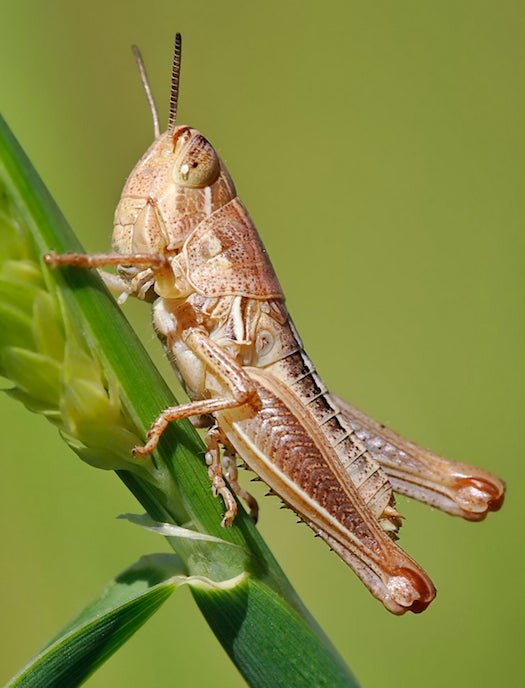
Soothe a grasshopper, save the planet

Grasshopper Wikimedia Commons

In the same way humans might be tempted to binge on some junk food when they're under stress, grasshoppers head for the carbohydrate-rich foods when they get scared. The difference is the grasshoppers can leave behind some big-scale problems for the environment.

A stressed grasshopper's body has less nitrogen because of the change in its diet, and microbes in the soil rely on that nitrogen to break down other material. Without the nitrogen from the grasshopper, plant parts will be broken down by microbes more slowly than usual, and without that help from the microbes, new plants will struggle to grow too.

So what freaks out grasshoppers? Well, getting eaten is pretty high on the list, and that's what researchers at the Hebrew University of Jerusalem and Yale used to test this idea. They split up two groups of grasshoppers; the unlucky group was exposed to spiders, and the other acted as the control. Understandably, the spider-exposed bugs went for the carbs. When they measured the rate of plant-decomposition in both areas, plants in the stress-free portion decomposed between 62 and 200 percent faster than their counterparts.

Researchers went one step further in the experiment, substituting fake "grasshoppers" in the soil with a mix of sugar, protein, and the organic compound found in grasshoppers' external skeletons. Even the small amount of nitrogen microbes took from the protein was enough to help out in decomposition.

If it sounds like an exterminating-bees-would-destroy-the-food-chain scenario, that's because it sort of is, researchers say. If humans, directly or indirectly, cut too many species in the area, it could mess with the balance of spiders, potentially causing problems from decreased crop production to more CO2 in the atmosphere.

[Science Daily]

4 Comments

I read this article a few times and it confused me at the end, when they introduce one sentence, "exterminating-bees-would-destroy-the-food-chain, to quickly conclude to some point.

I thought the object and the point of this article were stressed out grasshoppers?!

'If it sounds like an.. scenario' is inferring a example since it is common knowledge (?) that bee's are struggling to survive due to disease and they also play a critical role in the well-being of plant life (pollination etc). Similarly if we loose grasshoppers we loose greater quantities of Nitrogen in the soils that planets rely on.

I wonder if spiders will revert to eating carbohydrate based planets or plants in general if their food source is cut? Probably just eat each other till the last one eats its own-self in desperation of survival :)

planets = plants. Damn the lack of edit button.

"...If humans, directly or indirectly, cut too many species in the area, it could mess with the balance of spiders, potentially causing problems from decreased crop production to more CO2 in the atmosphere..."

Sorry, the above statement is just a speculative exaggerated opinion. The below comment is much more plausible and reasonable explanation of the reduction of spider populations and increased CO2 in the atmosphere!

If a ant is walking through the woods and trips over a branch, causing a echo to resonate off a mountain and be amplified, to be interpreted by the local nuclear defense department by the USA nuclear watch command, and said interpretation inspired a nuclear missile counter attack towards the ant that tripped over the branch, this could devastate the spider population in that area, killing the local crops and causing CO2 to increase.


June 2013: American Energy Independence

Five amazing, clean technologies that will set us free, in this month's energy-focused issue. Also: how to build a better bomb detector, the robotic toys that are raising your children, a human catapult, the world's smallest arcade, and much more.


Online Content Director: Suzanne LaBarre | Email
Senior Editor: Paul Adams | Email
Associate Editor: Dan Nosowitz | Email
Assistant Editor: Colin Lecher | Email
Assistant Editor: Rose Pastore | Email

Contributing Writers:
Rebecca Boyle | Email
Kelsey D. Atherton | Email
Francie Diep | Email
Shaunacy Ferro | Email

circ-top-header.gif
circ-cover.gif