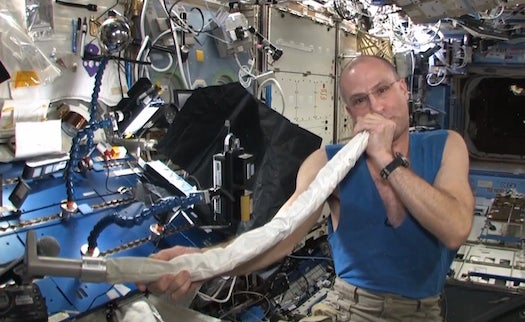
Don Pettit Astronaut/didgeridooist. Don Pettit

When he's not busy with his full-time gig, NASA Astronaut Don Pettit takes the time to run some of his own personal science experiments. His latest? A zero-gravity didgeridoo performance — for science.

Actually, it's not really a didgeridoo: Pettit takes a space station vacuum cleaner and cleaves off half of it, attaching two different end pieces and measuring their resonance against a couple drops of water, which throb excitingly and shed mini-droplets. Even if you're not interested in tribal music or liquid surface tension in space, the video is worth watching if only for the wacky costume change.

8 Comments

Ok, all who are about to comment, I dare you not to make jokes!;)

..........................................
See life in all its beautiful colors, and
from different perspectives too!

"Why does the amount of water on the speakers affect how often droplets are ejected?"

Well it takes more energy to break the surface tension because there's more water to absorb the energy. If you increase the energy(frequency), it should act the same as before. I'm no scientist but that's what I'm guessing.

Wow....It must be really lonely in space to drive people to rip off their sleeves and suck face with a vacuum cleaner

Dit ditt ditt dit... new flash, this just in.
Apparently as Don Pettit made his musical triumphed, 1000s of African Elephants were recorded looking to the sky!

His sleeves magically reappear!

@ Antaro

This may be more than you were looking for... but you had a great comment I wanted to speak more on because I think you are mostly correct. In reality there are likely multiple things going on, but you're pretty close.

This is really a classic example of resonance at natural frequencies, and the affects of mass and stiffness on those resonant frequencies. They've just gone about showing it in an unconventional manner (and didnt fully explain it).

You briefly hear the second astronaut discuss near the end of the video the various frequencies produced by the hoses, and the water spheres themselves:

" the spheres are tuned, and you can excite a mode in those..."

As you watch the video, you'll notice the didgeridoo fluctuates in pitch (frequency), and the spheres will suddenly burst with droplets at a particular pitch. The frequency of that tone has essentially matched closely with the natural frequency of the sphere of water and excited a primary mode of vibration which causes the surface of the water to experience nearly uninhibited vibrations.

(as an aside, the amplitude of forced vibration of any structure at its natural frequency is limited only by the systems damping, of which there is little to none in the water spheres... so the surface simply vibrates apart, if you will)

The natural frequency of any system is generally related by sqrt(k/m). As you increase the stiffness of a system, you shift the natural frequency higher. As you increase mass, you shift the natural frequency lower.

Going back to your comment on surface tension, you are half right, but specifically the force at work is the electrostatic attraction of the water molecules (sometimes called van der waal forces, this is the force causing surface tension as well). Think of these forces as little springs between each molecule and all the other molecules near it. The more molecules you have, the more 'springs' you have, increasing the effective total stiffness of the sphere.

This shifts the natural frequency up in frequency mostly out of the range of the didgeridoo, and thus no longer causing the sphere to resonate. Though they dont show it, I suspect that if you zoomed in on the water when they lowered the pitch of the didgeridoo later in the video you would see little to no excitation of the sphere, as the natural frequency would be well outside the range of tones the didgeridoo was producing.

A little bit of a long answer, but hopefully educational :)

Recently a drug \ urinalysis was done on Don P. He was quoted to respond to NASA, claiming rather loudly, “Look man! I never inhaled. I only blew!".

He later said, he is going to fight this claim in court and his supporting lawyer will be former, President Clinton.

Mr. President Clintion was quoted in the past at saying: "...As a Rhodes Scholar at Oxford University in the late 1960s, tried marijuana. “I’ve never broken a state law,” he said. “But when I was in England I experimented with marijuana a time or two, and I didn’t like it. I didn’t inhale it, and never tried it again...”


June 2013: American Energy Independence

Five amazing, clean technologies that will set us free, in this month's energy-focused issue. Also: how to build a better bomb detector, the robotic toys that are raising your children, a human catapult, the world's smallest arcade, and much more.


Online Content Director: Suzanne LaBarre | Email
Senior Editor: Paul Adams | Email
Associate Editor: Dan Nosowitz | Email
Assistant Editor: Colin Lecher | Email
Assistant Editor: Rose Pastore | Email

Contributing Writers:
Rebecca Boyle | Email
Kelsey D. Atherton | Email
Francie Diep | Email
Shaunacy Ferro | Email

circ-top-header.gif
circ-cover.gif