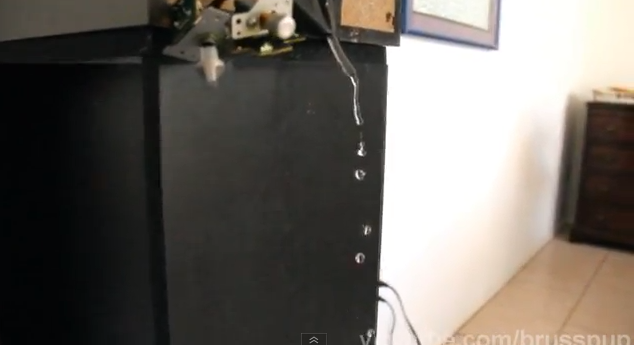
If you only watch one optical illusion today in which a stream of water appears to have droplets freeze in mid-air or inch their way backwards back into the tube from whence they came, make it this one.
The effect is caused by syncing up a camera with the vibrations of the water. The speaker behind the stream of water is generating a 24 hz sine wave, and the camera is filming at 24 fps, which causes the water to appear frozen. Or, you can adjust the hz rating of the wave and move the stream very slowly forwards (at 25 hz) or, much crazier for our purposes, very slowly backwards, at 23 hz. Check out the video:
[YouTube]
Five amazing, clean technologies that will set us free, in this month's energy-focused issue. Also: how to build a better bomb detector, the robotic toys that are raising your children, a human catapult, the world's smallest arcade, and much more.


Online Content Director: Suzanne LaBarre | Email
Senior Editor: Paul Adams | Email
Associate Editor: Dan Nosowitz | Email
Assistant Editor: Colin Lecher | Email
Assistant Editor: Rose Pastore | Email
Contributing Writers:
Rebecca Boyle | Email
Kelsey D. Atherton | Email
Francie Diep | Email
Shaunacy Ferro | Email
Well that is a cool little effect. I suppose the movie industry could make interesting use of it, having a water fall in the background suck water upstream and people infront are acting in normal motion. I am just guessing though. The video was fun to watch.
..........................................
See life in all its beautiful colors, and
from different perspectives too!
I did a similar experiment last weekend, with a frequency matching the frame rate of the camera, and a shutter speed of over 1/1000s see here: youtu.be/vt27eplJXI0
sle118 Do you think you could use this trick with shutter glasses and get some cool results without the camera?
All of this makes perfect sense except the apparent backward flow. The only way that could work, that I can think of, is if the droplets of water were forming in the exact same way each time. Then, if you’re seeing every 24th frame and you’re synched with a 23 fps video, you would see each droplet one frame earlier than you’d expect, and the water would “flow backwards.” But when the water is breaking into three droplets as seen in the video, it’s breaking into the same three sizes/shapes repeatedly? It must be, right? Because when you see the next frame, the droplets you saw are not moving backward, really. You’re seeing new droplets breaking up the same way, which have not fallen as far, yet, as the similar droplets you just saw in the previous frame, right?
I would not have expected that. I would have thought the collected water molecules would break up randomly as they fell.
The use of the speaker and taking advantage of a camera is new. But the effect has been done decades ago with strobes. Here is an example:
http://youtu.be/rvY7NGncCgU
All water flowing out of a small hose into a free-fall will separate into droplets (given the distance all free-falling water will separate into droplets). You can see the illusion with your "naked eye" if you use a strobe light and adjust the flashing frequency in a dark room. (any video camera will be able to capture the effect without frame rate adjustment because you are adjusting visual frame rate with the strobe)
You can set the strobe to flash fast enough that the light almost seems to be on all the time and the droplets 'hang in the air.' (add two hoses and watch the droplets collide in mid-air in slow motion.)
By adjusting the strobes Hz you can make the droplet (which are all similar in appearance) appear to move backwards. Which in fact are different droplets, just appearing during the flash a step behind the one you saw on the previous strobe flash.
This is similar to looking over at the car next to you and what looks like their cars rims rotating backwards as they accelerate from a stop. (instead of using a strobes frame rate you are using your eyes and brains processing frame rate)
(sorry for my loquacious response)
I don't understand how he's using the speaker. Weren't the droplets going to fall down anyway or is he stimulating them with the vibrations of the speaker?
Or is he just using the vibrations to break the water from falling like a straight line? So, he's using them to disturb the flow in a controlled way. Right?
@killerT Yes. If the shutter speed matches the sine wave frequence, it should work. If the "exposure" (or the time the shutter is opened) gets too long, however, droplets won't appear as "frozen in mid-air". A stroboscope could also be used to get the same result.