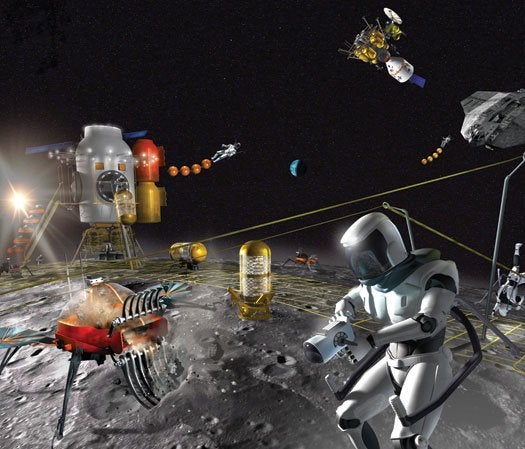
Planetary Resources, a mysterious organization whose investors include Google execs Larry Page and Eric Schmidt, Microsoft alum and astronaut Charles Simonyi, director James Cameron, "space visionary" Peter Diamandis, and Ross Perot, Jr., is planning to announce more details of the project this coming Tuesday. We'll be covering it, so we thought we'd give you a heads-up. It has something to do with space resources and exploration--its LinkedIn page says it "develops technologies and systems to enable low-cost commercial robotic exploration of the solar system," and cofounder Peter Diamandis has hinted at asteroid mining--but we don't know much more than that at the moment. Check in here on Tuesday (and, I mean, on Monday too, for other things) for the reveal.
The incredible innovations, like drone swarms and perpetual flight, bringing aviation into the world of tomorrow. Plus: today's greatest sci-fi writers predict the future, the science behind the summer's biggest blockbusters, a Doctor Who-themed DIY 'bot, the organs you can do without, and much more.


Online Content Director: Suzanne LaBarre | Email
Senior Editor: Paul Adams | Email
Associate Editor: Dan Nosowitz | Email
Assistant Editor: Colin Lecher | Email
Assistant Editor: Rose Pastore | Email
Contributing Writers:
Kelsey D. Atherton | Email
Francie Diep | Email
Shaunacy Ferro | Email
I dread the day, when I gaze up at the moon and no longer can see its texture and with a telescope see it craters. For all of humanity memories gazing up at the heavens, the moon, its shape and texture was always a constant.
No, I will see its dust being kicked up and land leveled, dug and plowed!...... Sigh... :(
They best are careful! Some of those moon rocks are actual moon creatures. Has anyone seen Apollo 18?!
.............................
Science sees no further than what it can sense, i.e. facts.
Religion sees beyond the senses, i.e. faith.
Open your mind and see!
I welcome the day, when I gaze up at the moon and no longer can see its texture and with a telescope see it craters. For then we will be proven that humanity has its future in the stars.
They're talking asteroids Robot, not defacing the moon. The JPL study on this involves a solar powered ion drive with an expandable capture container for asteroids up to a few tons. These would be used for both rare materials and, in the case of water ice small comet cores, rocket fuels for in-space use.
DocM
docmordrid,
It would take a lot more recourses to exploit the asteroids, than the moon. The moon at least has Helium 3. Oh yes the moon will be an exploited recourses and eventual ugly sight to see from earth, I dread. For humans in their want will never end.
.............................
Science sees no further than what it can sense, i.e. facts.
Religion sees beyond the senses, i.e. faith.
Open your mind and see!
@Robot
Mars or bust!
-Spouting a fountain of nonsense since 1995-
I can only imagine what's next....carving the moon with huge logos for advertising, to be seen from earth. The ultimate billboard.
in lak'ech
@Truedat
Someone asked Neil DeGrasse Tyson how much that would cost once...
-Spouting a fountain of nonsense since 1995-
I hope commercial exploration of our solar system is about to become reality.
In 2005 I gave a presentation at the Mars Society Conference in LA about how we could create a profited journey to Mars by mostly commercial partners including NASA, as a cost sharing partner. James Cameron was at the conference, I don't know if he was in the audience. One of the advantages would be "Adventure Rides And Theater Quality Video Made From Footage Of Mars By A Commercially Funded Robotic Expedition" including IMAX 3D.
See here for a pdf format from that presentation.
http://shineinnovations.com/media/Theater$20Quality$20Video$20From$20Mars.pdf
Ron Bennett
How do you spoil a surface that was created by basically throwing huge rocks at it for thousands of years?
Any change would be an improvement.
I bet instead of landing equipment on the asteroid their strategy will be to blow it up, if only in the mineral sweet spots, then collect the chunks that they want to keep.
I like to bring to attention the concept of 'Unique Manufacturing of Unique Products'. If we could establish ourselves in outer space in an 'artificial created develop environment that humans can live and work in outer space’. Some of the unique things we need are gravity and shielding from radiation, cold and the lack of atmosphere, among many other things. Plus this environment must be self sustaining and deal with human and manufacturing waste products.
On Earth in the last decade or so we have create great and wonderful things in manufacturing of unique products that can and are useful, but also can be harmful for our Earth and human environment in the manufacturing process. But now consider, if we had a remote place, with confidence we can manufacture products that would be impossible to contaminate Earth and human environment.
Outer space may not only be useful in the things we discover and find in mineral recourses, but also may be useful in Manufacturing of goods that can be useful for us on Earth, we no hazards of polluting our environment further. At the end of Manufacturing those goods, can be shipped back to Earth, leaving the toxins back on that outer space location. It might be economically feasible depending up the location, to send off towards the sun or to deep space those toxins too.
.............................
Science sees no further than what it can sense, i.e. facts.
Religion sees beyond the senses, i.e. faith.
Open your mind and see
The idea of asteroid prospecting has been around for a long time. I’m interested to see what this new group suggests but I would guess to make a profit on a trip they would need to be very selective on the asteroid they go after (mythical midas asteroid?) and there will be no humans going because the costs would be too high.
My initial thought is they may try to make some cash on a proof of concept test mission. If they sell off returned pieces (even if it’s not mineral rich rock or iron only) to the public and universities to study they could make some money to offset the research expenses. NASA will probably give them a research grant in exchange for the right to be able to make use of tools and technology they come up with and that would help defray some costs as well. Don't forget the marketing angle, perhaps people pay to put things on the ship to be left on the asteroid there and also set up a pay internet television feed camera as well. I can Imagine the huge techno hurdle though involved with the return a huge payload to earth (if only we had a space truck, oops retired, or even a space elevator) but that would be more of a future problem.
I think the moon will be safe for some time to come and public outcry would force industry to stay on the back side if they did go after isotopes for fusion power.