How Pigs on Antibiotics Are Making Superbugs Stronger
Meanwhile, genome detective work could uncover new weapons in the war on bugs
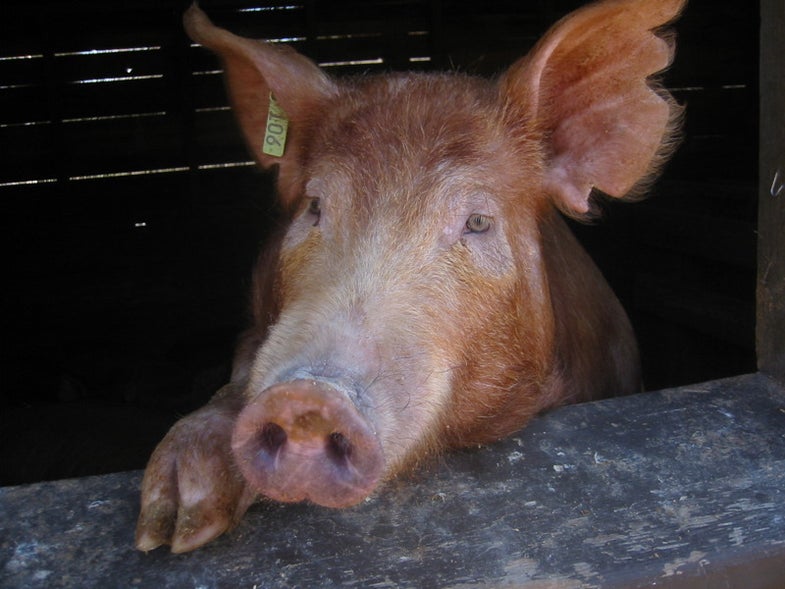
Methicillin-resistant Staphylococcus aureus, (MRSA) a nasty strain of bacteria that resists most antibiotics, probably developed its defenses while spending time down on the farm, a new study says. It has been thought that humans’ antibiotic abuse is the catalyst in superbug genesis, but this new research suggests it’s the animals, and the drugs we feed them, that we should worry about.
A new paper in the journal mBio, published by the American Society for Microbiology, describes how a human strain of MRSA started out as a drug-defeatable bug and then transferred into the pig population, where it developed resistance to two common forms of antibiotics. Then the newly potent antibiotic-resistant staph jumped back into humans. Researchers traced its evolutionary history by examining 89 genomes from humans, turkeys, chickens and pigs from 19 countries.
“[It’s] like watching the birth of a superbug,” Lance Price, director of the Center for Food Microbiology and Environmental Health at the Translational Genomics Research Institute (TGen) in Flagstaff, Ariz., said in a statement.
The CC398 strain of MRSA first appeared in 2003, and is found in pigs, cattle and poultry in the United States, researchers said. It’s in nearly half of all meat in the U.S. food supply, according to the American Society for Microbiology. Most of the time, you can kill it by cooking your food thoroughly. (At least one other staph strain previously jumped from humans into chickens, and humans can also pass it on to their pets.)
Livestock are commonly fed a cocktail of pro-growth hormones, antibiotics and other pharmaceuticals to help them grow faster and prevent infection in the crowded spaces where they spend their lives. Among several concerns, opponents of this practice say profligate antibiotic use can force microbes to mutate and become more dangerous. This is apparently what happened with CC398.
“The most powerful force in evolution is selection. And in this case, humans have supplied a strong force through the excessive use of antibiotic drugs in farm animal production,” said Paul Keim, a co-author on the study and director of Northern Arizona University’s Center for Microbial Genetics and Genomics. “It is that inappropriate use of antibiotics that is now coming back to haunt us.”
So what’s next? Developing new antibiotics that can fight harder or with different methods. A separate study in the Journal of the American Chemical Society discusses a new way to do this.
It’s difficult to test lots of hard-to-culture microbes harvested from soil in the hopes of finding new antibacterial agents to exploit. Instead, Sean Brady and colleagues removed DNA snippets from some soil bacteria that would not grow in lab cultures, and inserted it into bacteria that do grow in culture. The lab-friendly bacteria served as incubators for this foreign DNA, enabling Brady and colleagues to study various substances the bacteria made. This metagenomics method led to two new antibacterial compounds, called fasamycin A and fasamycin B. And guess what they killed: MRSA.
Their method could be a new way to find natural antibiotics that have not been accessible before, the researchers say. They could conceivably be used to fight new strains of MRSA, like CC398, and any other drug-resistant mutants that may jump from animals to humans. Until the microbes evolve to resist them, too.